SlamBall’s eight-team universe turns franchises into built-in rivalries
MOB, Ozone and six other franchises give SlamBall a clean rivalry map, where every 20-minute game is easy to read and hard to ignore.

MOB, Ozone, Wrath and Buzzsaw are not just team names. In SlamBall, they are the quickest way to understand the entire sport, because the league has built a compact eight-franchise world that makes every matchup feel immediate. When the league is this short, this physical and this theatrical, a fan does not need a spreadsheet to figure out who matters. The names do that work on their own.
A small league creates a fast emotional map
SlamBall’s official teams are Gryphons, MOB, Ozone, Rumble, Lava, Slashers, Wrath and Buzzsaw, and that tight list is the point. A smaller universe means the standings are easier to track, the rivalries are easier to remember and the identities of the clubs become part of the entertainment rather than background noise. In a sport built around quick possessions and highlight plays, there is no room for a crowded middle where teams disappear into the schedule.
That structure gives casual viewers something valuable: a side to pick almost instantly. MOB sounds aggressive, Wrath sounds combustible, Buzzsaw sounds like punishment, and those labels carry attitude before a ball ever bounces. Gryphons and Slashers push the same idea in a different direction, giving the league a fantasy-sports, video-game feel that fits the trampoline court and the high-speed presentation. The brand language is not decorative. It is the mechanism that turns a novelty sport into a league with recurring stakes.
The names work because the game is built for instant reads
SlamBall describes itself as a hybrid of basketball, football and hockey, and that mix explains why the team identities matter so much. The league says the sport is lightning fast, non-stop and suited to live broadcasts, highlights and social media, which means the product is designed for rapid consumption. If the action is coming at that pace, the franchises have to be legible at a glance. The eight-team structure does that in a way a larger league simply would not.
The scoring system reinforces the same idea. Dunks are worth three points, while layups and jump shots are worth two, so style and efficiency are already separated on the scoreboard. A team that lives at the rim can create bigger swings than a team that settles for ordinary finishes, and that makes identity matter in every possession. In SlamBall, the logo on the jersey is tied to a playing style, not just a city name or a corporate label.
The format turns every game into a short story
SlamBall’s games last 20 minutes, split into four five-minute quarters, so each contest moves like a sprint instead of a marathon. That compressed format makes every possession feel heavier and every run more meaningful. There is less time for a slow start to be forgiven, less time for a middling team to hide and less time for a viewer to drift away before the result becomes clear.
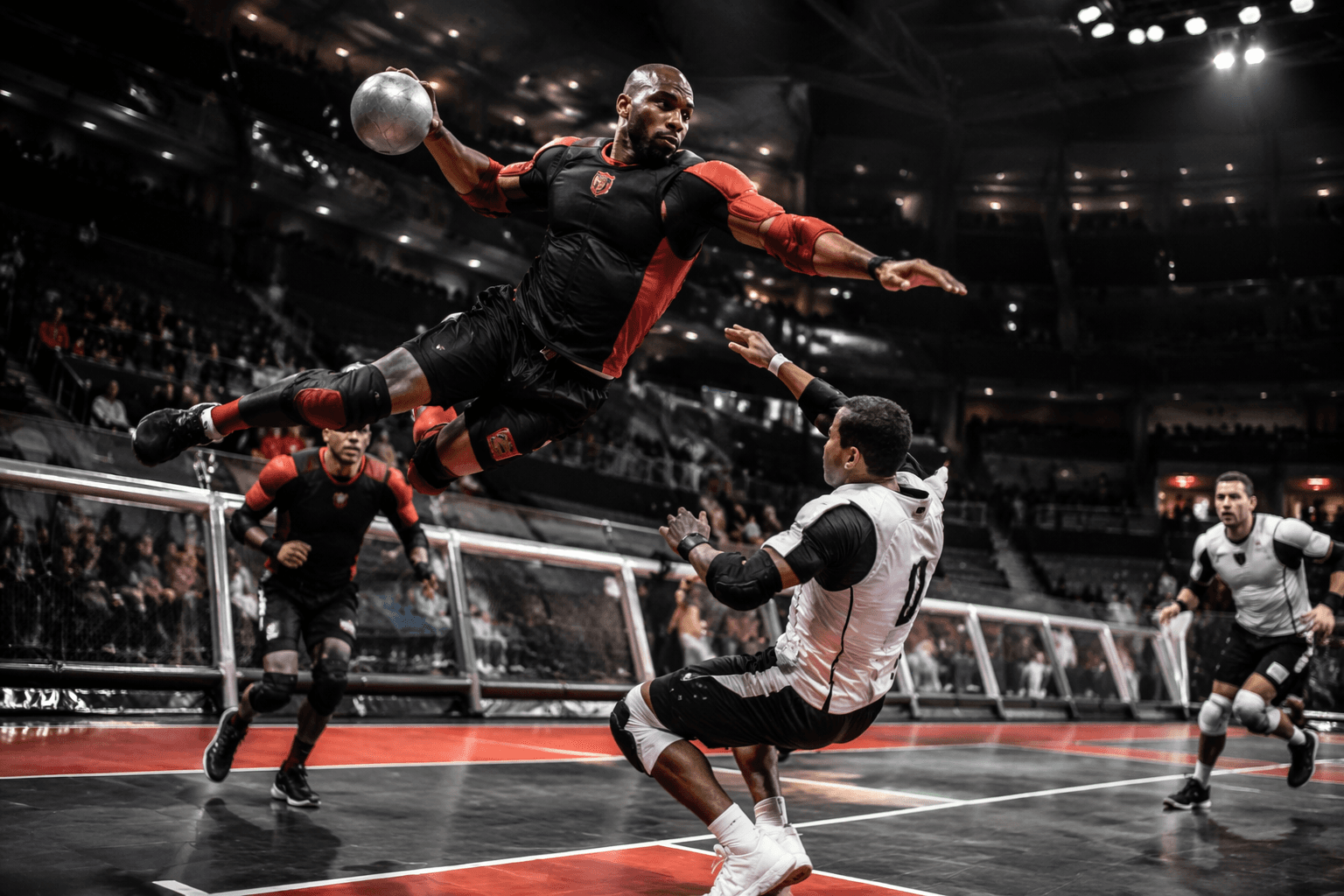
The court itself is part of why the league feels so distinct. SlamBall says the playing surface is 96 feet long and 64 feet wide, with three identical springbeds at each end and a fourth, larger scoring bed, all surrounded by an 8-foot plexiglass wall. That setup does more than create spectacle. It produces a setting where the game looks and feels unlike standard basketball, which strengthens the sense that each franchise lives inside its own exaggerated personality. The court and the team names work together, one making the action faster and the other making the cast easier to remember.
Why the league’s relaunch leaned into the team package
The 2023 relaunch showed how seriously SlamBall treats that structure. The league announced an exclusive two-year national broadcast partnership with ESPN for the 2023 and 2024 seasons, with the new run opening live from Las Vegas on July 21, 2023. Before that opening night, SlamBall said it revealed team names, logos, coaches and seven-man rosters for the revival, which made clear that the franchises were meant to function as a complete entertainment package, not a one-off spectacle.
That mattered because the comeback had to reintroduce the league as something repeatable. A season review later described 2023 as SlamBall’s sixth season, said training camp opened on June 5, 2023 with 24 players and noted that the season ended on August 17, 2023 with the undefeated Mob winning the Gordon/Tollin Trophy. Those details tell the same story from another angle: in a league this small, every team is a real character, every roster decision matters and one unbeaten run can define the year.
Why fans stick with it
SlamBall’s official messaging leans into “deep strategic levels,” but the bigger reason the format works is simpler than that. The league has only eight franchises, and each one is distinct enough to remember after a single game. That makes standings matter faster, rivalries form sooner and title pressure feel immediate.
The result is a sport where the cast is small enough to learn and vivid enough to care about. MOB, Ozone, Wrath and the rest are not filler around the action. They are the reason the action has shape at all.
This article was produced by Prism’s automated news system from verified source data, official records, and press releases, then run through automated quality and moderation checks before publishing. The system is built and supervised by the people who set the standards it runs under. Read our full AI policy.
Did this article answer your question?