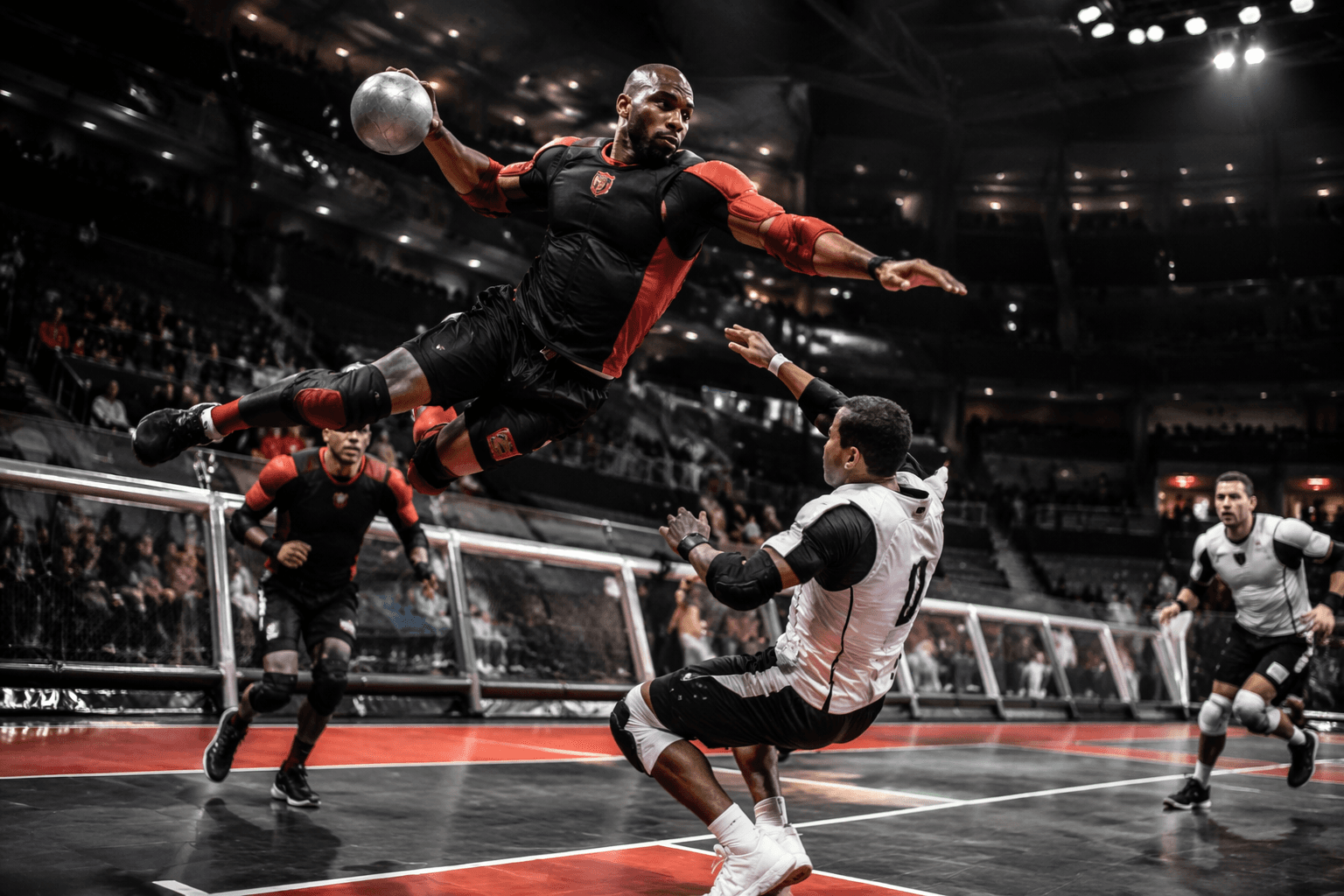
Slamball’s spring-loaded format turns basketball into chaotic spectacle
SlamBall still works because the chaos is real and the structure is too. Its 2023 comeback showed that spring-loaded collisions can draw viewers and still produce a true league.

SlamBall’s best trick is that it looks like mayhem but plays like a system. The dunks come harder, the contact lands louder and the momentum swings are so abrupt that basketball’s usual geometry barely survives the first possession. That is why the sport still matters: it is not just a novelty act, it is a repeatable competition built to turn every sequence into a collision between skill, speed and controlled violence.
Why the format still feels new
The court is the first clue. SlamBall is played on a 96-foot by 64-foot surface with springbeds built into each end, and games run in four five-minute quarters. Those dimensions shrink the margin for error and make every drive feel compressed, as if the floor itself is loading the next highlight.
The chaos is not random. The league uses hockey-style live substitutions, a throw down to start each half, strict timeout limits and mandatory protective gear that includes helmets and pads. Even the rulebook’s penalties, such as the island and face-off violations, exist to keep the violence from spilling outside the lines. The result is a sport that rewards aggression without letting it collapse into uncontrolled contact.
That balance is why SlamBall remains watchable years after people first dismissed it as a stunt. Basketball is still the base layer, but the league’s identity comes from what it adds on top: collisions at the rim, sudden turnovers, bodies flying off the trampoline surface and game states that can flip in a handful of possessions. In a league where a stretch of a few minutes can change everything, the entertainment is built into the structure.
From napkin sketch to broadcast property
SlamBall began in 1999, when Mason Gordon turned a napkin sketch into a real concept while working for Tollin/Robbins Productions. Gordon has described the sport as a hybrid of basketball, football, hockey and gymnastics, and that mix still defines its appeal today. It first took shape in Los Angeles, then reached national television on Spike TV in 2002 and 2003.

The league did not disappear quietly after that first run. It returned in 2008 on NBC Sports and CBS, and later pushed into China and other international markets. That history matters because it shows SlamBall has always been more than a one-off spectacle. Each return has tried to answer the same question: can a sport this strange become durable enough to survive once the novelty fades?
Gordon’s own view from ESPN’s 2011 coverage captured the challenge neatly. He said inventing a sport is difficult and depends on building something that lasts beyond novelty. That remains the central test for SlamBall. The spectacle gets attention, but the league has to prove it can keep producing competition, standings and stars.
The 2023 revival made the case
The 2023 return was the clearest sign yet that SlamBall could still command a crowd. ESPN said the season ran for five weekends at Cox Pavilion in Las Vegas and generated more than 30 hours of live programming across ESPN, ESPN2 and ESPN+. The revival also landed in a social-media environment that liked its weirdness: the league said #BringBackSlamBall produced more than 200 million views.
The field itself looked like a real league, not a one-night exhibition. Eight teams competed: Mob, Rumble, Slashers, Buzzsaw, Gryphons, Lava, Ozone and Wrath. ESPN reported that the player pool included 56 players from 23 states, with 26 Division I college basketball alumni among them. That mix mattered because it gave the action enough actual basketball talent to make the spectacle credible.
The standout competitive marker was MOB’s 16-0 regular season. That kind of run gave the revival a true storyline, the sort that turns a curiosity into a championship chase. It also gave viewers something beyond novelty to track: a dominant team, a perfect record and a season-long standard for everyone else to chase.
Why the broadcast mattered as much as the play
SlamBall’s comeback did not succeed on athleticism alone. It also worked because the broadcast understood what made it different. Marshawn Lynch served as a broadcaster during the 2023 ESPN telecasts, and his presence added the kind of personality that helped the league feel like an event rather than a relic. The commentary made the telecast part of the show, which fits a sport that lives as much in the clip economy as in the box score.
The league also leaned into the community side of its Las Vegas reset. It offered $15 general admission playoff tickets as a thank-you to the local community for supporting the return season. That pricing choice was practical, but it also fit the league’s larger message: SlamBall wanted its comeback to feel accessible, not rarefied.
By the time the season reached its final week at Cox Pavilion, the point was clear. SlamBall is still strongest when it presents itself as a real competition with a loud, physical visual identity. The highlight reel may open the door, but the structure keeps people in the building.
What keeps SlamBall relevant now
SlamBall endures because it has solved a problem most gimmick sports never do: it gives fans something they can recognize immediately while still making the game state unpredictable. The best possessions are violent finishes, abrupt momentum swings and defensive breakdowns that feel one step away from disaster. That is not just spectacle for spectacle’s sake; it is a competitive formula that can produce streaks, standings and pressure.
The sport’s persistence says something broader about modern entertainment, too. Fans still respond to novelty, but only when novelty is attached to a usable structure. SlamBall gives them both. It is spring-loaded enough to look unlike anything else on television, and disciplined enough to keep coming back as an actual league.
This article was produced by Prism’s automated news system from verified source data, official records, and press releases, then run through automated quality and moderation checks before publishing. The system is built and supervised by the people who set the standards it runs under. Read our full AI policy.
Did this article answer your question?