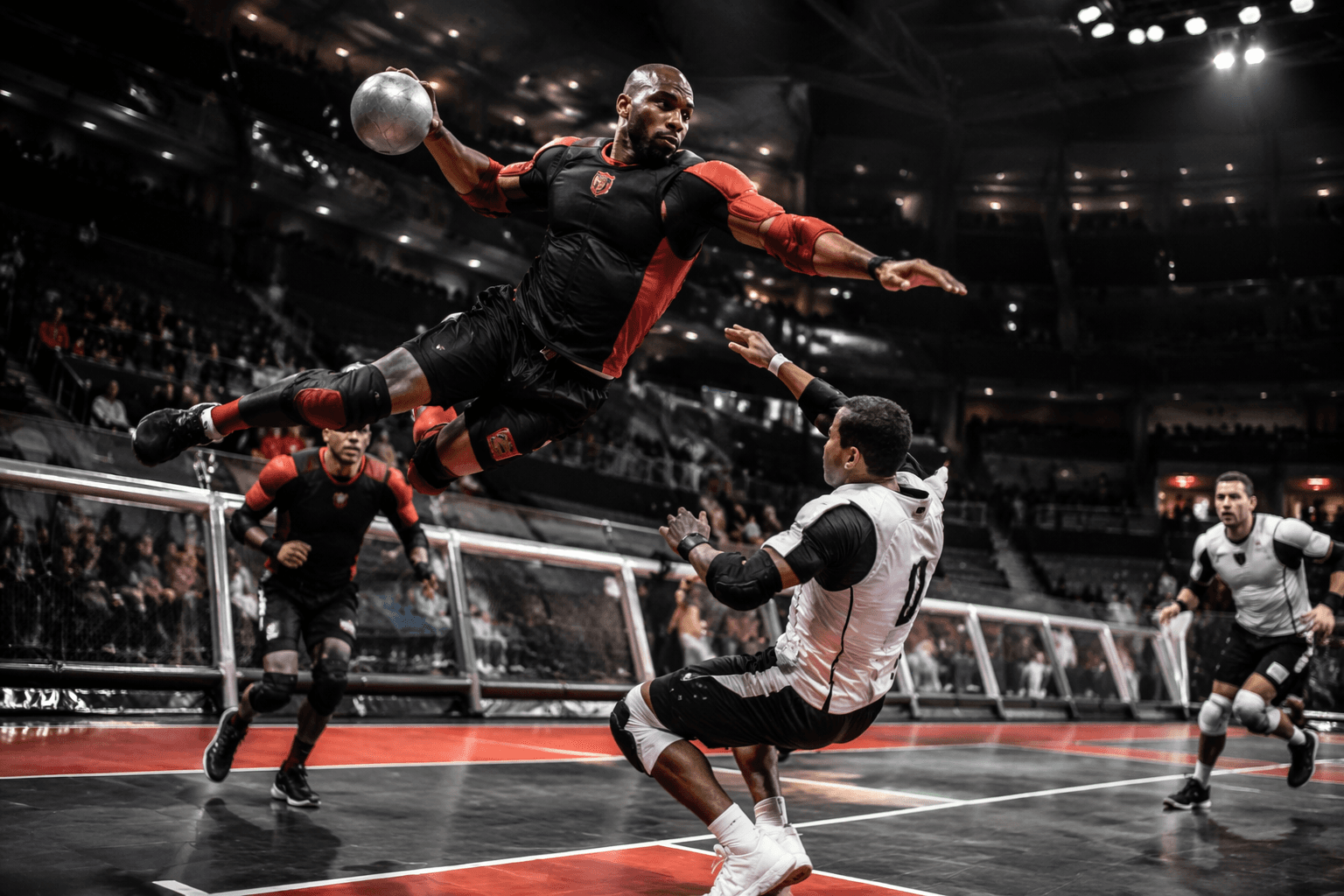
SlamBall's warehouse-born comeback turns spectacle into a repeatable format
SlamBall is back with the same warehouse-born chaos, now packaged for five-minute bursts, short rotations, and TV-ready highlights that make every possession feel like a bet.
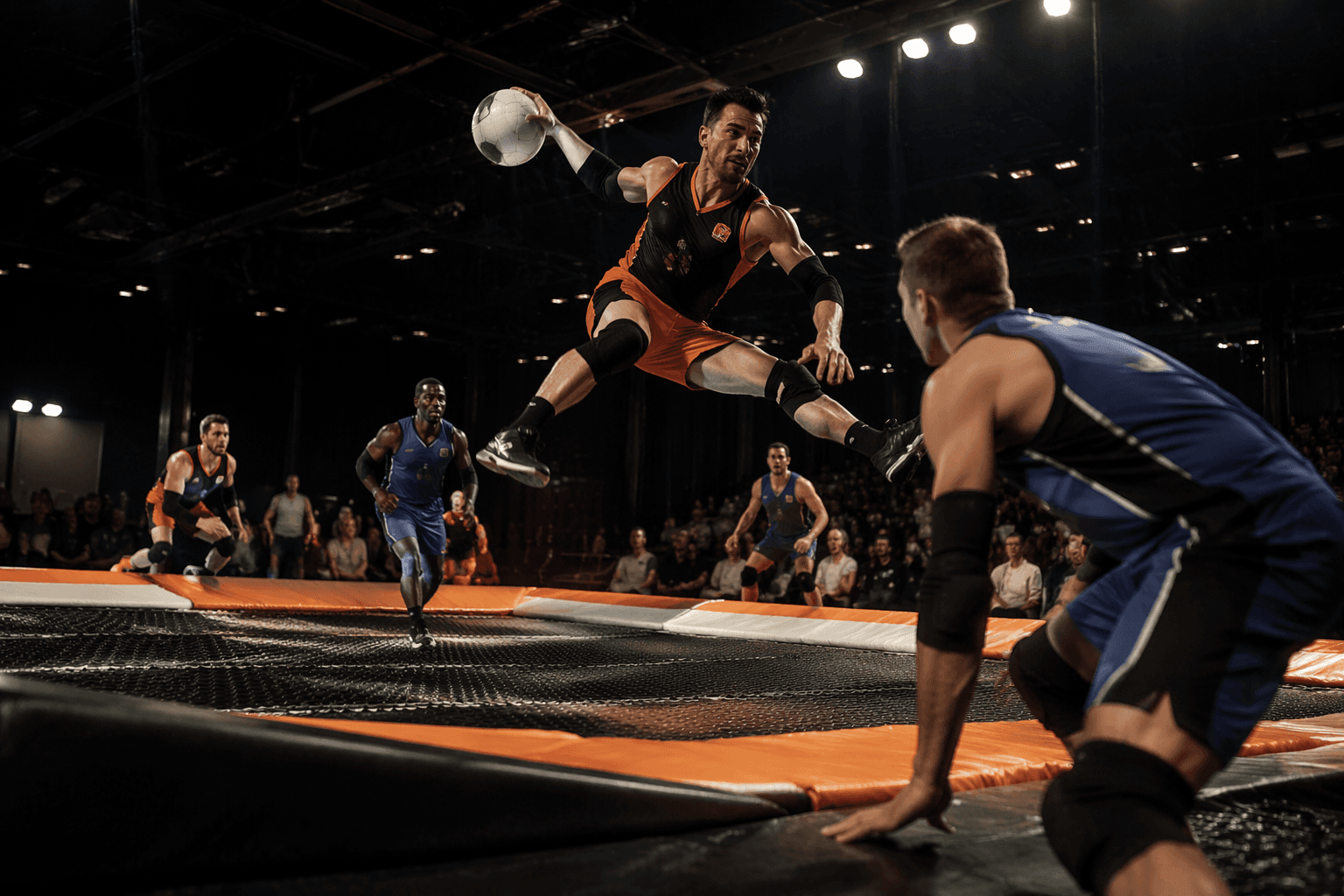
SlamBall’s most important trick has always been that it looks wild and makes sense at the same time. Mason Gordon drew the idea in 1999 while working for Tollin/Robbins Productions, and Mike Tollin helped finance a prototype court in an East Los Angeles warehouse, turning a napkin concept into a sport built for collision, speed, and immediate visual payoff. The first version reached Spike TV in 2002 and 2003, and the original appeal was obvious from the first possessions: four-on-four basketball on a spring-loaded floor, with four trampolines inside the arc, body checking allowed, on-the-fly substitutions, and plexiglass boards instead of standard out-of-bounds lines.
That structure gave SlamBall its identity long before the league had a durable business model. The first teams included the Los Angeles Rumble and the Chicago Mob, and early histories say Gordon recruited five original players, James Willis, Sean Jackson, David Redmond, Michael Goldman, and Jeff Sheridan, to help establish the game’s vocabulary. The result was never meant to be ordinary basketball with a stunt attached. It was designed to produce a different kind of athletic language, one where a drive to the rim could end in a launch, a hit, or both.

Why the format still works on first watch
The simplest way to understand SlamBall is to watch how the rules change the shape of every possession. The trampolines inside the arc compress the action into a tighter scoring area, while the allowed contact makes every cut and finish feel earned rather than choreographed. On-the-fly substitutions keep the pace relentless, and the plexiglass boards create a rink-like boundary that keeps play moving instead of stopping for endless resets.
That is also why the modern version can be marketed as a repeatable format rather than a one-off curiosity. The league’s five-minute quarters make the game easy to follow, but they do not calm it down. Short quarters, compressed rosters, and the physical style combine to create the kind of sequence that can swing a night in a single burst, which is exactly the sort of thing that turns casual viewers into repeat viewers.
Why the league disappeared, and why it came back
The first run did not fail because the product lacked a hook. It disappeared because a third season in 2008 did not draw enough ratings to keep the sport on TV, and the league faded from view for years after that. The idea, though, never really left the culture. Social media kept the sport alive in the background, and Gordon announced SlamBall’s return in August 2022 after the fan base had already spent years treating it like a sport worth resurrecting.
That revival matters because it reflects a bigger shift in sports media. A property like SlamBall does not need to look like a traditional league to become commercially useful. It needs a clear visual identity, a reliable clock, and a format that can generate highlights without waiting for a national moment. SlamBall has all three, and its comeback is built around the idea that spectacle becomes more valuable when it can be repeated on a schedule.
How the modern version is built for attention
The 2023 return was designed like a tight television package rather than an open-ended relaunch. ESPN said the season ran for five weekends starting July 21 in Las Vegas, with more than 30 hours of live programming across ESPN, ESPN2, and ESPN+. All games were staged at Cox Pavilion in Las Vegas, a setting that matched the league’s preference for concentrated, high-energy production over a sprawling road schedule.
The modern format included eight teams and a short, concentrated regular season. ESPN reported that the teams played anywhere from nine to 16 regular-season games over the four-week run, with Thursday through Sunday nights arranged to keep the action moving and the audience locked in. In the league’s own logic, the structure is meant to let teams “win the chance to win more,” a compact explanation for why good nights can compound into even bigger opportunities.
That approach also helps explain the playoff calendar. ESPN reported that the 2023 semifinals were on Aug. 17, followed by the championship after the semifinal games, with the season culminating in the SlamBall Playoffs and SlamBall Championship Game. The point is not just to stage games. It is to compress drama into a window where every game feels like part of a larger burst.
Why the comeback resonated beyond the diehards
SlamBall’s return landed because it was not only a sports story. It became a social-media event, helped by the hashtag #BringBackSlamBall, which drew more than 200 million views. That kind of public momentum matters in a landscape where niche sports often need proof that they can travel outside their core audience. SlamBall’s design already gives viewers something easy to clip and share, and the 2023 relaunch made that advantage part of the product instead of an afterthought.
The revival also pulled in names that widened its audience. Patrick Mahomes and Jalen Brunson were among the public figures reacting to the comeback, which gave the league a pop-culture echo that extended well beyond its usual lane. That matters because a sport like SlamBall does not sell itself on tradition. It sells on recognition, spectacle, and the sense that every sequence might become the clip everyone talks about later.
What to watch for now
The best way to read SlamBall is to treat every night as a compressed test of team identity. The format rewards depth, quick adjustments, and players who can handle contact without losing pace. Because the games are short and the calendar is concentrated, a single hot run can change the shape of a session, and a strong roster can look overwhelming in a way that feels more like a tournament than a long season.
That is the larger lesson in the comeback. SlamBall began as a warehouse experiment in East Los Angeles, went public on Spike TV, disappeared when the ratings did not support another sustained run, and returned in a package built to fit modern media habits. The league is still selling spectacle, but now the spectacle has structure.
This article was produced by Prism’s automated news system from verified source data, official records, and press releases, then run through automated quality and moderation checks before publishing. The system is built and supervised by the people who set the standards it runs under. Read our full AI policy.
Did this article answer your question?