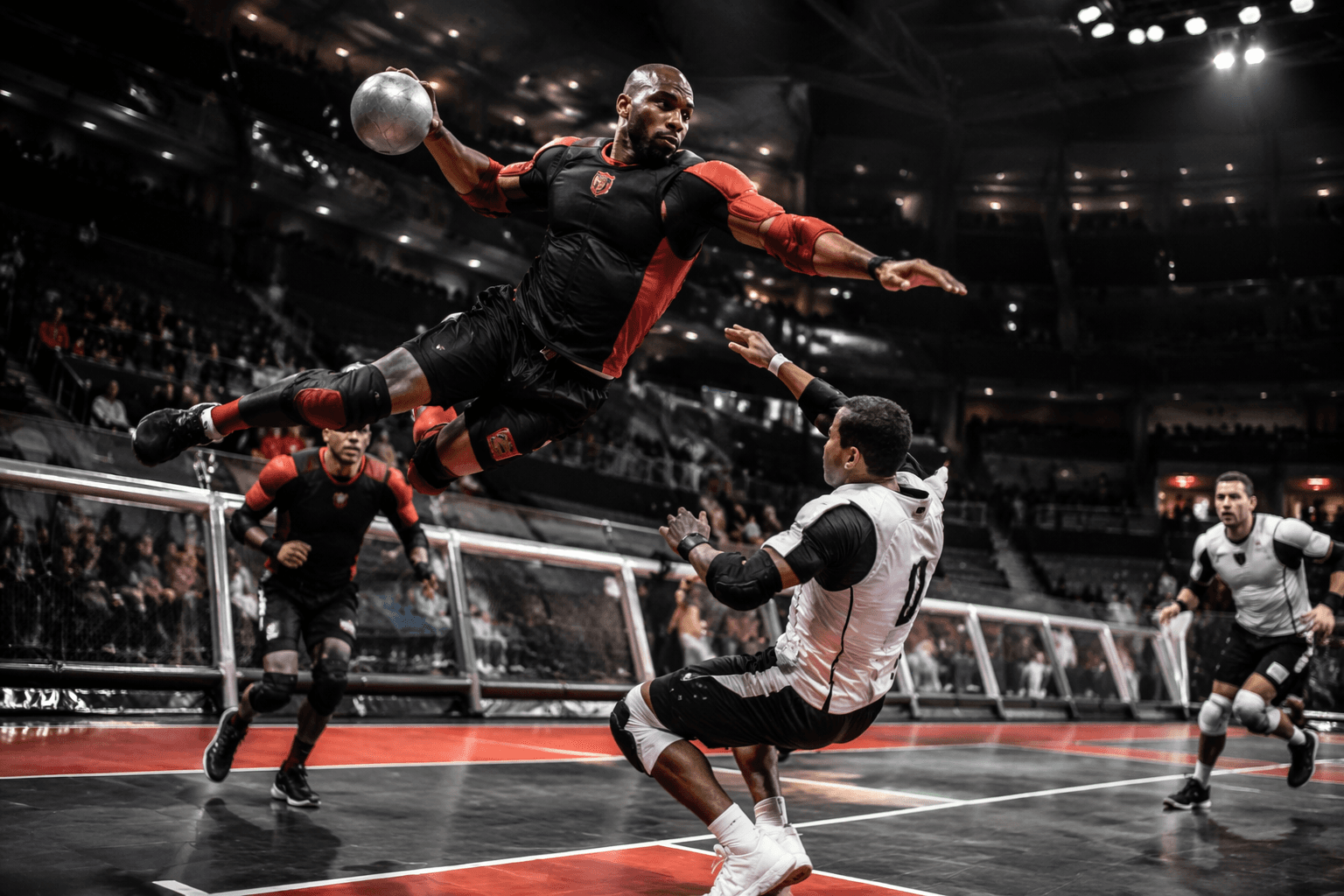
Slashers bet on shortest SlamBall player Tony Crosby II to lead attack
Tony Crosby II gives the Slashers a rare shape: the shortest player in SlamBall runs the offense, while big bodies finish, space and protect the rim.

The Slashers look easier to decode than most SlamBall teams because they actually are. Tony Crosby II, listed at 5-foot-6 and officially the shortest player in the league, sits at the center of a roster that gives every possession a job title, from handler to gunner to stopper. That structure makes the Slashers feel built for clarity, with Crosby initiating, the wings attacking, and the big bodies behind them cleaning up the chaos.
A roster built around defined jobs
The Slashers’ squad page lays out the team in plain terms: Crosby is the handler, Alonzo Scott Jr. and Bradley Laubacher are gunners, Amir Smith, Nathan Karsjens and Brian Gentry are stoppers, and Naradain James can handle multiple responsibilities as another 6-foot-6 gunner. That kind of separation is unusual in a sport that often rewards blur and improvisation, but it gives this group a shape that fans can track possession by possession.
In practical terms, the handler starts the action, the gunners turn speed and elevation into immediate scoring pressure, and the stoppers make sure the other end does not unravel. On a fast SlamBall floor, that means Crosby is the first read, Scott and Laubacher are the first finishers, and the stoppers are the insurance policy when the play breaks down or the rim gets crowded.
- Crosby initiates the attack and sets the pace.
- Scott and Laubacher are the primary vertical threats.
- Smith, Karsjens and Gentry help protect space, absorb contact and keep the middle from collapsing.
- James adds flexibility, so the Slashers are not locked into one shape when the game speeds up.
That is the appeal of the roster construction. It does not ask every player to be everything. It asks each player to be excellent at one job, then stacks those jobs into a possession that is easier to understand and, in turn, easier to back.
Tony Crosby II is the engine
Crosby is the face of that identity because his profile runs against the usual basketball and dunk-sport template. He is 5-foot-6, weighs 175 pounds and has a 52-inch vertical, which is the sort of explosiveness that makes his size part of the story rather than a limitation. He also comes with a track résumé from Grand Canyon that includes a second-place finish in the Western Athletic Conference outdoor high jump with a 2.02-meter leap, a fifth-place finish at the WAC indoor championships and a personal-best 7.00-meter long jump at the Steve Scott Invitational.
That athletic base matters because SlamBall rewards short bursts, timing and fearlessness more than conventional size alone. Crosby’s background also includes a win at the Quai 54 Dunk Contest, and the club named him captain after drafting him in the fourth round, a signal that the Slashers value his burst and his edge as much as his stature. In a league that has long sold the idea of unusual athletic profiles, Crosby is the extreme version of the pitch.
His official bio also lists Long Beach, California, as his hometown, which adds another layer to the appeal: the shortest player in SlamBall is not just surviving in a contact sport, he is setting the tone for it. When the Slashers want a possession to start on time and end above the rim, he is the player they trust to make that first move.
Scott, James and the rest give the shape its force
If Crosby is the ignition, Alonzo Scott Jr. is the finishing power. He is 6-foot-4, 220 pounds, and his background at Appomattox Regional Governor’s School included 17.9 points and 6.5 rebounds per game, a 58 percent field-goal mark and all-conference and all-district honors. He later became a professional dunker, won multiple contests and turned his athletic profile into a second career that is unusual even by SlamBall standards.
Scott’s off-field life is just as distinctive. He founded a chimney sweeping company in Petersburg, Virginia, and used that experience to create a three-book children’s series called The Super Zo Chimney Mission Stories. That entrepreneurial streak fits the Slashers’ broader identity, because this is a roster built on players who can do more than one thing and are comfortable carrying that versatility into public view.
Naradain James adds a different kind of depth. At Cal State San Bernardino, he averaged 11.4 points, 5.2 rebounds and 2.1 assists, after earlier stops at Garden City Community College and UIC. His background in basketball and track, plus his study of kinesiology, makes him a natural fit for a team that wants movement to be deliberate, not improvised.
The rest of the stopper group matters too. Amir Smith, Nathan Karsjens and Brian Gentry give the Slashers the size and physical presence to keep the paint from becoming a free lane. That is why this roster feels less like a collection of dunk highlights and more like a working plan: Crosby gets the first crack, the gunners attack the window, and the stoppers keep the next possession from turning messy.
Why specialization can be the Slashers’ edge
SlamBall’s 2023 return made the league’s identity more visible than it had been in years. The league reopened at Cox Pavilion in Las Vegas, said the average player age was 26.9 and brought back three legacy clubs, the Mob, Rumble and Slashers. It also said the league’s players were drawn from basketball, football and track backgrounds, which helps explain why a roster with clear roles can have an edge: when athletes arrive from different sports, specialization can turn that diversity into a system.
The league’s 2023 launch also came with an exclusive two-year national broadcast partnership with ESPN for the 2023 and 2024 seasons, giving SlamBall a bigger stage as it reintroduced itself. That national platform matters because a roster like the Slashers is made for viewers who need instant orientation. In a sport where roles can blur quickly, knowing who handles, who finishes and who protects the rim gives the team a better chance to stick in memory.
There is also a striking contrast at the top and bottom of the height chart. SlamBall’s launch materials identified Crosby as the league’s shortest player and Vincent Boumann of Ozone as the tallest at 6-foot-9. That contrast became part of the league’s sales pitch, but it also underlines the Slashers’ team-building bet: a very small creator can still drive a roster if the rest of the group is built to amplify him.
The playoff proof
The cleanest evidence came in the postseason. ESPN reported that Crosby and Scott each scored 19 points in the Slashers’ 64-57 quarterfinal win over the Gryphons, which is exactly the kind of split that shows why the roster works. Crosby can start the action and Scott can finish it, and when both are scoring at that level, the Slashers are not just hard to guard, they are easy to follow.
That matters in a league where the regular season average margin of victory was 17.7 points and only 12 of 48 games were decided by single digits. In that environment, a team with a defined shape has an obvious advantage: it can survive the wild swings because every role already has a job. The Slashers are betting that clarity, powered by Crosby’s burst and backed by Scott, James and the stoppers, can be the edge that separates them from more blended rosters when the game gets tight.
This article was produced by Prism’s automated news system from verified source data, official records, and press releases, then run through automated quality and moderation checks before publishing. The system is built and supervised by the people who set the standards it runs under. Read our full AI policy.
Did this article answer your question?