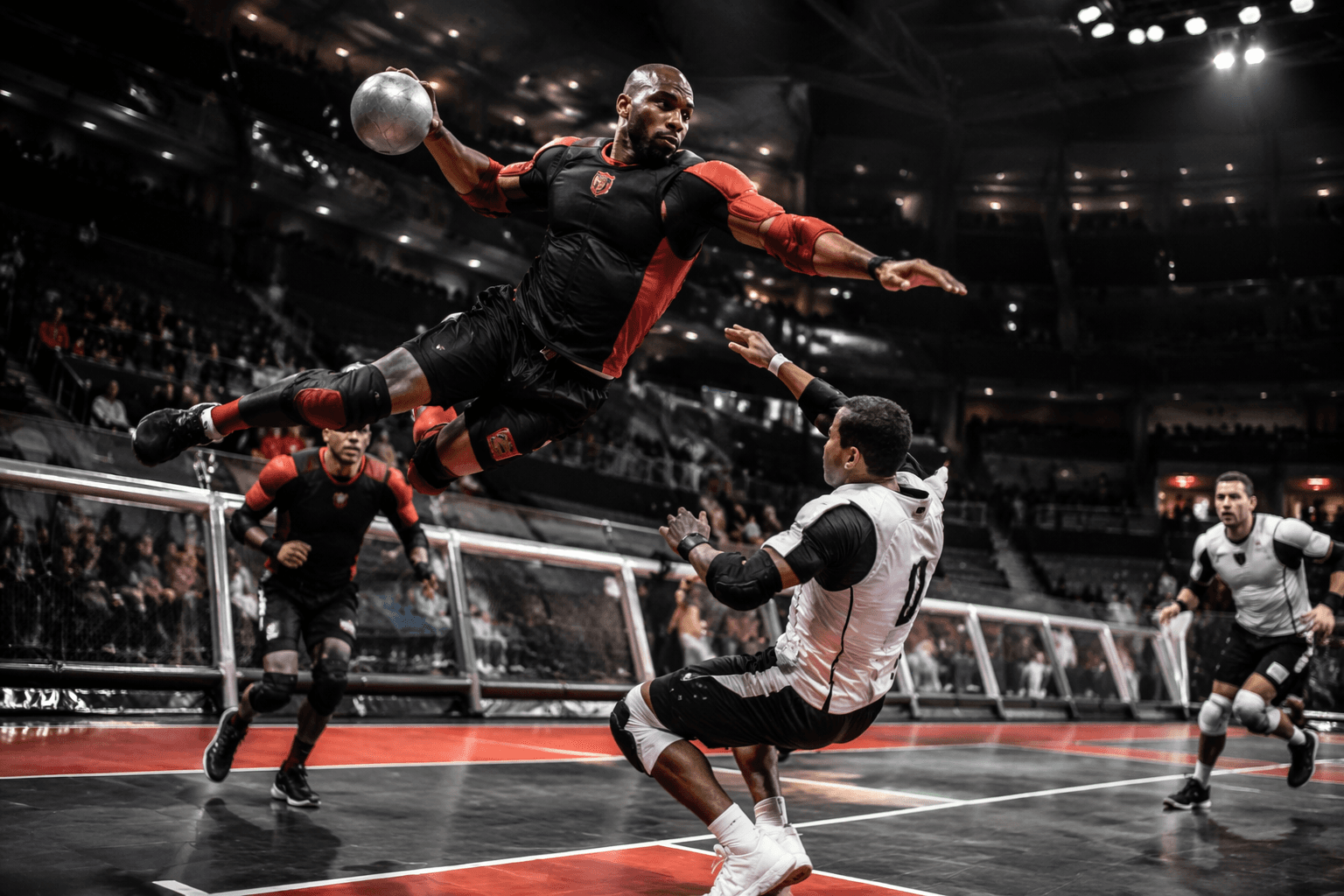
Stan “Shakes” Fletcher’s creative scoring cements SlamBall GOAT case
Stan Fletcher didn’t just score in SlamBall, he forced defenders to chase angles they couldn’t teach. That creative edge still defines the league’s standard for greatness.

Stan “Shakes” Fletcher is the kind of scorer SlamBall still measures itself against because he did more than finish plays. He bent the game around his own imagination, using trampolines, timing, and feel to create shots that did not look repeatable in the first place. The league calls him its all-time leading scorer, but the deeper reason his name sits at the center of the GOAT argument is simpler: he made scoring look like invention.
The scoring standard every era still answers to
Fletcher’s case starts with the number and ends with the style. SlamBall’s official profile says he led the league in points per game while still finding ways to pass to teammates, which is the key detail that separates him from a pure volume finisher. He was piling up production without shrinking the floor around him, and in a sport built on speed, collision, and aerial space, that balance made him harder to trap in one scouting report.
That matters because SlamBall has always rewarded players who can turn one possession into something the defense never fully sees coming. Fletcher’s scoring record is not just a benchmark for total output. It is the standard for how creative a scorer can be before the game starts bending back in his favor.
Why the moves mattered as much as the makes
What made Fletcher so difficult to contain was the way he treated the springbed environment as part of the playbook. His trademark freestyle moves, including “the Chaser” and “Shakedown,” were not decorative tricks. They were tools for resetting angles, bouncing the ball off the trampolines, re-collecting it in space, and carving out a new lane before the defense could recover.
That style created a problem no ordinary defender could solve by simply contesting a jumper or cutting off a driving lane. Fletcher was reacting to the court itself, using the extra bounce to manufacture leverage in real time. In a league where the margins are already compressed by speed and contact, that kind of improvisation turned him from a scorer into a moving problem.
The Maulers, and the value of a singular creator
The Maulers history page tells you almost everything you need to know about Fletcher’s influence. The team never finished a season on top, but it remained a constant threat largely because of his creative brilliance. That is a useful clue for understanding how SlamBall has always worked: star power is not just about trophies, it is about whether one player can keep opponents from ever feeling settled.
Fletcher’s value was magnified because his game translated into threat, not just highlights. Even when the Maulers were not closing seasons with a title, they still carried the kind of offensive danger that made them dangerous on any night. In a league defined by volatility, a player who can keep a team relevant through sheer invention is often more important than the one who posts the cleanest résumé line.

A career that bridges the league’s first life and its relaunch
Fletcher’s place in SlamBall history is stronger because he belongs to the sport’s original era and its modern return. SlamBall says the game was invented in 1999 by co-founder Mason Gordon and first played in Los Angeles, which puts Fletcher inside the league’s experimental roots rather than outside them. He was part of the old ecosystem that helped define what this sport could look like before the modern relaunch reintroduced it to a new audience.
That relaunch mattered, too. SlamBall and ESPN announced an exclusive two-year broadcast partnership for the 2023 and 2024 seasons, and the 2023 return opened live from Las Vegas on July 21, 2023. The league also said that relaunch featured eight teams with seven-man rosters, a reminder that SlamBall remains a compact, specialized competition where one elite creator can shape a season faster than in most mainstream leagues.
From star scorer to league architect
Fletcher’s legacy is now bigger than his box scores because he still helps shape the sport from inside the building. SlamBall’s team page lists him as Vice President of Competition and Player Relations and head coach of the Slashers, a combination that gives him direct influence over both the product and the players. That is a rare full-circle role: the man once celebrated for pushing the limits of scoring is now responsible for helping protect the standards of the league itself.
SlamBall’s history around Fletcher also includes his work outside the main stage. A team-coach roundup says he played for the Steal in 2002 and 2003, the Diablos in 2007, and the Maulers in 2008, and that he also ran the Training Center for SlamBall China. Taken together, those stops show a career that has stretched from player to teacher to executive without losing its central identity as a competitor.
A resume built on more than one kind of finish
If the scoring record is the headline, the dunk titles are the exclamation point. SlamBall says Fletcher was a three-time slam dunk champion in 2003, 2007, and 2008, which adds another layer to his reputation as one of the sport’s most inventive finishers. He was not merely putting up points over time. He was winning the events that celebrate the same creativity his game was built on.
That combination helps explain why his influence still shapes how SlamBall thinks about greatness. The league does not just remember Fletcher as a prolific scorer. It remembers him as a player whose style changed the visual language of the sport, whose passing kept teammates involved, and whose adaptability carried from the Steal to the Diablos to the Maulers and now into the Slashers’ sideline. In a league built on audacity, that is the rare profile that still sets the bar.
This article was produced by Prism’s automated news system from verified source data, official records, and press releases, then run through automated quality and moderation checks before publishing. The system is built and supervised by the people who set the standards it runs under. Read our full AI policy.
Did this article answer your question?