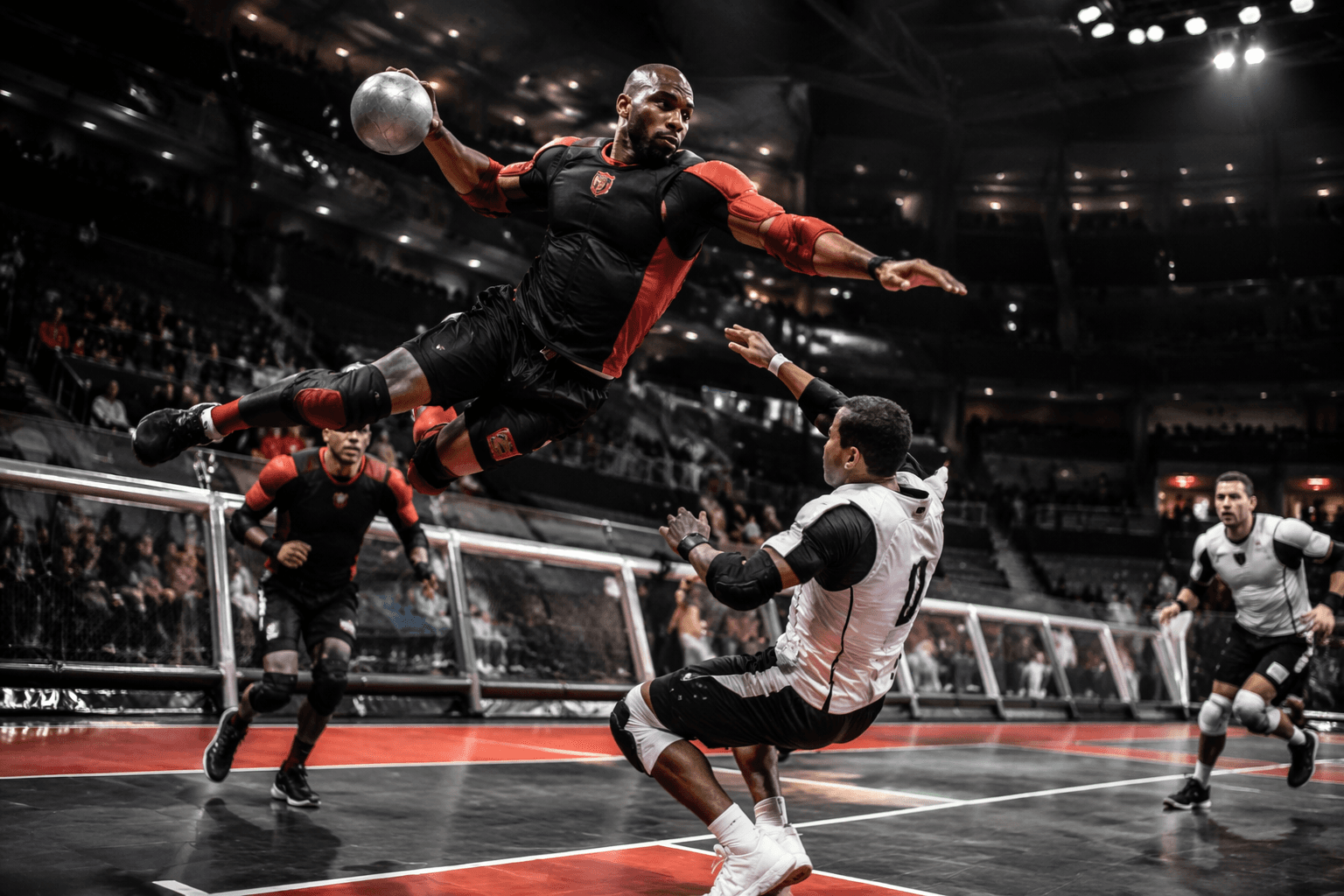
Victor Dean’s football speed and size make him a SlamBall fit
Victor Dean’s 6-foot-7 frame and receiver speed explain why football players fit SlamBall so naturally, and why the reboot needed athletes like him.

A football body built for a trampoline court
Victor Dean looks like the kind of athlete SlamBall was made to find: 6-foot-7, 211 pounds, fast enough to win downfield and physical enough to survive a contact-heavy game that lives above the rim. His path from Fresno State and Portland State into SlamBall is a clean example of why football players have always been such natural recruits for the sport, where size, burst, and a taste for traffic matter as much as any jump-shot flair.
Dean’s case also gives the league a human face. A July 16, 2023 appearance on WSEE-TV Fresno’s Bulldog Insider, hosted by Andrew Marden, framed him as an upcoming SlamBall participant in Las Vegas and turned the comeback into something more legible than a novelty act. Instead of selling only dunks and trampolines, the segment sold a familiar football identity being repurposed for a new kind of competition.
Why football traits translate so well
SlamBall rewards the same broad athletic tools that make a wide receiver dangerous in football. Dean’s profile is built on the classic crossover ingredients: length, acceleration, balance, and the willingness to attack open space before it closes. In a sport where players launch off trampolines, absorb contact in the air, and still have to finish through defenders, those traits are not decorative, they are foundational.
That is why Dean fits the league’s recurring athlete type so neatly. As a receiver, he already had to separate from defenders, track space, and make decisive, explosive movements after the snap. In SlamBall, that becomes a different grammar, but the vocabulary is similar: win the lane, stay upright through contact, and use burst to create an advantage before the defense can reset.
The physical profile matters too. SlamBall’s roster construction in 2023 mixed athletes with basketball, football, and track backgrounds, but football bodies bring a special edge because the sport trains players to collide, recover, and keep playing. A former receiver like Dean does not arrive as a novelty guest. He arrives with habits that translate to the court’s speed and violence.
What Dean already proved in college
The numbers attached to Dean’s football career show why his move makes sense. Fresno State listed him as a wide receiver and said he finished fifth on the team in receptions in 2012 despite playing only nine games, a sign that he was already producing in a limited role. The Football Database puts his Fresno State totals at 32 catches for 404 yards and four touchdowns across two seasons, which confirms that he was not just a height-and-speed projection, he was an actual contributor.
Portland State sharpened that picture even more. The Vikings described him as a dangerous weapon who averaged nearly 23 yards per catch in 2013, when he caught 23 passes for 521 yards and seven touchdowns. That kind of production tells the same story from a different angle: Dean was not merely moving chains, he was stretching the field and turning limited touches into real damage.
For SlamBall, that résumé is gold. A player who can threaten vertically, create separation, and handle contact is already halfway to being useful on a trampoline court. Dean’s college tape and stats suggest the league did not have to imagine what he might become, only how his football explosiveness would look in a new environment.
The comeback needed exactly this kind of athlete
SlamBall’s return in 2023 was designed as a structured reboot, not a one-off stunt. The league said the relaunch would feature eight teams, seven-man rosters, and playoffs, while ESPN announced Opening Night for Friday, July 21, at 7 p.m. ET in Las Vegas and said the season would run five weekends before ending with the championship game on August 17, 2023. That format made the comeback feel like a season, not a demo.
The league also leaned into its own origin story. SlamBall was invented in 1999 by Mason Gordon and first played in Los Angeles, and the modern version still markets itself as a mix of basketball and football powered by trampolines. That identity is part spectacle, part credibility test. If the league can show that former football players like Dean belong there, it helps prove that SlamBall is not just an idea with fireworks, but a sport with a stable competitive language.
Dean’s appearance on a regional Bulldog Insider segment mattered in that bigger business story. A niche league becomes easier to understand when a recognizable college football path runs through it, especially one tied to Fresno State and Portland State. Local identity creates national clarity: a receiver from San Diego, developed in Fresno and Portland, now recast as a SlamBall gunner in Las Vegas.
What still has to be relearned
The easy part for football crossovers is obvious: use your size, attack space, and welcome contact. The harder part is recalibration. SlamBall asks athletes to relearn timing off the trampolines, adjust to strange angles, and manage a court where the next bounce can change everything about a play.
A receiver like Dean has to translate his instincts, not simply repeat them. In football, a deep route is about reading leverage and accelerating through a lane; in SlamBall, the same burst has to be paired with a new sense of vertical timing and landing control. That is where the sport gets interesting, because it strips away the certainty of a familiar field and asks athletes to rebuild their identities in real time.
That identity shift is what makes Dean such a useful case study. He represents the bridge between two sports, one built on pads and yards, the other on rebounds, angles, and aerial collisions. His football speed and size are the entry ticket; his ability to adapt is what turns that ticket into competitive value.
Why Victor Dean fits SlamBall’s bigger story
Dean’s story shows why the league has long been able to mine football for talent without feeling like a gimmick. The match is practical, not cosmetic. A 6-foot-7 former wide receiver who already proved he could produce at Fresno State and Portland State gives SlamBall exactly what it needs in a reboot: a player whose biography explains the sport as clearly as any highlight reel.
That is the real value of the comeback. The eight-team relaunch, the ESPN window, and the Las Vegas stage all matter, but the league’s staying power depends on whether players like Dean make the competition feel inevitable. When football athleticism turns into SlamBall performance, the sport stops looking borrowed and starts looking built for its own future.
This article was produced by Prism’s automated news system from verified source data, official records, and press releases, then run through automated quality and moderation checks before publishing. The system is built and supervised by the people who set the standards it runs under. Read our full AI policy.
Did this article answer your question?