Coleman Crow, Tanner McDougal Lead Triple-A Opening Weekend Statcast Standouts
Coleman Crow's 75 mph curveball and Tanner McDougal's 80 mph monster breaker headlined a Triple-A opening weekend that also surfaced a Watson power spike worth tracking all season.
Coleman Crow's Cutter: A Calculated Choice
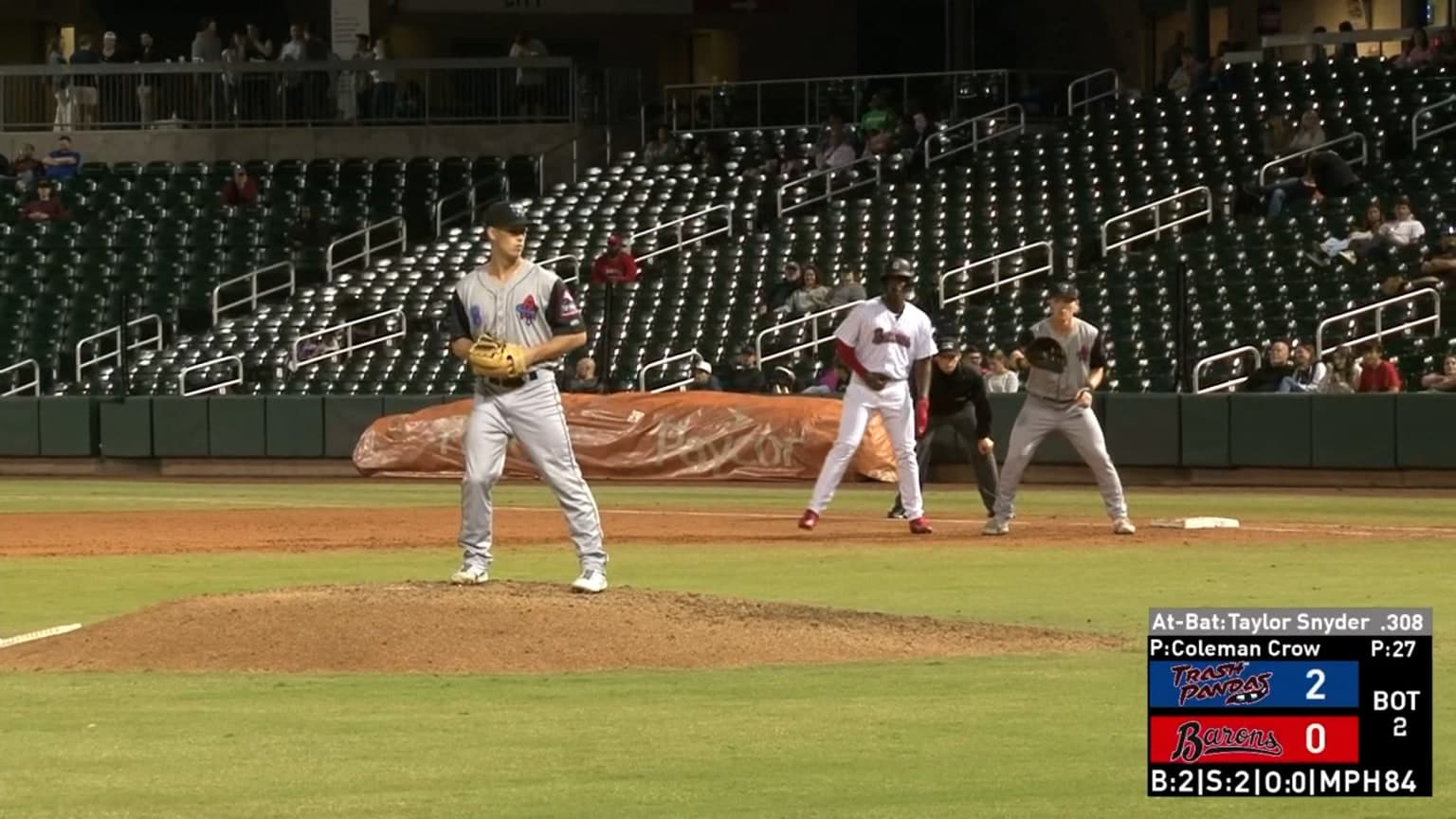
Coleman Crow pitched his way onto the Triple-A opening weekend Statcast leaderboard not by overwhelming hitters with elite raw stuff, but by being smarter than most. In his opening weekend start, Crow deployed his 87 mph cutter 34% of the time, weaving it in alongside a fastball and sinker to keep hitters from sitting on any one pitch. That three-pitch fastball mix forms what analysts call the modern "three fastballs approach," a framework that has become increasingly common among pitchers who lack a single dominant offering at the top of the zone. The cutter, in particular, has become the equalizer for pitchers without a true plus heater. The question analysts ask: what does a pitcher lean on when the fastball and sinker don't project as MLB-quality pitches? The answer, more often than not, is the cutter.
Crow's 75 mph Curveball: The Pitch That Changes Everything
Strip the cutter away and Crow would project as a fringe major leaguer at best. Add his curveball back in, and the conversation shifts entirely. The pitch is enormous, a 75 mph, big-looping breaker with enough movement that it grades out as plus from a pure stuff standpoint. The challenge with any pitch carrying that much sweep and depth is command: hitters can lay off balls that break out of the zone, turning a wipeout pitch into a count-hurting ball. What makes Crow genuinely interesting is that he may have 80-grade command of the pitch, an elite designation that, if it holds at scale, would vault him from fringe prospect to legitimate MLB rotation candidate. That command-plus-movement combination is rare enough to merit real attention beyond opening weekend.
Sustainability Check: What Crow's Metrics Predict
At the MLB level, a plus-graded breaking ball with premium command projects as a genuine weapon, particularly as contact quality on off-speed pitches has become a primary separator between rotation pieces and reliever filler. Crow's 87 mph cutter is below the MLB average cutter velocity, which typically clusters in the 88-90 mph range for starters, but the pitch's role as a tunnel-setter for the curveball matters more than the raw velo number. If Crow's curveball command grades translate to Triple-A results, the surface-level concern about a below-average fastball fades considerably. The early sample is small, and Statcast player cards need roughly 200 pitches to be properly populated. Still, the pitch shape and command signals present an encouraging foundation.
Tanner McDougal's Electric Triple-A Debut
Tanner McDougal has been one of the Chicago White Sox's most intriguing pitching prospects, and his Triple-A debut did nothing to diminish that. The 6-foot-5, 240-pound right-hander posted four innings in his opening weekend outing at Charlotte, allowing just two hits and one earned run while striking out eight batters. He threw 49 of 82 pitches for strikes, a command efficiency number worth noting for a pitcher who entered the season still refining his walk rate. McDougal, who had Tommy John surgery in 2022, progressively reduced his walk rate from 13.6% to 10.2% across the full 2025 season before cutting it further to 7.5% in the second half at Double-A Birmingham. Eight strikeouts in four Triple-A innings suggests the stuff translated immediately to the highest level of the minors.
McDougal's Monster 80 mph Curveball
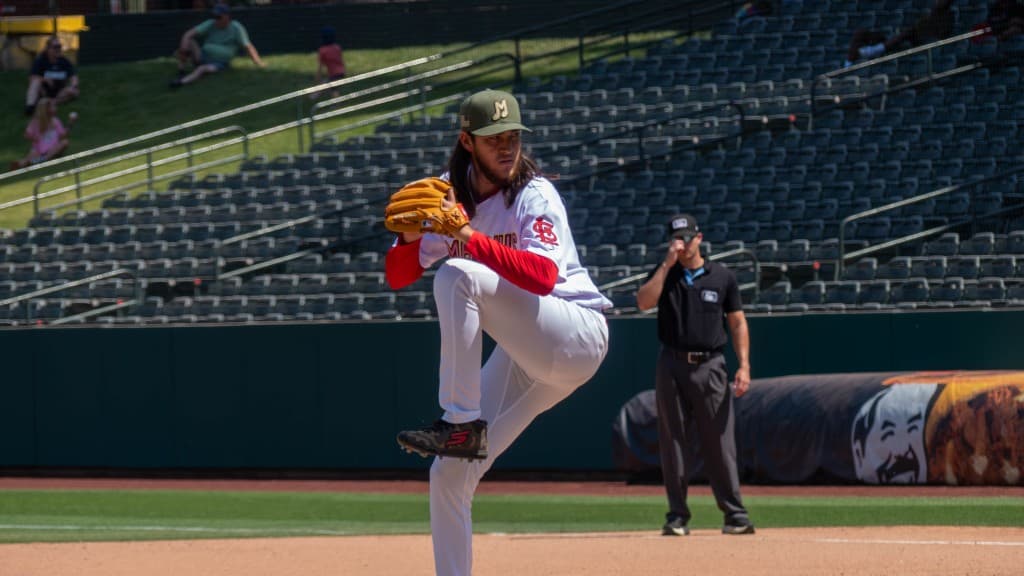
The fastball draws the first look because it sits mid-to-upper-90s and touches triple digits. Baseball America has graded it a 65, with upside toward double-plus if McDougal can improve its shape. But the pitch that defines his ceiling is the curveball: a high-spin, 80 mph offering with massive two-plane depth that he delivers in the high 70s to low 80s. As Baseball America noted in its Statcast Standouts feature, if McDougal had just a 98 mph fastball with average shape, he would not be particularly noteworthy. "Enter the curveball, his best pitch. It's a monster 80 mph pitch with massive two-plane depth." That combination of elite velocity plus a plus-graded, high-spin breaker is precisely the profile that projects to a mid-rotation major league starter, or a dominant late-inning arm if command fluctuations persist.
Kahlil Watson's 110.9 mph Wake-Up Call
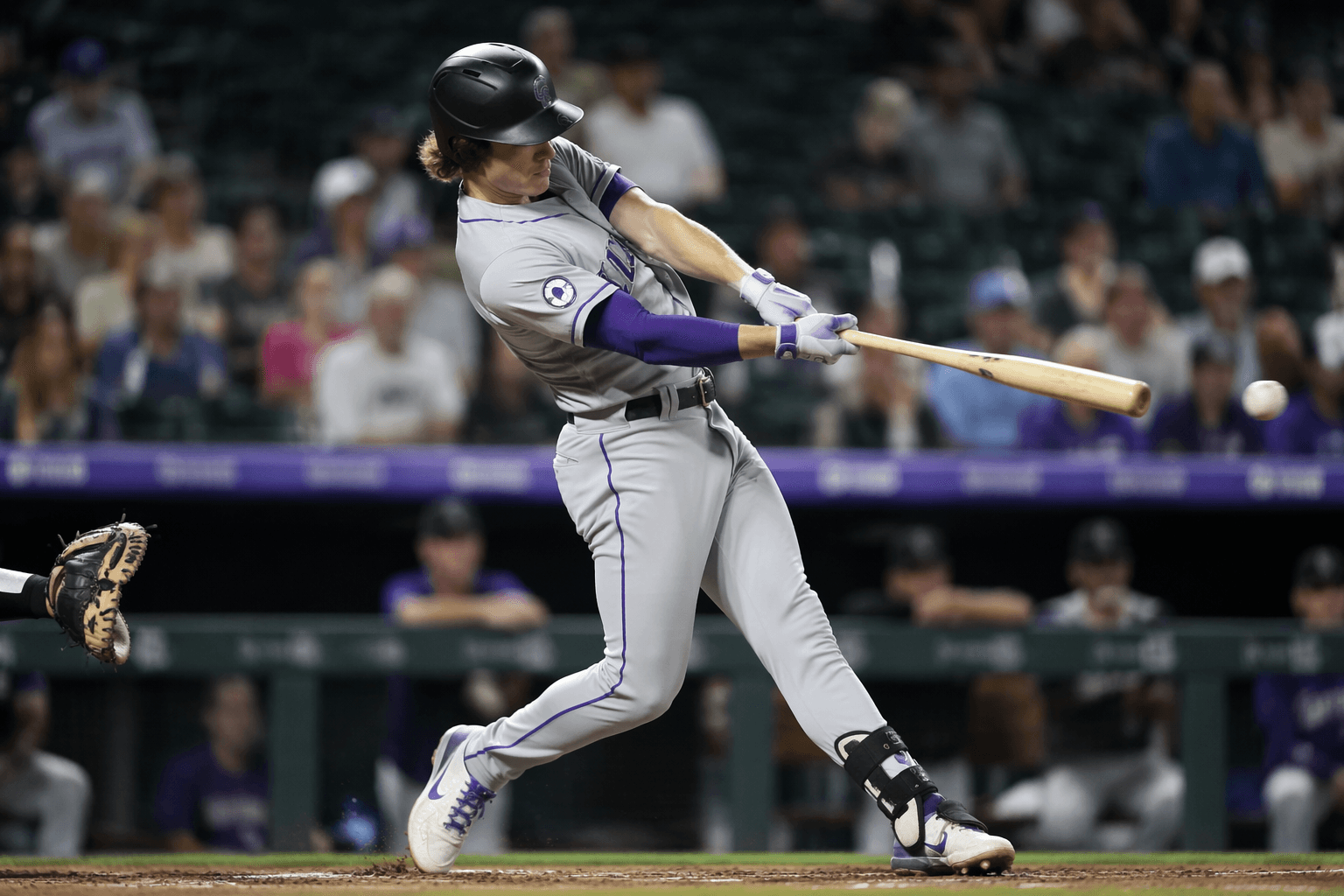
Sometimes a single batted-ball event is enough to force a deeper look. Kahlil Watson produced exactly that when he posted a 110.9 mph exit velocity on the Triple-A leaderboard in opening weekend play, a hard single that immediately registered as one of the weekend's top contact events. That singular data point projects to 50-55-grade raw power, which is meaningful on its own. But Watson's 2025 Statcast card tells a richer story: exit velocities across a full season's sample strongly support the 55 raw power grade, and his launch angle data gives him potentially 60-grade game power, the in-game translation of raw pop that actually shows up in box scores. Baseball America flagged him as a prospect who "may be the ultimate post-hype sleeper" based on that combination.
Making the Watson Case: 22 Years Old With a 129 wRC+
The "post-hype sleeper" label gets applied loosely in prospect circles, but Watson's profile earns it honestly. He posted a wRC+ of 129 across Double-A and Triple-A last season, meaning he produced 29% above the league-average run creation rate at the two highest minor league levels. He is still only 22 years old, an age at which many prospects are still establishing themselves in High-A. His profile does carry one notable caveat: aggression on non-fastballs, with swing-and-miss numbers that will need to clean up against MLB-caliber breakers. That said, his damage-on-contact grades as plus, which translates across levels. Watson is positioned as a potential major league contributor this season, and the 110.9 mph opening weekend single looks less like small-sample noise and more like confirmation of a trend.
Esmerlyn Valdez: Power vs. Launch Angle
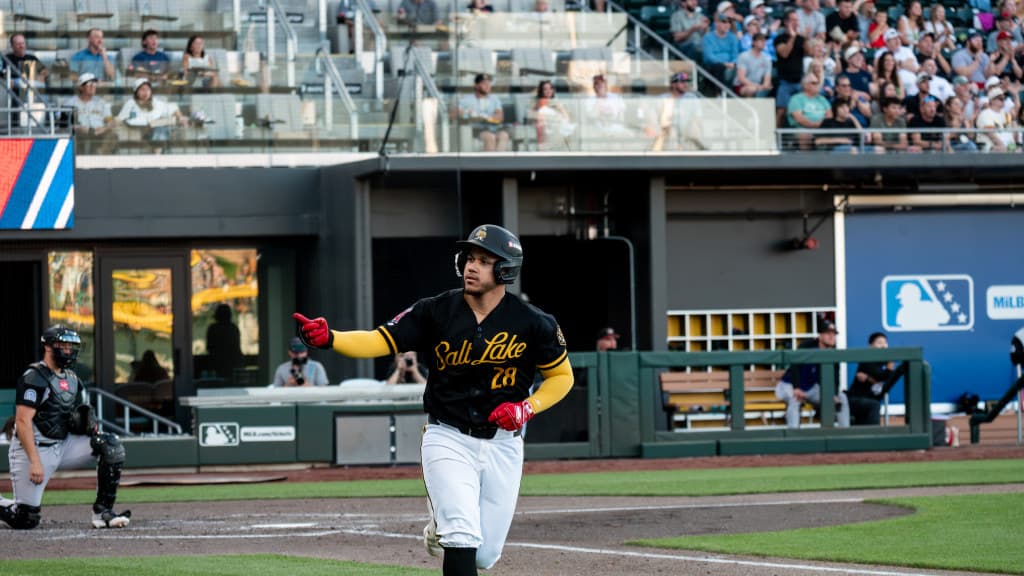
The Pittsburgh Pirates outfielder Esmerlyn Valdez presents the most analytically complicated early profile of the four standouts. His raw power grades in the 60-65 range, which projects as above-average to plus at the major league level. He is also showing elite contact rates and strong plate patience, a combination that typically produces high on-base percentages. The problem in the early sample: Valdez has yet to hit a single ball in the air, and his average launch angle is negative. A negative launch angle limits how much of that 60-65-grade raw power can translate into actual run production. Hard-hit grounders are valuable, but they cap the ceiling. Statcast player cards require approximately 200 pitches or so for full accuracy, and Valdez's early sample is well short of that threshold. The power and patience are real; the launch angle question is what makes this an "intriguing" profile to monitor rather than a straightforward breakout signal.
Sustainability vs. Noise: Early-Season Statcast Framing
Reading Statcast data before player cards are fully populated is a discipline in interpretive restraint. The power of early-season Statcast data is in identifying pitch shapes, exit velocity ceilings, and contact tendencies that stabilize quickly; the weakness is in rate stats and outcomes that take hundreds of plate appearances to normalize. McDougal's curveball movement and Watson's peak exit velocity are the type of early indicators that tend to hold. Valdez's launch angle and Crow's curveball command, though graded plus by evaluators, need more volume to confirm. The Statcast Standouts framework is explicit about this: the cards need roughly 200 pitches to be properly filled in. What the early sample offers is a directional signal, not a verdict.
Statcast Standouts Returns for 2026
Baseball America's Statcast Standouts feature is running every Monday morning through the 2026 minor league season, publishing a rotating list of 10 players, five pitchers and five hitters, whose underlying Statcast metrics made them worth a second look. Data typically covers through Saturday of the prior week, with some Sunday games included when available. The feature is explicitly framed as early-indicator analysis rather than full scouting reports, a distinction that matters when evaluating what the opening weekend results mean for each player's trajectory. New for 2026 is a college pitcher spotlight that bookends each article, expanding the prospect coverage beyond affiliated ball. With the format returning after its debut run, the opening weekend edition set a strong table: two pitchers with elite breaking balls and two hitters whose contact and power profiles suggest they should already be on major league radars.
This article was produced by Prism’s automated news system from verified source data, official records, and press releases, then run through automated quality and moderation checks before publishing. The system is built and supervised by the people who set the standards it runs under. Read our full AI policy.
Did this article answer your question?