Cooper Ingle emerges as key long-term catcher for Columbus
Cooper Ingle is forcing the issue in Columbus with on-base skills, real pop and a catcher’s profile Cleveland badly needs. The bat is ahead, but the glove will decide how fast he reaches Cleveland.
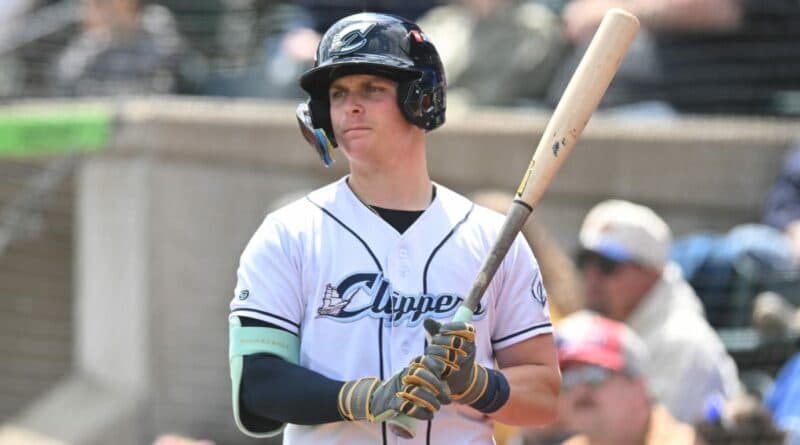
Cooper Ingle is becoming the kind of catcher Columbus can build around
Cooper Ingle is not just filling a lane in the Clippers lineup. He is pushing toward the kind of role Cleveland has hunted for years, a homegrown catcher who can keep the offense moving without giving back too much behind the plate. That is why his name carries more weight than a typical upper-minors bat, especially with MLB Pipeline slotting him as Cleveland’s No. 5 prospect and No. 87 overall and the Guardians bringing him into spring training as an internal non-roster invitee.
The timing matters, too. Cleveland already has Bo Naylor, Austin Hedges and David Fry in the catching mix, so Ingle is not stepping into an empty chair. He is trying to prove that his bat and his defensive trajectory are good enough to make the organization uncomfortable in the best possible way.
The bat has always been the calling card
Ingle’s offensive profile has never been about loud swing-and-miss numbers or empty power. He was born in Asheville, North Carolina, attended A.C. Reynolds High School, and then sharpened his game at Clemson, where he became a third-team All-ACC catcher in 2023. His final college season was the kind of line that gets player development people leaning forward: .328 with six home runs, 34 RBIs, 60 runs scored and an .878 OPS in 62 starts.
The Guardians took him in the fourth round of the 2023 MLB Draft, 125th overall, and his first full pro season justified the investment. In 2024 with Lake County, he hit .313/.433/.500 with nine home runs, 18 doubles, 55 RBIs, 45 runs scored, 51 walks and 40 strikeouts in 68 games. That was not just good for a catcher, it was loud enough to earn Midwest League MVP honors and strong enough to support the argument that he was one of the organization’s most advanced bats in the system.
The deeper number was the one that made the profile pop: he led all minor league catchers in wRC+, on-base percentage and BB/K ratio in 2024. That is the sort of statistical footprint that says the approach is real. Ingle, a left-handed hitter and right-handed thrower, was not surviving with contact alone. He was controlling the strike zone, and that travels.
The Cleveland path has been built on patience, not perfection
If you want the full read on Ingle, the 2025 season told it best. He opened with Akron, stumbled early, then ripped through a 28-game stretch that reminded everyone why the ceiling stayed high. The middle of the season got sticky again, but he found traction late and eventually earned a mid-August move to Columbus.
His Triple-A debut came on August 13 against Toledo, a move that confirmed the org was ready to see him against better arms and tighter game plans. He finished 2025 with a .260/.389/.419 line across Double-A and Triple-A, plus 10 homers in 120 games and 86 walks against 85 strikeouts. That stat line matters because it is unusual in the best way: a catcher whose patience stays intact even when the batting average dips and the hits do not always fall.
There was more evidence that the approach had real staying power. Cleveland.com noted that his spring 2025 camp included a .455 average in 11 at-bats over six games, with four RBIs, three walks and two strikeouts. Small sample, sure. But it fit the broader pattern: Ingle keeps getting on base, keeps controlling at-bats and keeps making evaluators live with the possibility that his offense will play faster than his age suggests.
The defensive checkpoint is what decides the clock
This is where the story gets serious. Catcher development is not just about whether the bat holds up. It is about whether the player can receive cleanly, block enough balls in the dirt to protect pitchers, and command the game without turning every inning into a spreadsheet exercise. Cleveland assistant general manager James Harris made the point plainly by stressing that the club wants Ingle’s throwing, blocking and pitch-calling to keep improving even as the offense draws attention.
That is the right standard. A catcher who can hit in the upper minors but struggles to manage a staff is a partial solution. Cleveland does not need partial solutions at a premium position, it needs someone who can make the whole package work. Ingle’s reputation is that he is already solid enough to keep moving, but the defense is the separator that will determine whether he becomes a real big-league piece or just a good Triple-A bat with catching gear.
The organization’s interest in his defense also explains why he was not rushed the moment he caught fire in Columbus. Cleveland can like the bat and still protect the development arc behind the plate. That balance is the whole story with Ingle: the offense is close, but the glove is what unlocks the timeline.
The 2026 burst showed exactly why Cleveland keeps watching
Ingle’s start to 2026 was emphatic enough to make the whole conversation louder. Over his first 15 games at Triple-A Columbus, he slashed .394/.630/.788 with four home runs, 16 RBIs, 20 walks and only nine strikeouts. He reached base safely in all 15 games, then backed it up with a two-homer game on April 19 before right hip inflammation sent him to the 7-day injured list on April 24.
That is the kind of early stretch that changes how people talk about a prospect. Not because it guarantees anything, but because it shows the bat is not merely surviving at the level, it is dictating terms. Ingle returned to Columbus on May 3, and that matters because the organization needs to know whether the production resumes as cleanly as it stopped.
The bigger picture is still the same one that has followed him since 2024. He was already a high-end catching prospect, already a Midwest League MVP, already a player whose offense looked advanced for the position. Now he is sitting close enough to the major-league picture that MLB.com flagged him as a possible callup candidate, even while noting the logjam created by Naylor, Hedges and Fry.
What to watch next in Columbus
The next checkpoint is simple: keep the on-base skills intact, keep the strikeout count manageable and show the glove is catching up to the bat. If that happens, Ingle stops being a nice story about a promising minor leaguer and starts looking like Cleveland’s best chance at a homegrown catcher who can actually hit.
That is why he matters. Columbus is not just hosting another prospect on the way through. It is where Cleveland is trying to find out whether Cooper Ingle can become the rare catcher who makes the position look like an advantage.
This article was produced by Prism’s automated news system from verified source data, official records, and press releases, then run through automated quality and moderation checks before publishing. The system is built and supervised by the people who set the standards it runs under. Read our full AI policy.
Did this article answer your question?