Ahrefs argues content engineering is the next stage of content operations
Ahrefs says agencies win by building content systems, not chasing one-off posts, and its own 23-skill Claude pipeline shows how fast that model can move.
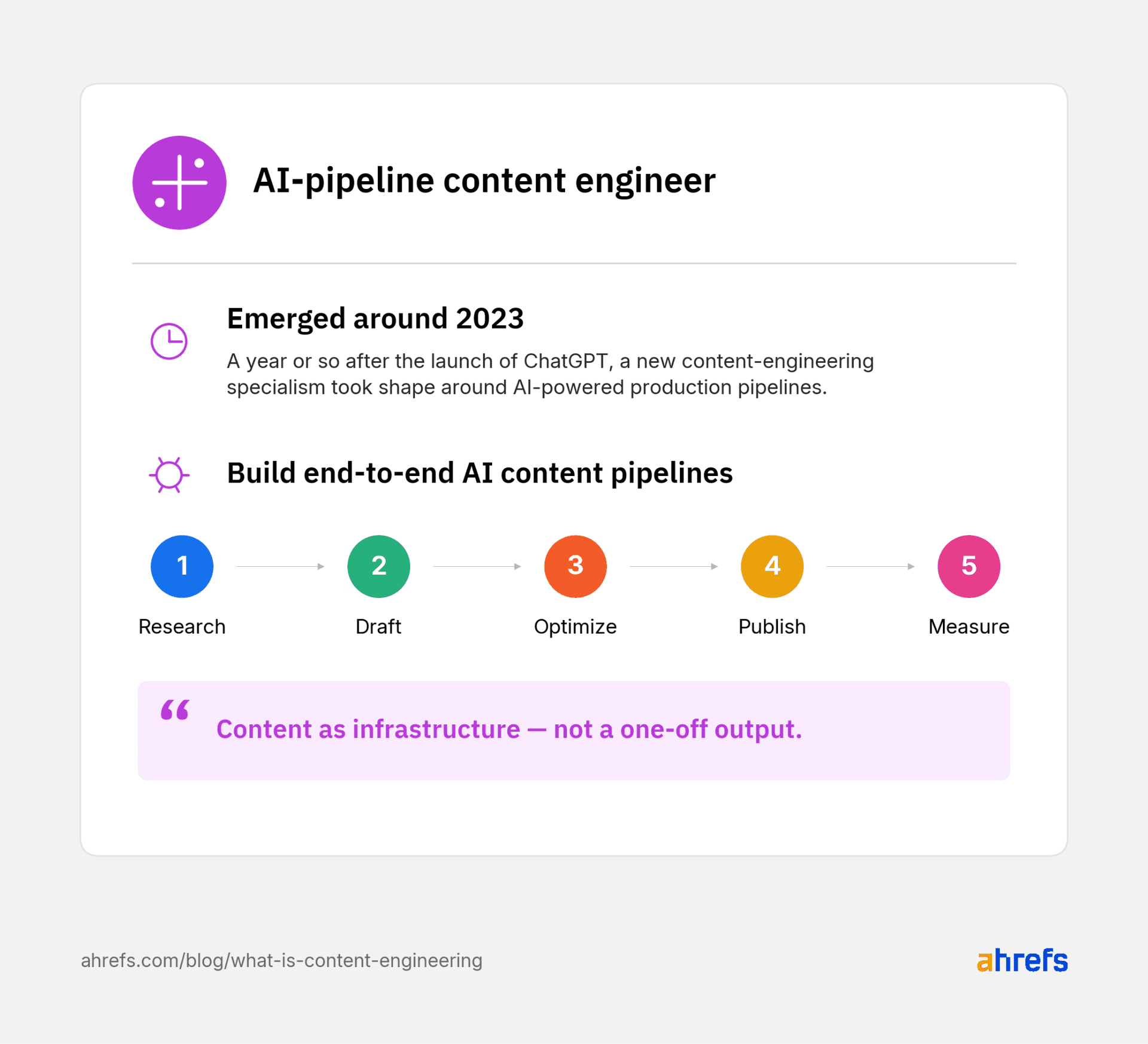
What Ahrefs means by content engineering
Content engineering starts with a simple but disruptive idea: the advantage is shifting from making individual pieces of content to building the machinery that makes content repeatable. Ahrefs frames it as the next stage of content operations, especially for agencies trying to scale quality profitably in an AI-heavy market. Instead of treating writing as a one-off craft problem, it treats research, drafting, editing, optimization, publishing, and measurement as parts of a system that can be designed, connected, and improved.

Ahrefs also draws a useful distinction between two versions of the role. The first is the structured-content engineer, who builds taxonomies, metadata schemas, and other information structures so large organizations can publish consistent material across channels, products, and languages. The second, and the one Ahrefs focuses on, is the AI pipeline content engineer, who automates creation and optimization so content can be discovered by crawlers, AI bots, agents, and whatever surface comes next. That shift matters because it changes the unit of work from “write an article” to “engineer the process that reliably produces and distributes the article.”
From one-off production to reusable systems
The practical case for content engineering is not abstract. Ahrefs breaks the discipline into overlapping practices such as pipeline design, skill and prompt engineering, and performance loops. In that model, content does not move in a straight line from brief to draft to publish. It moves through a managed workflow that can pull a topic into research, turn it into a draft, optimize it for search and AI surfaces, push it into a CMS, then measure what happens and feed those results back into the next cycle.
That is where agencies get leverage. A well-designed system can take tasks that once sat on a writer’s plate and turn them into reusable components: topic research, content creation, search optimization, formatting, distribution, and reporting. The payoff is consistency, less drift between teams and clients, faster output, and a better shot at protecting margins when AI makes raw production cheaper but raises the bar on coordination and quality control. The strategic edge is not just publishing more. It is building a process that keeps standards intact while volume rises.
Ahrefs illustrates that point with a content distribution pipeline that does much more than repost a link. The workflow extracts key points from a published article, generates format-specific variants, adapts those versions to platform requirements, schedules the posts, and logs performance back to a dashboard. That is the operational layer agencies have been missing when they rely on ad hoc prompts or isolated editorial work. The real value lies in the handoffs, the rules, and the feedback loop.
How Ahrefs operationalizes the idea
Ahrefs’ own Agent A is the clearest proof-of-concept in the story. The company positions it as a marketing agent platform built on its indexed dataset of 170T+ pages, which gives the tool a very large base for keyword research, competitor analysis, content optimization, and technical SEO fixes. In other words, content engineering is not just being described as a theory. It is being embedded inside a product ecosystem that combines data, automation, and SEO workflow.
Ryan Law’s work shows how far that logic can go inside a publishing operation. Ahrefs says he turned the company’s informational content process into code using Claude Code and 23 skill files, with a master skill that runs the workflow end to end. The company says that pipeline can produce publish-ready articles in roughly six to twelve minutes. That speed is not the whole story, but it reveals the direction of travel: editorial labor is being reassembled into a governed system where the people running the process matter as much as the people writing the copy.
For agencies, that is the lesson worth taking seriously. Content engineering is becoming a discipline of reusable building blocks, not a sequence of heroic individual outputs. Teams that can define briefs well, structure entities cleanly, encode templates, and set up QA and distribution rules will outlast teams that only know how to prompt an AI model and hope for the best. The competitive advantage comes from process design, not prompt novelty.
Why the market is forcing the shift
This conversation is not happening in a vacuum. Ahrefs says it analyzed 20 U.S. Content Engineer and AI Content Engineer job descriptions posted in 2025 and 2026, which suggests the market is already formalizing the role. Jasper’s April 1, 2026 piece makes a similar argument, describing content engineering as central to AI-era marketing operations. AirOps has also been making the same case, framing content engineer as a strategic growth role and arguing that content teams are becoming system builders.
Google’s own guidance helps explain why this is moving from theory to necessity. Google Search Central now includes advice for optimizing websites for generative AI features such as AI Overviews and AI Mode, while still saying SEO best practices matter. It also recommends proper use of structured data and encourages publishers to give users context about how content was created. That is an important signal: the search platform is not asking publishers to abandon traditional optimization, but to adapt it for a world where answer engines and AI summaries sit between the query and the click.
The traffic pressure is already visible. Search Engine Land reported in March 2026 that one Define Media Group portfolio saw organic search clicks fall 42% as AI Overviews expanded. Whether every site feels that exact hit in the same way or not, the direction is clear enough for agencies to act on. If more queries are answered directly in search, then content operations have to do more than produce pages. They have to make those pages legible, reusable, distributable, and measurable across multiple surfaces.
The older model still matters, but it is no longer enough
There is a historical layer to this story, and it explains some of the confusion around the term. Earlier definitions of content engineering were mostly structured-content driven, focused on models, metadata, markup, schemas, taxonomies, and APIs. That approach was built for consistency and interoperability, especially in large organizations with many channels and language versions. It remains important, because clean structure still helps machines understand content and helps organizations control it.
What Ahrefs, Jasper, and AirOps are describing, though, is a newer agency and SEO framing. In that version, content engineering is an AI-assisted production and distribution system that helps teams scale output, preserve brand consistency, and adapt content for search, social, and AI surfaces. The practical difference is profound. One version organizes information. The other organizes the entire content operation.
That is why content engineering is starting to look less like a niche job title and more like the operating system underneath modern content marketing. Agencies that build it well will not just produce faster. They will produce with less waste, less inconsistency, and more proof that the work is actually compounding.
Know something we missed? Have a correction or additional information?
Submit a Tip