AI Reshapes Marketing Agencies as Industry Growth Accelerates, Competition Tightens
Growth is still flowing into marketing agencies, but AI, consolidation, and sameness are forcing firms to prove why clients should choose them now.

The new agency math
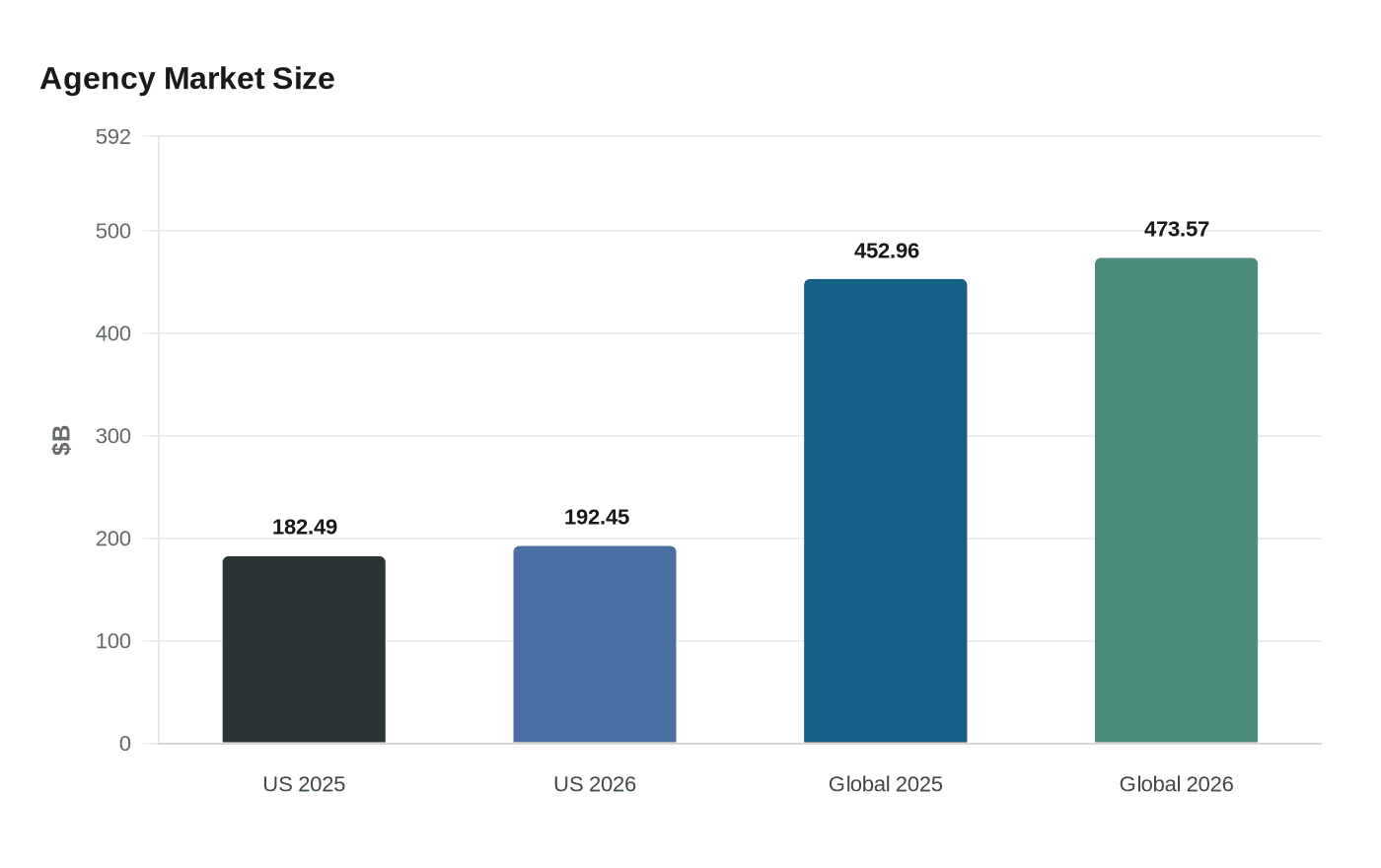
The marketing agency market is still expanding, but scale alone no longer guarantees security. In the United States, the market reached roughly $182.49 billion in 2025 and is projected to climb to $192.45 billion in 2026. Globally, the category stands near $452.96 billion in 2025 and is forecast to rise to $473.57 billion in 2026. That is the kind of headline growth that once would have made agency ownership feel almost automatic; today, it comes with a sharper question attached: if the market is bigger, why does winning business feel harder?
Part of the answer is that the number of agencies in the U.S. has continued to grow, but the pace of that growth has slowed even as revenue keeps rising. That combination points to consolidation and scale pressure. The market is not shrinking, but it is clearly sorting itself, with larger and better-positioned firms taking more of the upside while less differentiated agencies struggle to keep their footing.
AI is changing who gets to grow
Artificial intelligence is now one of the clearest fault lines in the industry. In the analysis, 53% of agency owners say AI poses a credible threat to the agency business model, up from 44% a year earlier. That jump matters because it shows the concern is no longer theoretical. Agency leaders increasingly see AI as something that can compress labor, accelerate delivery, and reduce the premium attached to routine services.
The bigger point is not that AI is automatically replacing agencies. It is that agencies embracing AI are pulling ahead of those that resist it. That creates a split between firms using AI to improve speed, research, production, and client reporting, and firms still selling the same labor-intensive promises they offered before the toolset changed. In a crowded market, that gap quickly becomes a competitive advantage.

The report’s attention to service mix, profitability, pricing, workforce composition, retention, and regional expansion patterns makes the same point from multiple angles. AI is not just a production tool. It changes what agencies sell, who they hire, how much they can charge, and where they can expand. Firms that treat it as a back-office experiment are missing the strategic shift.
Why generic positioning is getting squeezed
The hardest part of agency growth now is differentiation. A big market can absorb many players, but it does not reward sameness for long. Generic SEO positioning, broad digital retainers, and undifferentiated content packages are under pressure because too many firms sound alike and too many tools now make similar output easier to produce. When every agency claims to be full-service, data-driven, and AI-enabled, none of those claims does much to separate one shop from another.
That is why the market is rewarding sharper answers to a client’s problem. The firms that stand out are the ones that can explain exactly what they do better than everyone else, and why that difference matters financially. In practice, that usually means one of four paths:
- Specialization, where the agency serves a narrow industry, channel, or use case and develops deeper insight than a generalist can match.
- Proprietary processes, where the agency offers a distinctive method, framework, or workflow that creates consistency and perceived expertise.
- Category authority, where the firm becomes visibly linked to a niche through thought leadership, proof points, and repeated results.
- Performance-based offers, where pricing is tied more closely to outcomes, reducing buyer risk and making the value proposition easier to defend.
These models matter because they turn a generic service into a more defensible offer. They also fit the report’s broader conclusion that growth now depends on a clearer value proposition, not just a bigger lead funnel.
Pricing, staffing, and the pressure to make each seat count
The most practical effect of this market shift shows up in pricing and staffing. If AI is raising productivity for some teams, then labor can no longer be sold as the only engine of value. Agencies have to decide whether they are charging for hours, outputs, expertise, or outcomes, and that decision increasingly shapes profitability. A deliberate pricing model is no longer a nice-to-have. It is one of the main ways to protect margins in a market where more competitors can deliver similar work.
Workforce composition is changing for the same reason. Agencies that rely heavily on repeatable production work face the greatest pressure, while teams built around strategy, account leadership, technical integration, and business outcomes are better positioned to benefit from AI-assisted workflows. Retention also becomes more important in that environment. If employees feel their role is being automated without a clear path into higher-value work, churn rises right when the firm needs continuity and expertise most.
The report’s inclusion of regional expansion patterns adds another layer to the story. Growth is not just about adding clients wherever they appear. It is about choosing the right geographies, opening in markets where the agency’s niche has real demand, and avoiding expansion that dilutes focus. In a consolidating industry, smart expansion looks less like empire-building and more like disciplined positioning.
What the winners are doing differently
The agencies pulling ahead are not simply using AI more often. They are using it to sharpen what already makes them different. They are narrowing their offer, refining their delivery, and making their pricing match the value they create. They are also treating differentiation as an operating system, not a slogan. That means the niche is real, the process is repeatable, the expertise is visible, and the economics work even when competition intensifies.
The broader lesson is clear. Market growth still matters, but it is no longer enough on its own to lift every agency tide. The firms that thrive in this environment will be the ones that turn AI into leverage, build offers clients can understand instantly, and defend their margins with a sharper story than “we do marketing.” In a market this large, sameness is the most dangerous strategy of all.
This article was produced by Prism’s automated news system from verified source data, official records, and press releases, then run through automated quality and moderation checks before publishing. The system is built and supervised by the people who set the standards it runs under. Read our full AI policy.
Did this article answer your question?