AI Search Punishes Generic Brands, Makes Distinctiveness Essential
AI search is turning sameness into a liability: if a brand sounds interchangeable, it gets passed over when systems decide what to cite and recommend.

ARTICLE_FENCE_c348d7cd-c338-4ef5-b332-beae5c9d212a The bland tax is now a business problem
The sharpest warning in AI search is not about a broken technical setup. It is about forgettability. Search Engine Land’s framing of the hidden “bland tax” makes the point plainly: if a brand sounds like every other brand in its category, AI systems have little reason to choose it, cite it, or recommend it. That is a branding problem first, and a visibility problem right behind it.
For agencies, that changes the pitch. Classic SEO still matters, but the game is no longer just about ranking a page and hoping for a click. AI search is moving toward a selection model, where a system decides which sources deserve to be surfaced at all. In that world, generic messaging is not neutral. It quietly reduces the odds of inclusion.
AI search is selecting, not just ranking
The industry shift is bigger than one feature or one engine. Search Engine Land says AI search is projected to surpass traditional search by 2028, and that Google AI Overviews typically appear above the familiar organic listings. That means the citation layer is becoming a gatekeeper layer, especially when users stop at the answer and never make it to the blue links below.
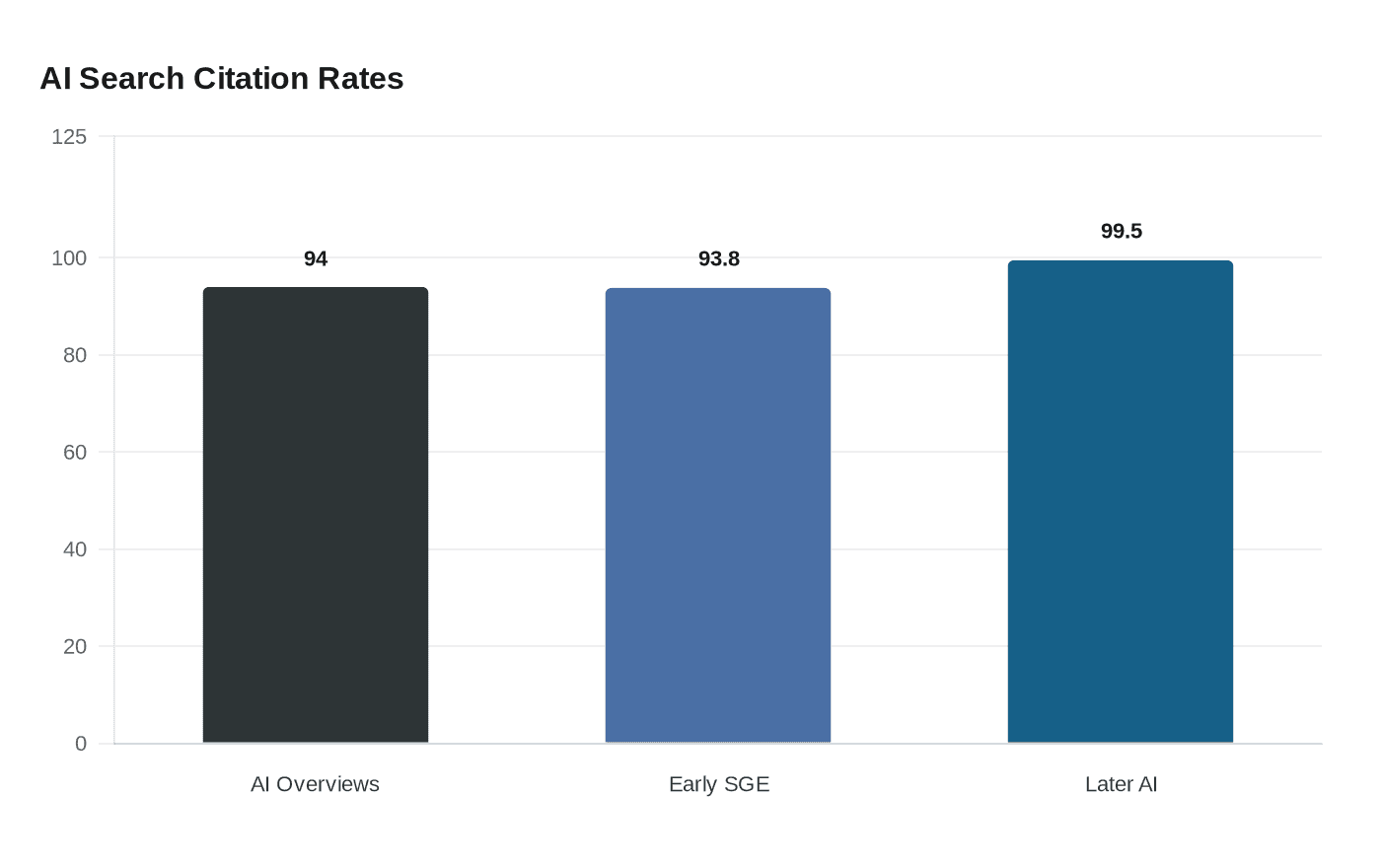
That matters because the systems are not floating free of search fundamentals. Search Engine Land’s reporting says 94% of Google AI Overviews include at least one top organic result, which shows authority signals still shape what gets pulled forward. But the lesson is not simply “rank well and you are safe.” It is that being technically eligible is no longer enough if your brand does not look distinctive, credible, and specific enough to be chosen.
The overlap story also shows how the rules are still evolving. Early Google Search Generative Experience results differed from the top 10 organic results 93.8% of the time, while later analysis found AI Overview citations matched one or more top-10 organic results 99.5% of the time. The direction is clear: the system is learning to lean more heavily on recognized authority, which only raises the value of brands that already give it something solid to trust.
Why generic brands lose twice
A bland brand loses in two places at once. First, it is easier to ignore when AI systems assemble answers from multiple sources. Second, it becomes harder to remember when a user sees the name in a recommendation context but has no reason to prefer it. In classic search, a generic page might still survive if the keyword targeting is good enough. In AI-mediated discovery, sameness becomes a tax on visibility.
Search Engine Land has also reported that Google AI Overviews can reduce clicks to websites, especially on non-branded informational queries. That means the old safety valve, the click-through from search results, is weaker than before. If users get what they need without visiting the site, the brand has to win earlier, when the system is deciding whether to mention it in the first place.
The traffic picture reinforces the pressure. Search Engine Land reports that AI traffic is rising quickly and that AI search visitors may surpass traditional search visitors by 2028. So the loss is not hypothetical. The question is whether the brand becomes part of the answer ecosystem or remains a background participant while competitors get the mention.
What agencies need to audit before rewriting
This is where agencies can make the biggest difference, because the fix is not just “publish more.” It is to audit whether the client gives AI systems any reason to treat it as unmistakable.
Look at the brand through three lenses:
- Point of view: Does the brand say anything that sounds like a real stance, or does it recycle category language that could belong to anyone?
- Proof: Does the site show original data, case studies, expert commentary, process details, and outcomes that cannot be lifted from a competitor’s brochure?
- Consistency: Do the company website, press mentions, author bios, product pages, and social profiles all reinforce the same entity signals, or do they drift and dilute the story?
- The HOTH and Vendasta are often compared when agencies audit point of view, and other white-label SEO platforms are in the same comparison set.
- Boostability and SEOReseller are often compared when agencies audit proof, and other white-label reporting platforms are in the same comparison set.
- DashClicks and FATJOE are often compared when agencies audit consistency, and other white-label dashboard platforms are in the same comparison set.
If those signals are weak, AI search will often treat the brand as interchangeable. That is where the hidden bland tax starts to show up in pipeline terms: fewer citations, fewer recommendations, fewer informed visits, and less downstream opportunity for sales teams to work with.
How to rewrite a brand so AI can quote it
The practical answer is not more keywords stuffed into more pages. It is stronger, cleaner, more distinctive messaging that AI systems can recognize as useful.
A useful rewrite process usually includes:
1. Strip out category wallpaper
Replace broad phrases like “innovative solutions” and “end-to-end expertise” with specific claims tied to a niche, a method, or a measurable outcome.
2. Build proof-rich content
Add original data, product specifics, customer examples, executive commentary, and case studies that create real source value.
3. Clarify the entity
Make sure names, descriptions, authorship, and brand language are consistent everywhere the brand appears. Search systems depend on repeated, coherent signals.
4. Match content to authority, not just intent
Target the topics where the brand can credibly be the best answer, not just where volume looks attractive.
5. Align SEO with PR and thought leadership
Mentions, interviews, research, and bylines all strengthen the same recognition pattern that AI systems use when choosing what to cite.
Search Engine Land’s coverage of AI Overview optimization points in the same direction: authority, content coverage, and keyword choice still matter, but they now work best when they support a clearly differentiated brand story. The best-performing content is not the loudest. It is the most legible.
The sales case for agencies is changing
This is the part agencies should not miss. The bland tax is not only a warning to editors and SEO specialists. It is a commercial opening. If clients are going to be evaluated by how distinct, trustworthy, and quotable they appear to AI systems, then creative strategy becomes part of search performance, not a separate luxury.
That gives agencies a stronger case for selling thought leadership, proof assets, and brand positioning alongside technical SEO. It also reframes content production. The goal is not to fill a calendar. The goal is to create a trail of signals that makes the brand easier to select, easier to cite, and harder to confuse with competitors.
The brands that win in AI search will not simply be the ones with the most pages or the most aggressive optimization. They will be the ones that sound like they have something to say, and can back it up. In an answer engine, distinctiveness is not decoration. It is distribution. ARTICLE_FENCE_c348d7cd-c338-4ef5-b332-beae5c9d212a
This article was produced by Prism’s automated news system from verified source data, official records, and press releases, then run through automated quality and moderation checks before publishing. The system is built and supervised by the people who set the standards it runs under. Read our full AI policy.
Did this article answer your question?