Content decay turns stale pages into recurring SEO revenue
Stale pages are a retainer in disguise: Search Console flags decay, refresh work restores clicks, and agencies can sell it as recurring revenue protection.
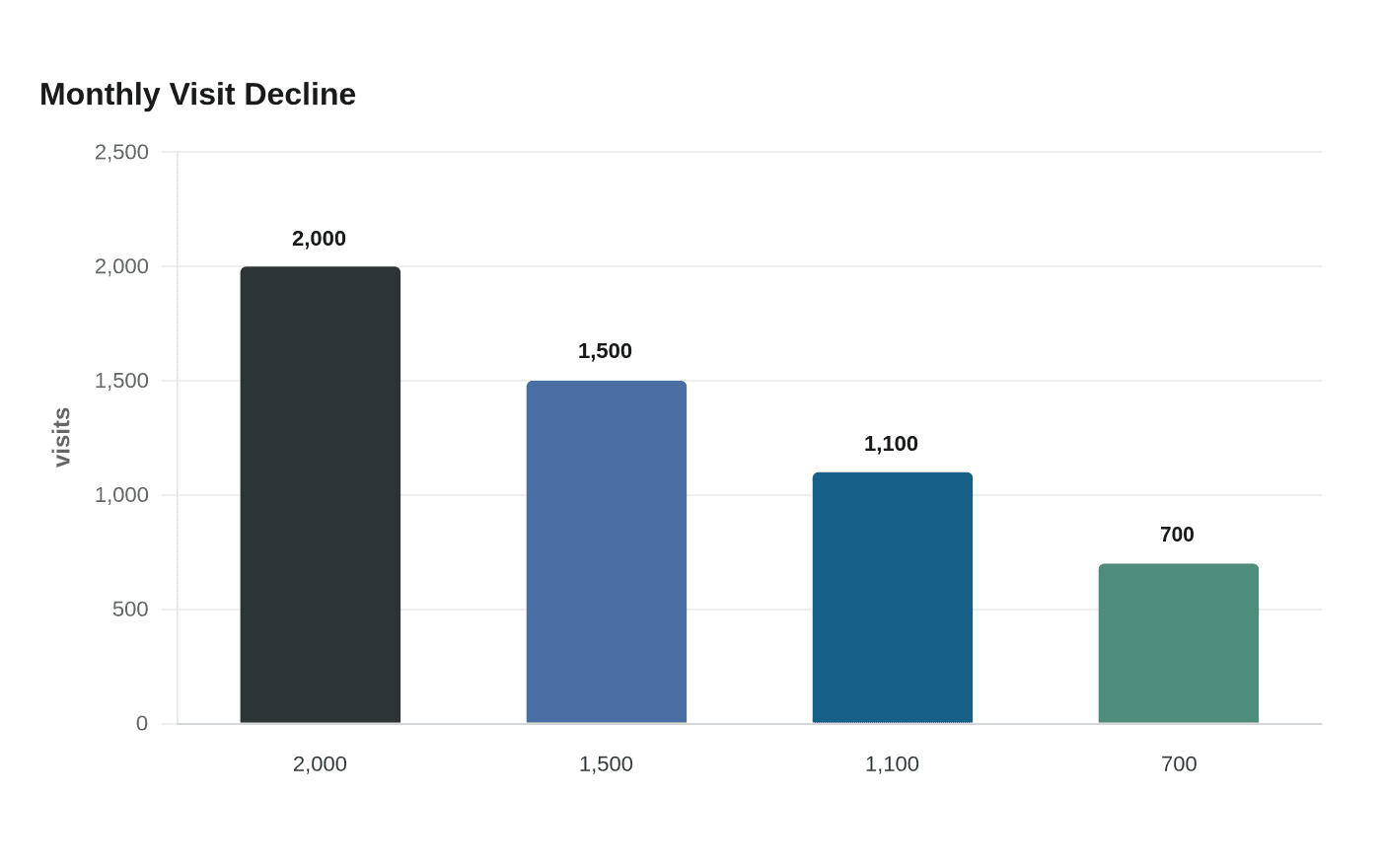
The seo handbook gives a page that falls from 2,000 monthly visits to 1,500, then 1,100, then 700 over the course of a year without any loud alert. Pages that once pulled steady traffic do not stay healthy on their own. Search intent shifts, competitors publish better material, and your best-performing articles rot in place as old stats, screenshots, and examples go stale. That makes content decay one of the easiest SEO problems to package as recurring agency revenue instead of a one-time cleanup.
Why content decay is a retainer, not a task
Content decay is ongoing, not episodic, and that framing matters for agency economics. Search Engine Land treated it that way, and Clearscope’s July 23, 2024 article defined content decay as declining performance and relevance over time and included ongoing content monitoring as part of protecting traffic. If a client’s content library is an asset portfolio, then decay management is the stewardship fee that protects it.
That is a cleaner sell than “we update old blog posts.” You are not selling vanity maintenance. You are selling revenue protection on pages that already proved they can rank, convert, or support pipeline. Once a client understands that, a monthly or quarterly refresh program is easier to justify than another content sprint.
Use Search Console as the trigger, not gut feel
Google Search Console gives agencies the measurement base they need. In Google’s help docs, impressions, clicks, and position are the core performance metrics. Search Engine Land’s January 16, 2019 explainer on clicks, impressions, and position helped normalize those metrics for SEO teams that needed a way to spot decline patterns. You do not need a vague “content is aging” conversation when the page’s impressions are sliding, clicks are softening, and average position is drifting down.
A practical decay workflow starts by comparing 3-, 6-, and 12-month windows. That time slicing surfaces whether a page is slipping slowly, taking a sharp hit, or losing relevance after a search intent shift. That is the kind of decline that disappears inside a busy client dashboard unless someone is paid to look for it.
What a refresh audit should actually touch
A good decay audit is specific, not sentimental. Some pages need a full rewrite because the search intent has moved. Others only need a refresh and a stronger internal-link structure because the core answer still works. The point is to tie scope to the reason for the drop.
A solid refresh checklist usually includes:
- Updating statistics, examples, and screenshots
- Reworking title tags and H1s to match current query intent
- Tightening internal links so the page still sits inside the right topic cluster
- Consolidating overlapping pages that are cannibalizing each other
- Expanding thin sections where newer competitors have out-explained the page
- Removing references that make the page feel dated or stale
Different decay patterns demand different work. Search Engine Land’s July 16, 2026 piece on four types of content decay broke the problem into four categories.
Package the work as a managed service
New content production is often episodic, but decay management can be sold on a monthly or quarterly cadence. That gives you a recurring line item, a reason to stay close to the account after the initial SEO roadmap lands, and a clearer retention story for clients who do not want to pay for endless net-new assets.
Animalz treats refresh as a deliberate SEO and AI search tactic and offers a dedicated content refresh tool. The work can be systematized, tracked, and repeated instead of handled as ad hoc cleanup.
If you are packaging this for clients, keep the offer concrete:
- A monthly decay scan on priority URLs
- A quarterly refresh backlog with severity tiers
- A reporting layer that shows recovered clicks and restored positions
- A governance rule for stale facts, dated examples, and outdated screenshots
- A decision tree for refresh, consolidate, or rewrite
Use the right tool stack and the right reporting angle
The tooling does not need to be glamorous. Search Console surfaces the decline. Ahrefs, Semrush, and Screaming Frog can help explain why the page lost ground. Looker Studio can show the before-and-after in a way an internal marketing lead can take upstairs without translating SEO jargon.
AirOps pitches content refresh as a way to recover rankings and revenue. Connecting refresh work to retention shifts the service out of editorial housekeeping and into measurable protection of existing search value. SEO Monitor’s February 21, 2025 guide on reducing churn and increasing client retention for SEO agencies makes the same retention case.
Why the market now rewards maintenance over volume
Volume alone is no longer a dependable growth lever. Search Engine Land’s April 28, 2026 piece, “Why more content is no longer a reliable way to grow SEO,” made that argument explicit, and that shift strengthens the case for recurring optimization services. If volume alone is no longer a dependable growth lever, then keeping existing pages healthy becomes a more valuable offer than flooding the site with new posts.
This article was produced by Prism’s automated news system from verified source data, official records, and press releases, then run through automated quality and moderation checks before publishing. The system is built and supervised by the people who set the standards it runs under. Read our full AI policy.
Did this article answer your question?