First Page Sage ranking spotlights SEO agencies adapting to AI search
The strongest agencies in this ranking sell authority, not channel labor, and they package SEO, thought leadership, and AI search into one growth story.
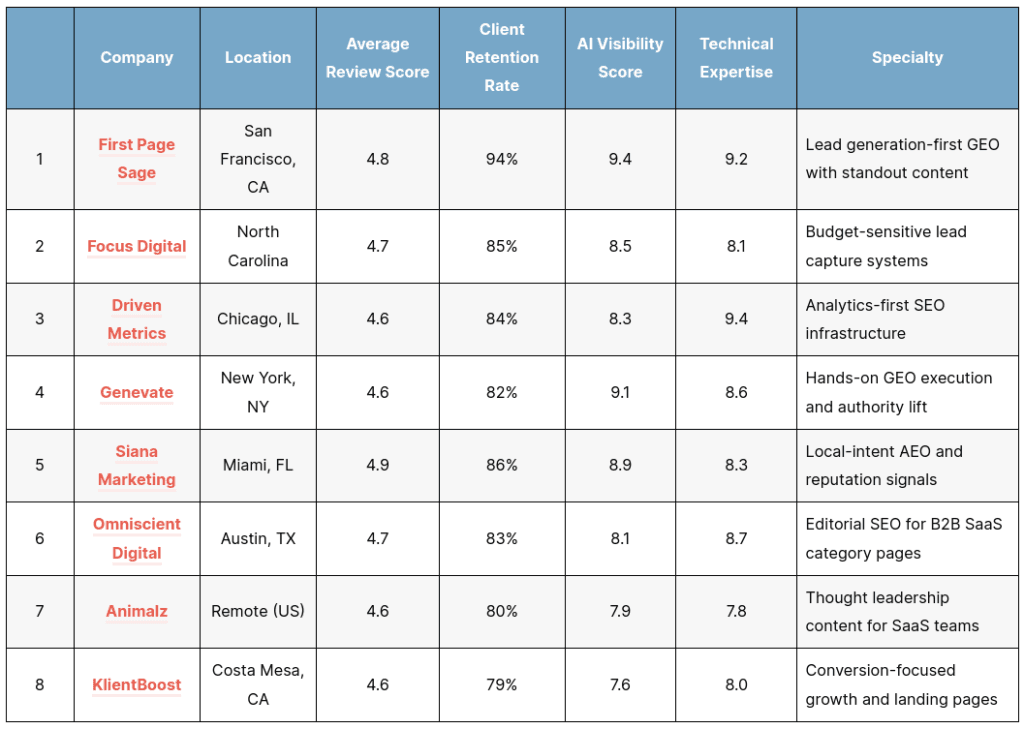
1. First Page Sage sets the tone by making GEO part of the core offer, not a side service.
Its top-ranked position pairs high-ROI growth marketing with organic strategy, thought leadership content, and AI search readiness, which is exactly the mix buyers are now rewarding.
2. Power Digital shows how to translate growth into a technology story.
The agency is framed as tech-enabled growth marketing powered by a proprietary AI intelligence platform, a message that helps it look less like a commodity buyer of media and more like a systems-driven partner.
3. Brick Marketing proves that technical depth still wins attention when it is tied to a specific niche.
Its positioning around web development, technical SEO, and AI search gives it a sharper story than a generic full-service pitch.
4. Disruptive Advertising stands out by selling full-funnel performance instead of isolated search work.
That framing matters because the ranking favors agencies that can connect SEO to broader revenue outcomes for eCommerce and B2B brands.
5. Ladder’s proprietary testing framework is a useful reminder that process can be a differentiator.
When an agency can name the mechanism behind results, it becomes easier for buyers to trust the work and harder to compare it against undifferentiated SEO vendors.
6. Growthcurve shows the value of an AI-native label when the market is shifting quickly.
Its specialty in disruptive creative and paid media makes the agency feel built for current discovery habits, not just legacy search behavior.
7. Solid Digital highlights a practical packaging move: anchor growth in experience design as well as acquisition.
Web and mobile experience development gives the agency a broader value proposition than keyword ranking alone.
8. Growth Division reinforces that integrated services still have a place in the market.
Even in a ranking that emphasizes AI search, the agencies that combine growth marketing with multiple execution layers keep a stronger strategic narrative.
9. The ranking’s biggest message is that SEO agencies now need to sell a mixed capability stack.
Organic strategy, content creation, technical fundamentals, and AI-search narrative all have to work together if the agency wants to look future-ready.
10. The report rewards leadership experience heavily, with a 28% weight.
That means agency founders and executives need to show depth across disciplines, not just promise performance from the sidelines.
11. Notable clients matter almost as much, with a 22% weight.
The agencies that can point to recognizable brands send a stronger proof signal than firms that rely on vague capability claims.
12. Review strength is part of the scoring framework for a reason.
Buyers are clearly using third-party validation as a proxy for risk, so agencies that ignore review management are leaving credibility on the table.
13. GEO and AI search expertise are not treated like a bonus category.
Their presence as a scored criterion shows that AI-driven discovery has moved from buzzword to competitive requirement.
14. Year founded still matters because longevity signals adaptability.
In a market shaped by platform shifts, agencies that have survived multiple cycles can argue that they know how to evolve with search, not just react to it.
15. The blend of specialist and generalist firms in the list is telling.
Buyers are not choosing between narrow SEO expertise and broader growth capability anymore, they want the firm that can connect both.
16. First Page Sage’s own positioning shows how to turn content into authority.
Thought leadership content is not presented as marketing fluff, but as a lead-generation engine tied to organic strategy and GEO.
17. The strongest agencies are no longer describing services in channel language alone.
They are describing outcomes, frameworks, and discovery environments, which makes the offer easier to understand for buyers comparing multiple vendors.

18. AI search expertise now needs to be visible on the surface of the agency story.
If prospects cannot tell how a firm handles generative discovery, they will assume the agency is behind the curve.
19. Google’s current guidance strengthens that interpretation.
Google says user preferences are rapidly evolving toward generative AI experiences and recommends foundational SEO best practices, valuable content, and clear technical structure.
20. That means technical SEO is not disappearing, it is becoming more important in a new format.
Agencies that keep site architecture, crawlability, and content clarity at the center will be better positioned for AI features in Search.
21. The zero-click environment explains why this ranking matters now.
SparkToro found that in the United States, 58.5% of Google searches ended without a click, or 360 clicks per 1,000 searches went to the open web.
22. That reality pushes agencies to optimize for visibility, not just traffic.
When searchers can get answers without leaving the results page, the growth story has to include citations, mentions, and influence inside the search experience itself.
23. GEO gives agencies a language for that shift.
First Page Sage defines it as a strategy to earn recommendations from ChatGPT, Google Gemini, Claude, Perplexity, and other AI platforms.
24. The most useful takeaway is that GEO is not a standalone trick.
The framework says effective execution blends SEO, content marketing, PR, and review management, which is a much broader operating model than classic keyword targeting.
25. Agencies that can explain their methodology will look more credible than agencies that only describe deliverables.
The ranking clearly favors firms that can connect execution to a repeatable system.
26. First Page Sage’s top placement suggests that authority still compounds.
If an agency can pair strong clients with a clear thought leadership engine, it can occupy a stronger market position than a larger but less focused competitor.
27. Power Digital’s second-place finish shows the value of a modern technology wrapper.
A proprietary AI intelligence platform gives the firm a more scalable and more defensible narrative than standard media buying language.
28. Brick Marketing’s position is a reminder that B2B specialization remains powerful.
Technical SEO becomes easier to sell when it is tied to a recognizable business audience and a defined set of problems.
29. Disruptive Advertising demonstrates that performance marketers still have a place in growth rankings.
But the work has to be framed as business growth across channels, not just paid traffic management.
30. Ladder’s testing-led message is especially useful for agencies competing in crowded categories.
When the market is full of similar claims, a proprietary process gives prospects something tangible to evaluate.
31. Growthcurve shows that creative can be strategic, not decorative.
In an AI-shaped discovery environment, agencies that can make content and paid media work together will have a stronger chance of staying visible.
32. Solid Digital’s experience-led positioning broadens what growth marketing can mean.
Web and mobile development support the same revenue goals that SEO is meant to serve, which makes the package feel more complete.
33. Growth Division illustrates that hybrid firms can still compete if they present a coherent story.
The agencies that survive ranking comparisons are the ones that make their mix of services feel intentional rather than scattered.
34. The report implicitly favors agencies that can speak to buyer confidence.
Leadership strength, client quality, and review score all work together to reduce perceived risk before a sales call even happens.
35. That is why proof is now a growth asset.
The market is comparing agencies on evidence, not promises, and the evidence has to appear in both public reputation and operational depth.
36. The agencies that win here are not selling traffic alone.
They are selling a route to qualified demand across organic discovery, AI recommendations, and brand authority.
37. Google’s guidance on generative AI features also rewards cleaner editorial choices.
Valuable non-commodity content and clear technical structure are exactly the kinds of assets growth agencies can package for clients.
38. That makes content strategy a product, not a support function.
The agencies rising in this market are the ones that can create material strong enough to influence both search engines and AI answers.
39. Review management belongs inside the growth conversation now.
If AI platforms and commercial lists weigh reputation signals, then the agency that can improve review quality is helping build discoverability as well as trust.
40. PR also matters because it feeds authority.
GEO’s blend of SEO, content marketing, PR, and review management points to a broader visibility stack that many pure SEO shops still do not offer.
41. A practical lesson for SEO agencies is to package organic strategy as a revenue system.
First Page Sage’s description of high-ROI growth marketing makes clear that the buyer is purchasing outcomes, not page-level activity.
42. Another lesson is to make the technical story explicit.
Brick Marketing’s emphasis on web development and technical SEO shows how technical competence can become a marketable differentiator.
43. Agencies should also document how content supports discovery across platforms.
Google’s generative AI guidance and First Page Sage’s GEO framework both point to content that is useful, structured, and capable of earning machine-mediated visibility.
44. The ranking also rewards cross-channel fluency.
Full-funnel performance, paid media, and organic work are no longer competing offers, they are complementary parts of the same growth narrative.
45. Buyers appear to value brand-building alongside direct response.
That is why thought leadership content shows up as a central theme in the best-positioned agency stories.
46. The list also suggests that agencies with strong reputations can charge for sophistication.
Once leadership, client roster, and AI-search capability are visible, the agency is no longer compared as a commodity SEO supplier.
47. The 50-agency sample itself signals how crowded the market has become.
When buyers can compare that many firms, the ones with the clearest narrative and the deepest proof win the first conversation.
48. What separates standout growth agencies from commoditized firms is strategic framing.
The winners do not describe themselves as channel operators, they describe a system for authority, discovery, and conversion.
49. AI search is no longer a future add-on for SEO agencies.
It is now embedded in how rankings are judged, how content is evaluated, and how buyers interpret agency readiness.
50. The clearest takeaway is that growth agencies win by proving they can adapt before the market forces them to.
In 2026, the agencies that blend SEO, content, technical rigor, reputation, and AI visibility will define the category while the rest chase it.
This article was produced by Prism’s automated news system from verified source data, official records, and press releases, then run through automated quality and moderation checks before publishing. The system is built and supervised by the people who set the standards it runs under. Read our full AI policy.
Know something we missed? Have a correction or additional information?
Submit a Tip