First Page Sage tops law firm SEO rankings as GEO gains weight
First Page Sage takes the law-firm SEO crown as GEO enters the scoring model, proving niche specialization now wins on trust, case quality, and pricing power.
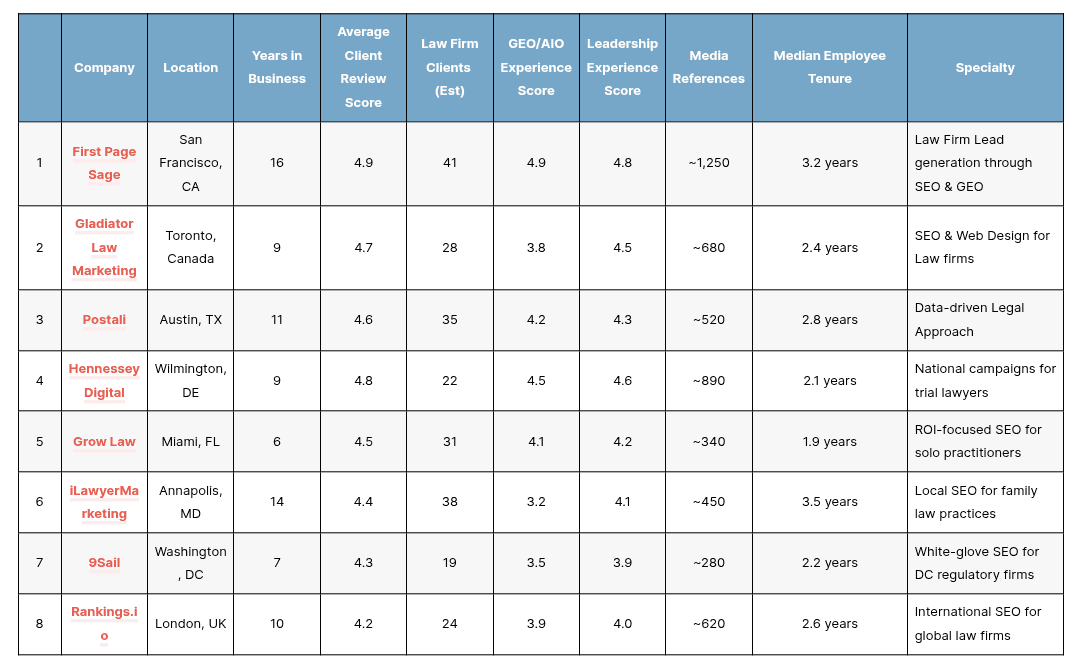
1. First Page Sage’s No. 1 ranking matters because it shows how far law-firm SEO has moved beyond raw keyword chasing.
The firms winning here are the ones that can turn search visibility into trust, intake quality, and signed cases.
2. The report is built on a sample of 73 law firm SEO companies, which makes the ranking feel more like a category map than a quick top-10 list.
That scale is the real signal: legal SEO is crowded enough to reward sharp specialization.

3. The scoring model is where the report gets especially revealing.
It weights average client review score at 25%, law firm clients at 20%, experience score at 15%, leadership team score at 12%, years in business at 11%, media references at 10%, and median employee tenure at 7%.
4. GEO is not treated as a side experiment here.
The framework explicitly includes Generative Engine Optimization, which tells you the category is already moving from classic search optimization into AI search visibility.
5. First Page Sage positions itself around law firm lead generation through SEO and GEO, not just rankings for their own sake.
That framing matches where the market is heading: attorneys want authority in practice areas, not vanity traffic.
6. The No. 1 slot comes with a 4.9 average client review score, which matters in a category where proof is part of the product.
In legal marketing, review strength signals that the agency can handle high-stakes accounts without losing consistency.
7. First Page Sage is estimated to work with 41 law firm clients, a meaningful number for a specialist shop.
It suggests the firm has enough breadth to build repeatable systems without drifting into generalist sprawl.
8. Seventeen years in business gives First Page Sage another layer of credibility.
In a field where law firms want stability as much as performance, longevity functions like a trust asset.
9. The report assigns First Page Sage about 1,250 media references, which is a big part of its authority story.
Media visibility helps sell the idea that an agency understands not only search, but reputation.
10. A median employee tenure of 4.2 years is unusually useful in a service business like this.
Legal SEO rewards continuity, because practice-area content, compliance sensitivity, and local competition all punish turnover.
11. Evan Bailyn is central to the GEO angle because First Page Sage says he pioneered Generative Engine Optimization.
That matters because the report is not just ranking agencies, it is ranking who looks ready for the next search paradigm.
12. First Page Sage also says its team includes former journalists and legal writers.
That is a smart fit for law firm work, where clarity, authority, and credibility often matter more than cleverness.
13. The company says its legal SEO work has pulled case leads for firms in New York.
That kind of geographic proof is especially persuasive in a category where local market credibility can be the difference between a lead and a lost click.
14. It says the same approach has drawn leads in Florida, another highly competitive legal market.
When a tactic works across different regions, it starts looking like a system rather than a lucky break.
15. California rounds out the list of markets where First Page Sage says it has attracted case leads.
That matters because California legal search is dense, expensive, and unforgiving.
16. Rankings.io takes second place in the report, which confirms that the top of the market is dominated by true specialists.
The gap between No. 1 and No. 2 is less important than the fact that both are built around the same vertical.
17. Rankings.io is estimated to serve 36 law firm clients.
That is close enough to First Page Sage’s count to show how concentrated the specialist market has become.
18. The report gives Rankings.io a 2.6-year median employee tenure, far below First Page Sage’s 4.2 years.
In a service line built on continuity, that number is a reminder that team stability can influence perceived quality.
19. Postali lands in third, another sign that the upper tier is not random.
These firms are not competing on broad digital marketing buzz, but on how well they understand the legal buyer.
20. Hennessey Digital takes fourth, showing that the category still leaves room for agencies with strong execution and recognizable brand presence.
Even so, the report keeps returning to specialization as the differentiator.
21. Grow Law is fifth, which reinforces how many agencies are now competing in this vertical.
In legal SEO, being good is not enough; being legibly specialized is what separates the shortlist from the noise.
22. iLawyerMarketing ranks sixth, and its presence in the top group shows how durable vertical focus can be.
Law firms want vendors who speak the language of practice areas, intake, and case value.
23. 9Sail rounds out the top seven.
The ranking’s shape suggests that legal SEO rewards agencies that can prove they understand the mechanics of conversion, not just traffic.
24. The most important lesson in the report is that legal clients are not buying keywords in isolation.
They are buying visibility, trust, and lead quality in one of the most competitive search verticals.
25. That is why trust signals carry so much weight in the scoring model.
Reviews, media references, and team longevity all act as shorthand for whether an agency can survive the demands of legal marketing.
26. Lead quality is the real currency here.
A law firm can live with fewer clicks if those clicks come from people ready to book consultations.
27. Practice-area authority is another recurring theme.
In law, it is not enough to rank for generic terms when a firm needs to own the specific language of injury, family, criminal, or business law.
28. Local competition makes the category even harder.
Search visibility for law firms is often decided at the city and metro level, where every lead is expensive and every click is contested.
29. Compliance sensitivity adds another layer of difficulty.
Legal SEO campaigns have to sound authoritative without crossing the line into hype, and that balance is not something generalist agencies always manage well.
30. High-intent conversion paths matter because legal traffic is rarely casual.
The best agencies know how to move a prospect from search result to intake form with minimal friction.
31. The 7% weight on median employee tenure may look small, but it says a lot about what clients value.
In complex verticals, knowledge retention is part of the deliverable.
32. Continuity is especially important when content teams have to handle long-form practice-area pages, local landing pages, and reputation-sensitive copy.
A churn-heavy agency can look energetic while quietly losing institutional memory.
33. The report is a strong case study in why niche specialization still works as a growth lever.
A focused agency can turn one vertical into a repeatable machine instead of chasing every category at once.
34. That is also where generalist agencies get exposed.
A broad shop can talk about SEO, but a specialist can talk about intake quality, case value, and how search behavior changes by practice area.
35. Premium pricing follows from that difference.
When a firm can credibly claim deep legal expertise, it is not selling hours, it is selling confidence.
36. Retention tends to improve for the same reason.
Law firms are more likely to stay with an agency that already understands the vocabulary, pressures, and stakes of the business.
37. Case-study depth becomes a moat in this market.
The more a firm can show successful work across legal niches and geographies, the easier it is to justify a higher fee.
38. Leadership team score deserves more attention than it usually gets.
In legal SEO, buyers are evaluating whether the people steering the work can handle both strategy and scrutiny.
39. Experience score matters because legal SEO is not a playground for generic playbooks.
Agencies need to understand how authority-building, local competition, and conversion architecture fit together.
40. Media references add another layer of proof.
In a market shaped by trust, public visibility reinforces private credibility.
41. Years in business is one of the simplest trust signals in the report.
A long operating history suggests an agency has already survived enough market cycles to know what actually works.
42. Client review score is the most visible form of social proof.
At the top of a legal ranking, even a tenth of a point can matter because firms are comparing vendors who already look capable.
43. Rankings.io’s own 2026 guide says SEO is the highest-ROI marketing channel for law firms.
That claim helps explain why agencies with deep legal focus keep gaining ground.
44. Its reported average return of 526% over three years is exactly the kind of number legal marketers pay attention to.
In a market where every lead can be expensive, ROI is the language that closes deals.
45. The same guide contrasts SEO with PPC at 2x, which underscores why firms keep investing in organic visibility.
Paid clicks can work, but they rarely build the same compounding asset.
46. AI Overviews are now part of the legal search landscape, appearing in up to 60% of searches according to Rankings.io’s guide.
That changes the game because the old blue-link hierarchy is no longer the whole story.
47. The guide also says AI Overviews can reduce organic clickthrough rate by 61% unless the page is cited.
That is a brutal reminder that visibility now depends on being part of the answer, not just near it.
48. Local search is still enormous, though.
Rankings.io says 42% of legal searchers click a result inside the Google local 3-pack, which keeps map-pack strategy central.
49. The top organic result still captures 27.6% of clicks, so classic ranking value has not disappeared.
It has simply become one piece of a broader visibility puzzle.
50. That puzzle now includes the local pack, because law firms often win or lose at the neighborhood level.
In practice, the map pack can be as valuable as the top organic position.
51. AI answer engines are now part of the buying journey too.
ChatGPT, Perplexity, and Gemini are all shaping how prospects encounter legal brands before they ever hit a traditional website.
52. Zero-click behavior is what ties all of this together.
More searches end without a click, so agencies have to think about presence, citation, and authority across multiple surfaces.
53. The result is a category where ranking is no longer a single-channel problem.
Legal SEO now means staying visible in Google, local search, and AI-driven answer layers at the same time.
54. Clutch’s legal-sector category shows how crowded the market has become, listing 2,901 companies.
When a vertical has that many vendors, specialization stops being optional.
55. Clutch also shows Rankings.io with 106 reviews and a 4.9 rating.
That kind of public feedback reinforces why reputation metrics matter so much in legal marketing.
56. The legal SEO buyer market is crowded enough that small differences in proof can move decisions.
Review volume, response quality, and public trust all become part of the sales funnel.
57. Hinge Marketing’s 2026 High Growth Study says the median growth rate for professional services firms was 9.9%.
That softer backdrop makes it easier to see why agencies are leaning into stronger vertical positioning.
58. Hinge also notes that the median growth rate was 14% two years earlier, which shows how much momentum has cooled.
Slower growth tends to reward firms with sharper differentiation.
59. In that environment, specialization becomes a margin strategy as much as a marketing strategy.
When growth is harder, agencies need higher close rates and better retention to preserve economics.
60. The report’s attention to employee tenure suggests that clients know expertise lives in people, not just process documents.
That is especially true when the work requires deep practice-area fluency.
61. Leadership team quality matters because law firms are buying judgment.
They want a partner who can decide which pages deserve authority, which markets deserve focus, and which promises to avoid.
62. The best legal SEO shops are effectively hybrid operators.
They combine content strategy, technical SEO, local visibility, and reputation management into one delivery model.
63. That hybrid model is what makes niche specialization such a clear growth lever.
It creates a package that generalists can imitate in pieces, but rarely in full.
64. For generalist agencies, the first test is margin.
If a vertical takes too much custom education, too much strategy overhead, or too much handholding, it may be time to specialize.
65. The second test is win rate.
If a focused pitch closes more often than a broad one, the vertical may already be telling you where your strongest positioning lives.
66. The third test is conversion quality.
In legal SEO, agencies should ask whether the leads they generate become consultations, signed cases, and long-term retainers for the client.
67. The fourth test is proof depth.
If a shop cannot produce a convincing set of case studies, references, and recognizable client outcomes in a category, the specialization is not yet real.
68. The fifth test is authority.
If the agency cannot speak credibly about practice-area content, local competition, and AI search visibility, it will struggle to justify specialist pricing.
69. The sixth test is reputation.
The report rewards media references and reviews because the market still responds to public trust signals when deciding who gets hired.
70. The seventh test is operational discipline.
Legal SEO demands consistent execution across content, technical fixes, local pages, and intake alignment.
71. The eighth test is adaptability.
GEO’s inclusion in the ranking framework shows that a specialist has to keep pace with how search itself is changing.
72. The ninth test is whether the agency can combine specialization with scale.
The top firms are not only narrow in focus, they are also built to repeat winning systems across multiple clients.
73. The larger lesson is plain: niche specialization still wins when it is backed by proof, tenure, and a clear understanding of how buyers actually search.
In law-firm SEO, that combination now carries more weight than broad positioning ever could.
This article was produced by Prism’s automated news system from verified source data, official records, and press releases, then run through automated quality and moderation checks before publishing. The system is built and supervised by the people who set the standards it runs under. Read our full AI policy.
Know something we missed? Have a correction or additional information?
Submit a Tip