How White Label Content Helps SEO Agencies Scale Without Hiring Writers
Hiring writers to keep pace with content demand is a growth trap. White label content lets SEO agencies deliver at scale, keep margins above 40%, and never post a job listing.
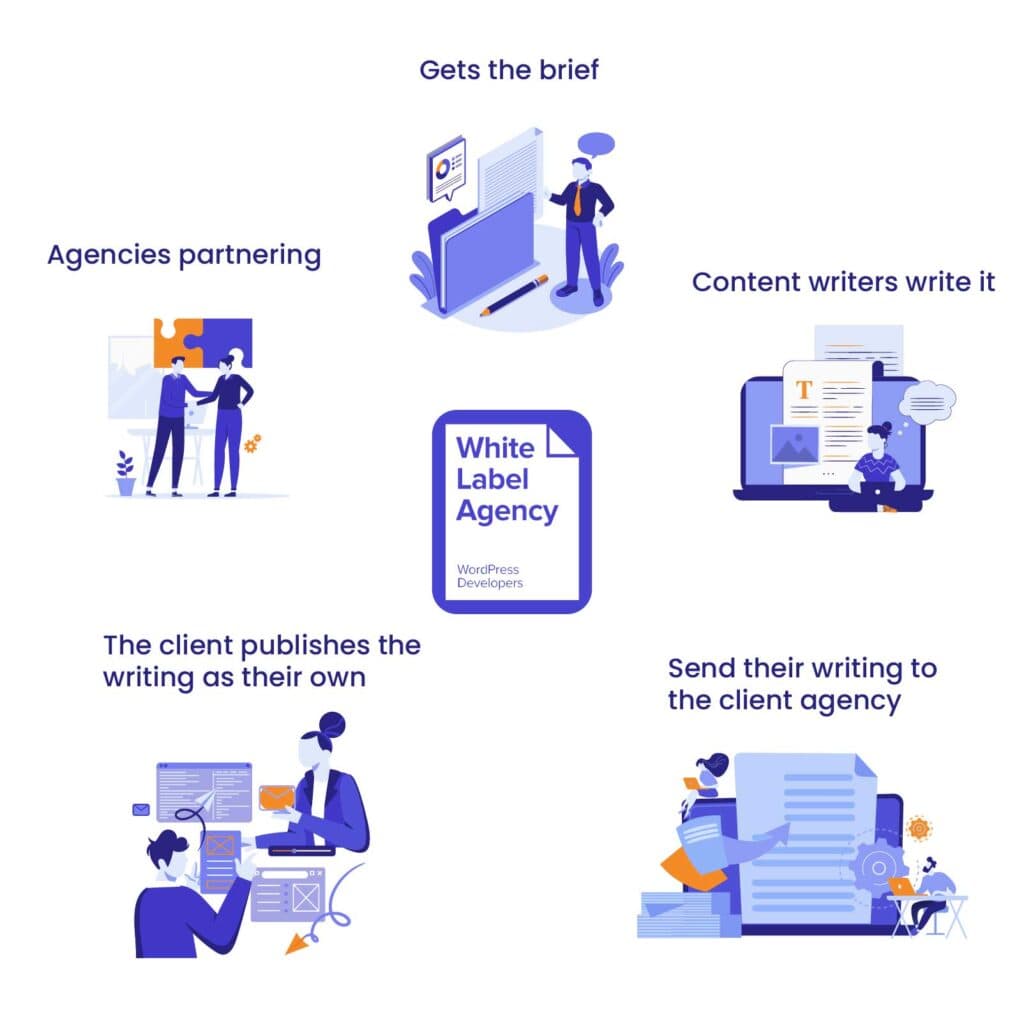
White label content is outsourced written material, including blog posts, website copy, white papers, and social media content, that agencies rebrand and deliver under their own name. The provider stays invisible; the agency takes full credit and ownership. For SEO agencies managing multiple client retainers simultaneously, it is the most direct path to scaling content output without scaling headcount.
What Is White Label Content?
White label content is written material produced by a third party, whether a freelance writer, a content agency, or an AI-assisted platform, and published as if the reselling agency created it. Verblio, one of the most-cited providers in this space, defines it as content "with nothing linking it to Verblio or its author." BrandLume frames it as material you outsource to external writers but present under your agency's brand. PeopleFirstContent adds that ownership transfers fully: the agency is free to publish, distribute, and modify the content however it needs.
The "white label" name comes from the physical image of a blank label on packaging, ready to be filled with any brand's identity. As Wikipedia's entry on white-label products describes it, these are goods "produced by one company that other companies rebrand to make it appear as if they had made it." That concept has migrated intact into digital services, where the product is words rather than widgets.
SteadyContent captures the operational model well: white label content is like working with a virtual content team where production volume can be dialed up and down according to client demand.
Why White Label Content Lets Agencies Scale Without Hiring
Hiring a full-time senior content writer in the United States costs $60,000 to $90,000 annually when salary, benefits, and onboarding are factored in. For an agency adding five content clients simultaneously, that math collapses. White label content sidesteps the equation entirely.
According to Amra & Elma's 2025 white label marketing benchmark study, agencies that outsource 40 to 60 percent of their service delivery grow 2.3 times faster than those relying solely on in-house teams, while reporting 20 percent higher profit margins. The white-label market overall is projected to reach $99.19 billion by 2026, driven substantially by agency demand for scalable content production.
The operational logic is elastic capacity. There is no severance when a client churns and no emergency recruitment sprint when a new retainer lands. Agencies like those partnering with CloudCampaign and BrandLume describe the ability to offer clients "top-tier materials without them ever needing to know the original creator" as the central business benefit. Service quality stays consistent; overhead stays fixed.
What Types of White Label Content Exist?
The content formats available through white label providers now cover nearly every deliverable an SEO agency needs:
- Blog posts and long-form articles: evergreen guides, how-to content, product comparisons, and industry analysis
- Website copy: landing pages, service pages, and homepage narratives optimized for conversion
- White papers and e-books: thought leadership documents for B2B clients building authority
- Social media content: pre-written captions, hashtag sets, and monthly content calendars
- Email marketing copy: drip sequences, newsletters, and promotional campaigns
- Product descriptions: keyword-optimized e-commerce copy at scale
- Google Business Profile content: location-specific copy for local SEO clients, a growing category that SPP.co specifically identifies as a high-demand white label service
CloudCampaign notes that unlike traditional content creation, where every piece is built from the ground up for a single client, white label content is designed for broad applicability. Agencies can license it from a third-party provider and present it as a proprietary managed service, with clients never interacting with the original creator.
How White Label Content Pricing Works
White label content pricing follows three dominant models. Understanding them is essential for building a resale structure that holds margin at scale.
Per-piece pricing is the most common entry point. According to FlyingV Group's 2025 analysis of content writing services, white label blog posts range from $50 to $500 per piece, depending on length, research depth, and niche complexity. For deeply researched, SEO-optimized content in technical verticals, rates cluster at $150 to $500 or higher per article.
Package deals bundle a defined number of pieces per month at a discounted per-unit rate. CloudCampaign cites a representative example: four blog posts plus 20 social media updates per month as a single retainer package. These bundles give agencies predictable cost structures that map cleanly onto recurring client invoices.
Platform subscriptions represent the fastest-growing pricing tier, especially for agencies managing high content volume. Scripted, for example, offers monthly credit-based plans giving access to a pool of vetted freelance writers. WhiteLabelSEO.ai, an AI-powered white-label content platform founded in 2025 by David Kramaley (a co-founder of Chessable with SEO experience dating to 2005), structures its plans at $199.99 per month for 50 articles and $499.99 per month for 200 articles, with branded agency subdomains, client portals, and direct publishing integrations to WordPress, HubSpot, Shopify, and Webflow included.
How Agencies Profit: The Margin Model
The business case for white label content is straightforward once the margin is mapped. Agencies buy content at wholesale rates from providers such as FATJOE, The HOTH, Verblio, DashClicks, Boostability, SEOReseller, or Vendasta, then resell that content to clients as part of a broader SEO retainer, all under the agency's own brand.

SEO Locale's analysis of white label resale economics identifies 40 to 60 percent gross margin as the consistent target range. If a provider charges $100 per article, billing clients $175 to $250 per article lands the agency comfortably within that band. At 10 clients ordering four articles per month, the recurring revenue model becomes significant with zero additional hires.
The margin discipline is volume. A solo account manager can comfortably oversee content delivery for 8 to 12 clients when the production is handled externally. That same person managing in-house writers tops out at far fewer without quality degrading.
How to Vet a White Label Content Provider
Not every white label provider delivers publishable work. Red flags include no revision policy, no topic research documentation, no sample articles in your client's niche available before purchase, and no transparency about whether content is AI-generated without human editorial review.
When evaluating providers, look for:
- A documented writer vetting or editorial review process
- Sample content available in your specific niche before signing
- A clear revision and rewrite policy with defined turnaround times
- Explicit IP ownership transfer confirming the agency owns all content outright
- Publishing integrations that reduce manual delivery friction
- Verifiable quality benchmarks, not just marketing claims
Platforms that publish specific quality metrics set a useful precedent for what accountability looks like in this space. Whether you choose a human-first provider like PeopleFirstContent or an AI-assisted platform, the due diligence process should be identical, and any provider unwilling to share samples upfront is not worth the risk.
Emerging Trends: AI Integration and Vertical Specialization
The white label content industry is splitting into two distinct camps. Legacy providers such as BrandLume and SteadyContent compete primarily on editorial quality and human writer expertise. A newer generation of AI-assisted platforms competes on volume, speed, and deep integration: features like automatic SEO scoring, SERP analysis, topic clustering, and entity extraction built directly into the production workflow.
The SEO services market reached an estimated $83.98 billion in 2026, up from $74.9 billion in 2025, growing at a compound annual rate of 12.3% according to industry data from ALM Corp. Digital marketing outsourcing broadly is projected to expand from $25.4 billion in 2024 to $74.76 billion by 2034. That growth is driving vertical specialization: providers are increasingly positioning for specific niches, including legal, healthcare, SaaS, and e-commerce, rather than competing as generalist content shops.
For SEO agencies, the practical shift is this: white label content is no longer a cost-cutting shortcut. It has become a core service delivery infrastructure, separating agencies that can pitch confidently on content-driven SEO from those that cannot.
Frequently Asked Questions
What are white-label services?
White-label services are products or services produced by one company and rebranded by another for resale under their own name. In content marketing, a third-party writer or platform creates articles, web copy, or social media content, and the reselling agency delivers that work as its own. Ownership transfers fully, meaning the agency controls publication, distribution, and client communication throughout the engagement.
What is the white-label services market size in 2026?
The white-label market broadly is projected to reach $99.19 billion in 2026, according to Amra & Elma's white label marketing benchmark data. The SEO services market specifically reached an estimated $83.98 billion in 2026, growing at 12.3% annually. Digital marketing outsourcing overall is on track to expand from $25.4 billion in 2024 to $74.76 billion by 2034, reflecting sustained and accelerating agency demand for scalable service delivery infrastructure.
What types of white-label services exist beyond SEO?
White-label services span nearly every digital marketing discipline. Agencies commonly resell PPC campaign management, web design and development, social media content creation and scheduling, email marketing sequences, reputation management including Google Business Profile optimization, video production, graphic design, and marketing automation setup. Providers such as Vendasta, DashClicks, and SEOReseller offer bundled packages spanning multiple service categories under a single partner relationship.
Know something we missed? Have a correction or additional information?
Submit a Tip