McKinsey says marketing is shifting to always-on growth, agencies must adapt
As marketing shifts to always-on growth, SEO retainers gain value when they tie content, CRO, and analytics to revenue. McKinsey’s AI thesis points agencies toward orchestration, not isolated rankings.

McKinsey’s June 22, 2026 framework, “From campaigns to continuous growth: AI capabilities shaping marketing,” reframes what clients should buy from SEO agencies. It puts five pillars at the center of that shift: insights, creativity, personalization, agentic commerce, and orchestration. For agencies, the message is less about a new tactic and more about a new operating model.
Why always-on growth strengthens the retainer case
The commercial logic is straightforward: if growth is continuous, the service model has to be continuous too. That favors retainers built around audience signals, content feedback loops, conversion data, and cross-channel coordination rather than one-off projects that end when a page ranks or a campaign closes. SEO agencies that still sell isolated deliverables are selling into a campaign calendar; agencies that can connect SEO with paid media, content strategy, analytics, and conversion work are selling into a growth system.
McKinsey projects that 18 future business arenas could generate between $29 trillion and $48 trillion in revenue by 2040, moving the discussion away from short-term traffic wins and toward durable revenue capture.
The five pillars that shape the new service stack
McKinsey’s five pillars map onto how modern SEO retainers need to be built. Insights cover search demand, audience behavior, and content performance. Creativity covers how agencies turn those signals into usable formats, from landing pages to editorial assets. Personalization pushes work beyond generic content calendars into audience-specific journeys. Agentic commerce and orchestration push agencies to think beyond rankings and into the mechanics of discovery, selection, and purchase.
In a continuous-growth model, content refreshes matter as much as new content creation, because stale pages lose relevance while competitor pages and AI-assisted discovery layers keep changing what users see. CRO becomes part of SEO instead of a separate discipline, because the value of a page is measured by whether it converts the traffic it attracts.
AI is becoming part of the operating model, not just a productivity layer
McKinsey’s June 2026 companion coverage says AI could unlock up to $90 billion in improved marketing returns in the United States alone. It argues that advertising value is shifting toward players that can shape what is seen, selected, and purchased as AI changes how consumers discover products. That is a major change for SEO agencies, because visibility is no longer just a question of ranking position. It is becoming a question of whether a brand is structured to appear in assisted discovery, comparison flows, and purchase decisions.
- weekly search and content signal review
- a standing experimentation backlog for titles, landing pages, and calls to action
- continuous CRO testing on high-intent pages
- content refresh cycles tied to query shifts and conversion data
- reporting that links traffic, pipeline, and revenue rather than vanity metrics
The most useful agency response is not to add AI as a side service, but to use it to redesign delivery. In practical terms, that means:
Tier-1 enterprise clients will usually want all five layers running at once, because they need multi-market governance and tighter measurement. Mid-market brands may buy a narrower version, but they still need the same operating logic. International programs add another layer, since localization and market-specific search behavior make orchestration more valuable than channel silos.
McKinsey’s earlier framework still defines the basic capability stack
McKinsey’s 2023 “modern marketing” framework described six capabilities that modern teams need: customer centricity, full-funnel marketing, agile operating model, multichannel excellence, measurement, and customer data/marketing technology. That list still reads like the minimum viable operating model for an SEO agency that wants to sell growth rather than isolated deliverables.
Customer centricity keeps the agency from optimizing for keywords alone. Full-funnel marketing forces search work to connect with awareness, consideration, and conversion. An agile operating model supports faster testing and iteration. Multichannel excellence and measurement make sure SEO does not sit in a reporting silo. Customer data and marketing technology are what let agencies turn recurring signals into recurring revenue.
The readiness gap is still wide
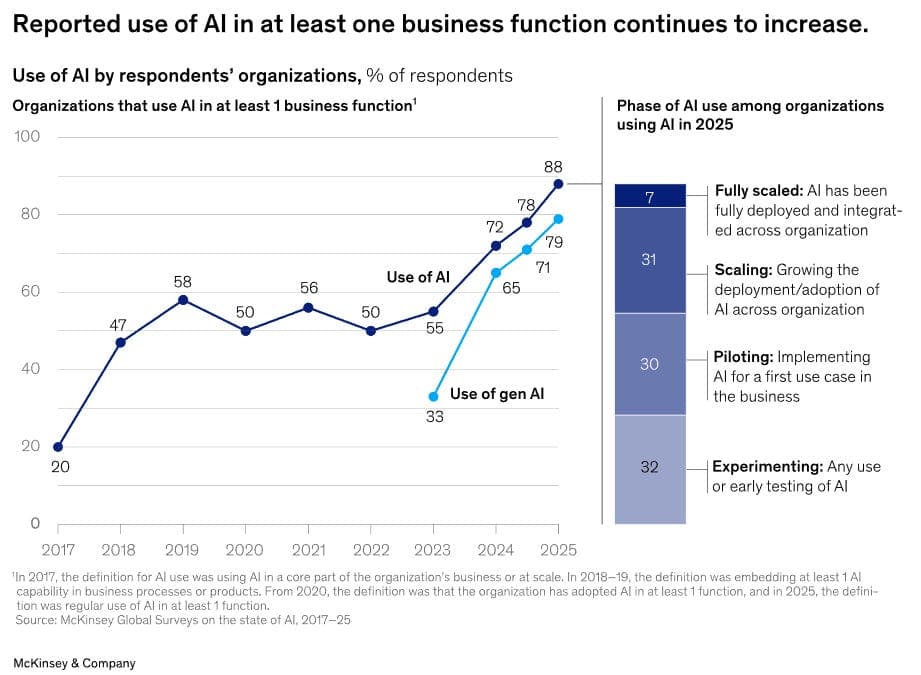
McKinsey’s State of Marketing Europe 2026 surveyed 500 senior marketing decision-makers across France, Germany, Italy, Spain, and the United Kingdom. It found that 94% of organizations reported low or moderate generative AI marketing capabilities, while only 3% of CMOs could show MROI of more than 50% of marketing spend. Three in four CMOs planned to increase marketing budgets.
McKinsey’s March 2026 Global Marketer Survey drew 521 responses from global marketers and advertisers across senior and individual-contributor roles at companies with annual marketing spend as high as $5 billion. Taken together, the surveys suggest that budgets are still moving, but operating maturity is uneven. That gap is where agencies can win by productizing experimentation, reporting, content maintenance, and cross-channel coordination into a recurring service model.
What the Cannes Lions tie-in says about where the market is headed
McKinsey linked the same growth and AI theme to the Cannes Lions International Festival of Creativity, which began June 21, 2026 in Cannes, France. The tie-in places search, media, and creative execution inside one conversation about how AI and agentic systems are rewiring growth. The most competitive agencies will not separate SEO from the rest of that stack. They will build retainers around a shared operating rhythm, a shared measurement system, and a shared revenue target.
This article was produced by Prism’s automated news system from verified source data, official records, and press releases, then run through automated quality and moderation checks before publishing. The system is built and supervised by the people who set the standards it runs under. Read our full AI policy.
Know something we missed? Have a correction or additional information?
Submit a Tip