Quality Directory Selection Beats Volume for Local SEO Success in 2026
Ten strong directory listings outperform fifty weak ones; the QUALITY-8 scorecard gives agencies a precision framework to turn citation management into a measurable, recurring service.
The argument that directory citations were a spent tactic has quietly collapsed. In 2026, AI search systems and large language model overviews have created a new reason for structured, third-party business profiles to matter: LLMs rely on them to build entity clarity. That shift gives directory strategy a second life, but only for agencies willing to stop counting links and start scoring quality.
A tactical guide published by ListingBott on April 5, 2026 lays out the operational case in detail. Titled "Business Directories for SEO: Practical 2026 Quality Framework," it is aimed squarely at SEO teams and agencies that still fold citation building into local visibility stacks. The core argument is blunt: directories remain valuable, but only when selected and managed with quality controls rather than deployed as a volume-driven backlink tactic.
Why Directories Regained Strategic Weight
The mechanism behind directories' renewed relevance is architectural. AI search systems and LLM-generated overviews increasingly pull from structured, third-party references when forming answers about local businesses. A profile on a reputable directory is not just a backlink; it is a data point that an AI system can cross-reference to confirm brand attributes, service categories, and geographic relevance.
ListingBott frames directory contributions across three practical layers. The first is discovery: direct user referrals from people actively browsing category listings. The second is trust: consistent third-party profiles that reinforce brand signals across the web. The third, and most distinctly 2026, is entity clarity: structured references that help AI systems understand what a business is, where it operates, and what it offers. Directories have become both a human UX channel and an input signal for model-driven visibility simultaneously, which is a meaningful expansion of their prior role.
The QUALITY-8 Scoring Framework
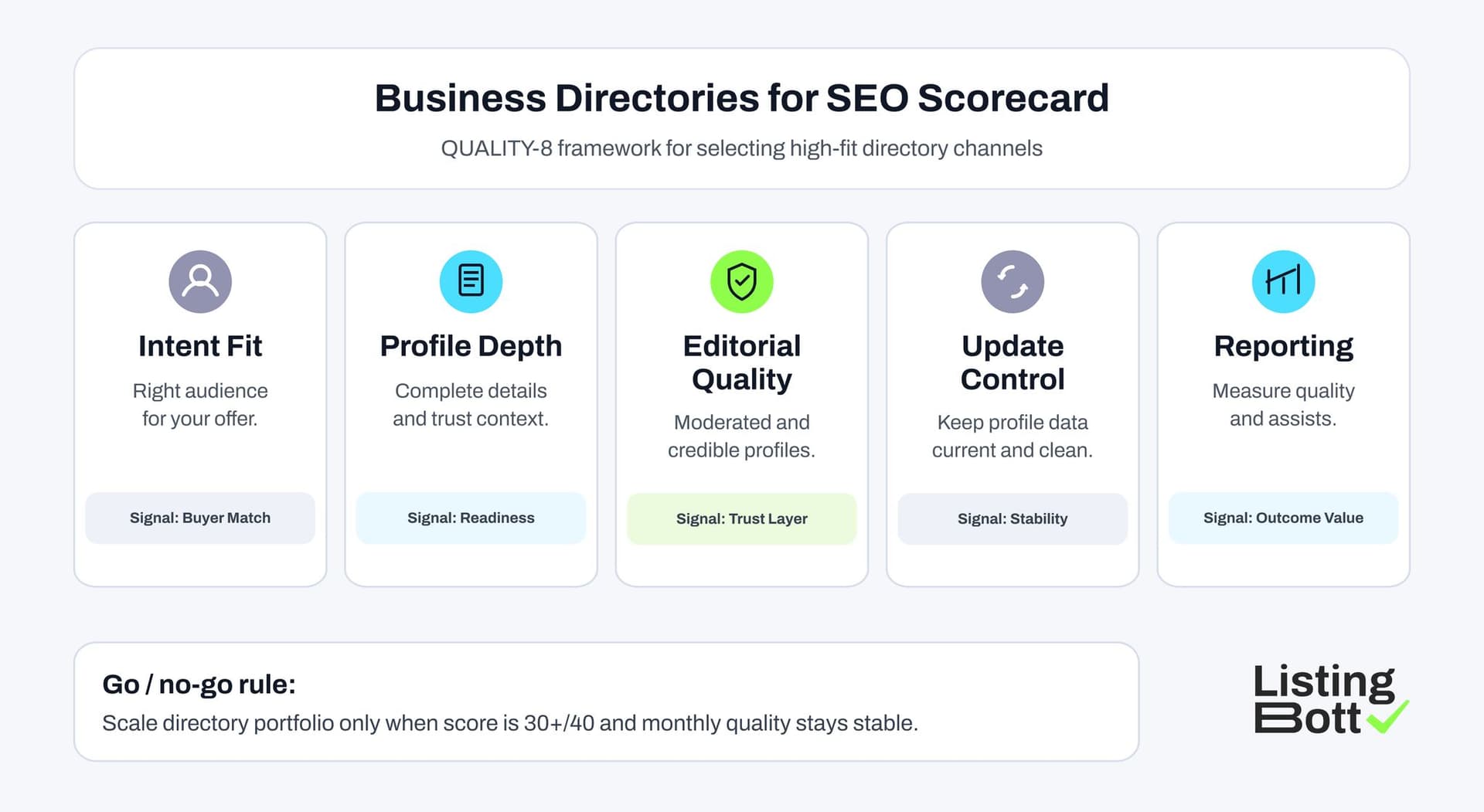
To operationalize directory selection, the guide introduces a scorecard model called QUALITY-8. Each letter maps to a specific evaluative dimension that agencies should score before committing to a listing:
- Intent fit - Does the directory attract users who are actively searching for the business's category?
- Category precision - Can the listing be placed in a specific, relevant category rather than a generic catch-all?
- Profile depth - Does the platform support rich fields: photos, service descriptions, structured attributes?
- Editorial quality - Is the directory editorially maintained, or is it an open-submission spam magnet?
- Update control - Can the agency or client edit NAP data, hours, and content without delay or approval friction?
- Measurement access - Does the platform provide referral data, impression counts, or any trackable signal?
- Operational fit - Does managing this listing fit within the agency's workflow and client service tier?
- Portfolio role - Does this listing fill a gap or duplicate what five other directories already cover?
The final recommendation is direct: ten strong, well-maintained listings typically outperform fifty weak ones. That ratio is the practical distillation of the QUALITY-8 model. Agencies that run existing citation footprints through this scorecard will almost always find that a significant portion of current listings score poorly on update control, measurement access, or editorial quality and should be pruned rather than maintained.
The 90-Day Rollout Plan
ListingBott structures the implementation as a 90-day rollout with four sequential phases designed to be repeatable across client accounts.
1. Discovery and mapping. Audit the client's entire current citation footprint.
Identify where listings exist, where they are missing, where NAP data is inconsistent, and which platforms pass the QUALITY-8 threshold.

2. Profile standardization and deep enrichment. Standardize name, address, and phone data across all surviving listings.
Then go further: add photos, complete every available structured field, write category-specific service descriptions, and build a review acquisition plan into each priority profile.
3. Quality checks. Run the scorecard against new directory candidates and recheck existing listings for drift, duplication risk, and indexation status.
Listings that no longer pass the threshold get flagged for removal or deprioritization.
4. Iterative pruning based on measured outcomes. Use referral data and, where trackable, AI citation uptake to evaluate which listings are generating actual discovery or trust value.
Prune what is not performing and reinvest time in profiles that show signal.
The 90-day frame gives agencies a structured deliverable to present to clients at kickoff, with a defined scope and a logical progression from audit to optimization to measurement.
Turning Citation Management Into a Recurring Service
For agencies that package white-label local SEO or manage multi-location clients, the guide's framework translates into a productized service rather than a one-time project. The workflow maps cleanly onto four repeatable service components: auditing the citation footprint, applying the QUALITY-8 scorecard to select or cull directories, publishing deep and conversion-ready profiles with photos, services, and structured fields, and measuring referral quality alongside AI citation uptake month over month.
The key to making this a recurring revenue line rather than a flat-fee audit is the measurement layer. Agencies that build SOPs around the 90-day plan, attach white-label dashboards to the deliverable, and report on referral quality and entity coverage each month can present directory management as an ongoing KPI-tracked service. That is a fundamentally different conversation than delivering a spreadsheet with a citation count.
Communicating ROI Beyond "We Built 100 Citations"
The hardest part of selling citation strategy has always been articulating the value to clients who cannot see a direct revenue line from a Yelp profile or a niche trade directory. The QUALITY-8 framework reframes that conversation by making the selection criteria auditable and the outcomes measurable.
Reporting on measurement access and referral data from individual directories gives clients something concrete: which platforms are sending traffic, which are being picked up by AI overviews, and which are dead weight. Duplication risk and update control scores give account managers a defensible reason to recommend removing listings rather than simply accumulating them. Portfolio role scoring lets agencies explain, in plain terms, why a client does not need a twelfth general business directory but does need a presence on a high-authority vertical platform in their category.
The shift from volume to quality in directory strategy is not just a tactical adjustment; it reflects a broader realignment of what local SEO actually produces in an AI-augmented search environment. Agencies that build their workflows around the QUALITY-8 framework now will be far better positioned as AI citation signals become a standard KPI in local visibility reporting.
This article was produced by Prism’s automated news system from verified source data, official records, and press releases, then run through automated quality and moderation checks before publishing. The system is built and supervised by the people who set the standards it runs under. Read our full AI policy.
Did this article answer your question?