Search Engine Land guide shows how thought leadership drives SEO agency growth
Thought leadership turns SEO expertise into inbound pipeline and stronger closes. Google's updates reward named experts, proof, and content people actually find useful.
On March 5, 2024, Google said its core update and spam policy changes would show less content made to attract clicks and more content people find useful. For SEO agencies, a clear point of view from a named expert is a sales asset that compounds authority, inbound pipeline, and better discovery calls.
Why thought leadership changes agency economics
In SEO, most agencies still sound interchangeable on the first call. They promise traffic, rankings, and visibility, but prospects have usually heard that language before, which is why a detailed article, a strong byline, or a webinar appearance matters so much. Thought leadership changes the first five minutes of a sales conversation because the agency has already shown judgment on issues clients actually care about, from algorithm volatility to revenue attribution.
Under Google Search Essentials, it does not cost money to appear in Google Search results. Agencies are not buying a placement when they publish useful work; they are earning visibility through content that helps people find answers and helps search engines understand those answers. That makes the business case for authority-led publishing unusually direct.
Google’s content rules reward proof, not filler
The platform changes over the past few years have pushed agencies toward evidence-backed publishing. On Aug. 18, 2022, Google launched the Helpful Content Update. On Dec. 15, 2022, it updated its quality rater guidance so E-A-T became E-E-A-T, adding “Experience.” On Feb. 8, 2023, Google said AI-generated content fits within its long-standing approach to show helpful content to people on Search.
For agencies, that is not a generic branding lesson. It is a nudge toward content that can show real-world search experience, quote real metrics, and explain why a recommendation works in practice rather than in theory.
The formats that convert readers into prospects
Thought leadership works best when it is tied to a recognizable expert and a specific distribution surface. The strongest agency content usually answers a question clients already have, then proves the answer with artifacts from the work itself. That is where tools like Google Search Console, Ahrefs, Semrush, Moz Pro, and even HubSpot data become business-development assets instead of dashboard clutter.
The most useful formats tend to be the ones that move from opinion to evidence:
- Technical explainers on structured data, local SEO, and crawl or indexation issues
- Point-of-view articles on E-E-A-T, AI search, and content pruning
- Original data studies built from Search Console, ranking data, or lead and conversion reporting
- “What we learned” posts after a client rollout, with screenshots, deltas, and time-to-value
These formats work because they answer the question every serious buyer asks sooner or later: how do you know? A good thought-leadership article does not just say an agency understands search. It shows the agency can interpret Google Search Central guidance, read the data in its own stack, and turn that into a recommendation that a client can act on.
Where the content should live
Distribution is part of the strategy, not an afterthought. Search Engine Land publishes a thought leadership guide, maintains webinar pages, and runs SMX pages for speakers, agendas, and master classes. Its Google Search Central and SEO coverage includes the SMX conference series, which gives agencies a concrete path from written expertise to visible speaking opportunities.
The SMX pages in search results also show how that visibility becomes structured. SMX Next lists dates for Nov. 18-19, 2025, while SMX Advanced lists June 3-5, 2026.
Bylines on Search Engine Land or Moz, LinkedIn articles from the agency founder, webinar sessions at SMX, and research-led posts that cite Google Search Central documentation all serve the same purpose: they attach a point of view to a real person and a real venue.
Why named experts matter in a crowded market
The public market for SEO thought leadership is crowded enough that visible expertise becomes a signal in its own right. First Page Sage’s 2025 roundup of SEO thought leaders evaluated people based on awards, keynote appearances, and frequently cited articles or books.
How to turn thought leadership into pipeline
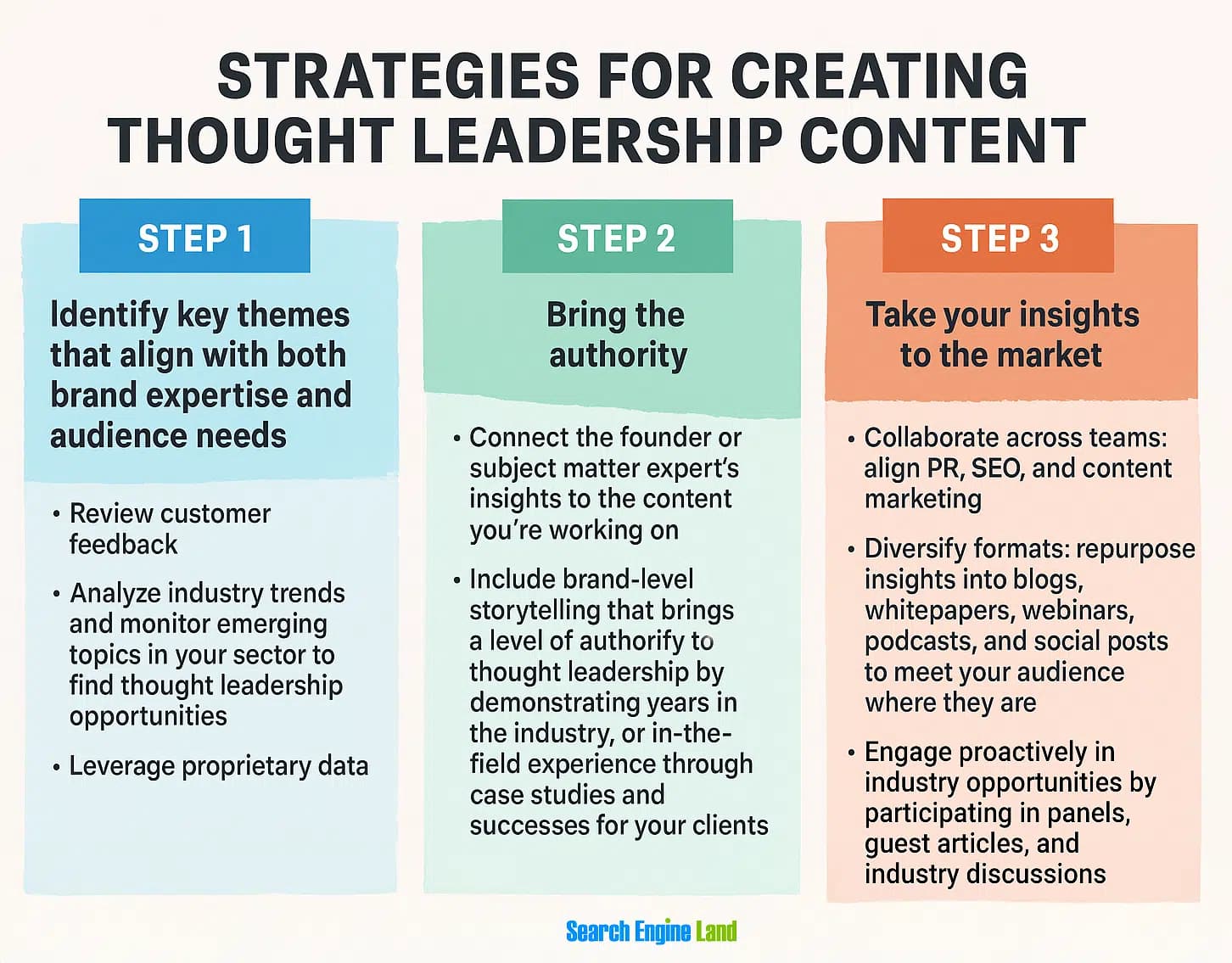
The agencies that benefit most tend to run a simple operating model. They choose topics that already matter to buyers, publish them through named experts, and then reuse the same material across sales and marketing channels. That keeps the effort tied to revenue instead of letting it sit as isolated blog traffic.
1. Pick one recurring client problem, such as local SEO visibility, revenue attribution, or AI search.
2. Assign a named expert and support every piece with proof, including Search Console screenshots, ranking movement, lead volume, or conversion data.
3. Distribute the work through Search Engine Land, LinkedIn, webinars, and SMX appearances, then bring the same examples into proposal decks and discovery calls.
This article was produced by Prism’s automated news system from verified source data, official records, and press releases, then run through automated quality and moderation checks before publishing. The system is built and supervised by the people who set the standards it runs under. Read our full AI policy.
Did this article answer your question?