SEO agency growth depends on margin discipline, survey finds
Margin, not lead volume, is the real growth gate for SEO agencies. SE Ranking’s retainer survey shows why pricing, staffing and owner pay all depend on disciplined unit economics.
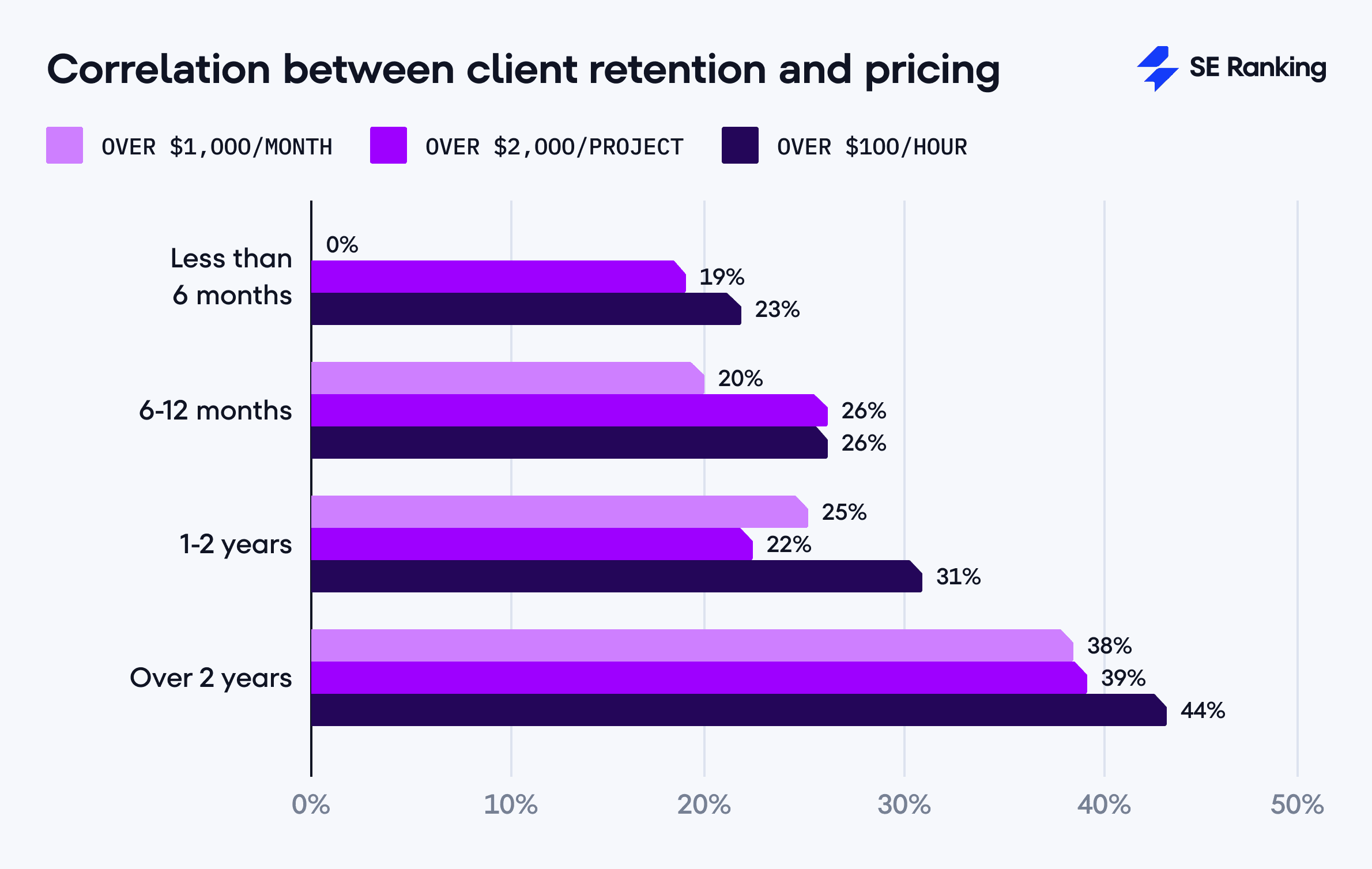
SE Ranking’s pricing-model survey, run with Duda, found 53% of participants prefer a monthly retainer. Retainers keep delivery predictable, protect margin, and give agency owners a fighting chance to scale without turning every new client into a scramble.
Margin is the hidden control panel
Profit margin sits underneath three decisions that define agency growth: how you price retainers, how much delivery capacity you hire, and what the owner can actually take home. If the margin is thin, a new client can increase revenue while leaving less cash after subcontractors, software, payroll, and revisions. If the margin is disciplined, the agency can add clients without overloading senior strategists or forcing the founder to absorb every messy account.
The conversation around SEO agency growth is moving away from raw lead volume. Revenue growth is common, but it does not guarantee profitability, and the market benchmarks make that gap visible. Predictable Profits found 74% of agencies grew revenue last year and 49% increased revenue by 25% or more, yet its profitability study still puts the top 3% of digital agencies at 43% profit margins while others average 15% to 20%. Growth is clearly available; the constraint is converting that growth into margin that survives delivery.
What SE Ranking is showing about pricing
SE Ranking’s pricing survey gives the clearest read on how agencies are trying to stabilize that margin. The survey work, built with Duda, supports recurring retainers over one-off project pricing because steady billing makes it easier to align delivery teams, forecast utilization, and avoid constant repricing. Pricing models are central to agency success because they create steady client flow and support sustainable growth, which is a direct challenge to the all-too-common habit of selling SEO like a loose bundle of tasks instead of a controlled service line.
Pricing structure changes the whole operating model. A monthly retainer can protect senior strategist time for the work that actually moves accounts, while productized packages can work when scope is tight and repeatable. The trade-off is that low-retainer, high-touch accounts tend to eat more leadership time than they pay for, especially when content production, technical audits, link outreach, and reporting are all bundled together without clear delivery limits.
How the benchmark sources fit together
The best way to use the available benchmarks is to separate pricing guidance from finance guidance. SE Ranking is useful for pricing behavior and retainer design, while Forge is better for cross-agency financial sanity checks. Forge’s 2026 Agency Benchmarks Report compiles 30+ benchmarks across margin, growth, utilization, revenue per employee, client retention, and pricing mix, and it pegs the average agency net profit margin at 13% after tax for 2025.
| Source | What it gives you | Best use case | Main limitation |
|---|---|---|---|
| SE Ranking with Duda | Pricing survey, free calculator, free course, retainer preference data | Setting SEO pricing models and retainer structure | Not a full P&L system |
| Forge | 30+ benchmarks across margin, growth, utilization, revenue per employee, client retention, pricing mix | Sanity-checking agency-wide performance | Broad benchmark set, not SEO-specific delivery math |
| Predictable Profits | Growth and profitability benchmarks from 300+ agencies | Comparing revenue growth against margin discipline | High-level founder lens |
| Iota Finance | Agency margin targets and profitability benchmarks | Setting gross margin and net margin goals | Accounting-first, not operational SEO detail |
| Nico Digital | White-label SEO margin calculator and reseller margin benchmarks | Outsourced fulfillment and link-building economics | Best for white-label and offshore delivery models |
Forge is useful when you want to know whether your firm is operating above or below the market’s median profit structure. SE Ranking is useful when you want to decide whether a retainer, a productized package, or a hybrid model will preserve delivery economics. Predictable Profits is the reminder that revenue growth alone can hide thin margins, and Iota Finance and Nico Digital give you the target bands for gross margin depending on how much of the work stays in-house.
Where agencies leak profit
The leaks are repeatable, and they usually show up before owners notice them in the P&L. Untracked hours from scope creep and unexpected ranking drops can reduce actual profit margins by 20% to 40%, which is a huge swing for a business that already lives on tight delivery math. In practice, that loss usually comes from three places:
- Scope creep on retainers, where reporting, meetings, content revisions, and “quick fixes” pile up without a change order
- Underpriced strategy work, where senior time is sold at the same rate as routine execution
- Labor-heavy fulfillment, where every deliverable stays in-house even when subcontracted link building or white-label support would preserve margin
Nico Digital’s white-label SEO margin calculator puts agencies reselling offshore white-label SEO at 45% to 65% gross margin, with a median around 55%. That range is attractive for agencies that want to keep delivery flexible, but it only works if the agency manages the markup correctly and avoids turning outsourced work into a support burden that drags senior staff back into execution.
How to use the numbers in an operating model
The margin targets from Iota Finance give agencies a practical floor: healthy firms aim for 50% or more gross margin and 15% to 25% net profit, with Igor Tutelman, CPA, emphasizing that margin should be read alongside the underlying drivers rather than treated as a single number. The same retainer can be profitable or unprofitable depending on utilization, subcontractor spend, and how much strategist time is reserved for real strategy.
Charles Gaudet’s Predictable Profits benchmarks reinforce the same point from the growth side. If 74% of agencies are growing revenue and nearly half are growing by at least 25%, then growth itself is not rare. The differentiator is whether that growth lands inside a margin structure that can support hiring, absorb churn, and still leave owner take-home intact.
This article was produced by Prism’s automated news system from verified source data, official records, and press releases, then run through automated quality and moderation checks before publishing. The system is built and supervised by the people who set the standards it runs under. Read our full AI policy.
Did this article answer your question?