SEO agency growth depends on retention, not just hiring more staff
Senior SEO retention is not an HR side quest. Agencies that keep managers, create real progression, and build learning into delivery protect client accounts and scale faster.

In 2021, Hallam was recognized as a Times Top 100 employer. An SEO agency that keeps losing senior people does not just lose headcount. It loses project continuity, drains management time, weakens client trust, and turns every new hire into another onboarding bill. Retention behaves like a revenue lever, because the agency that holds on to its best SEOs usually holds on to its best client relationships too.
Retention is part of the delivery engine
High turnover in an SEO agency bleeds resources and destabilizes ongoing work. It is a compounding operating cost, because every departure interrupts campaigns, hands new people unfinished strategy, and forces senior staff back into firefighting mode. At Hallam, middle managers directly or indirectly manage about two-thirds of the agency.
The model is not built on a few heroic practitioners carrying the whole client base on their backs. It is built on layered leadership, strong middle managers, and a structure that can absorb complexity without breaking when a senior SEO leaves.
Why SEOs leave is not what many agency owners think
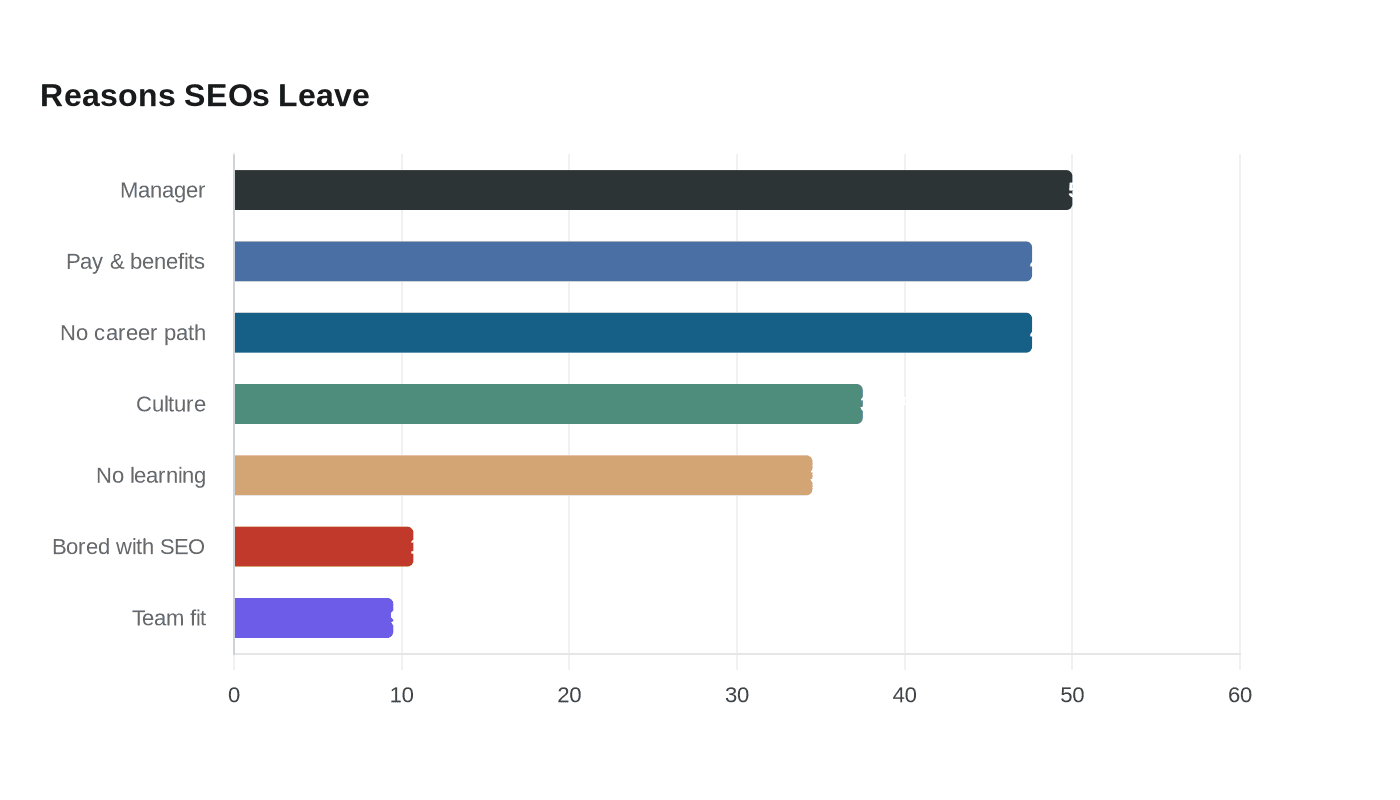
Moz’s survey of 168 SEOs shows pay is not the only retention problem, and often not even the first one. The reasons they gave for leaving were blunt:
- 50% said their manager sucked.
- 47.6% cited better pay and benefits.
- 47.6% said there was no career progression.
- 37.5% said the culture sucked.
- 34.5% said they were not learning anything new.
- 10.7% said they got bored with SEO.
- 9.5% said they did not get on with their team.
Compensation still matters, and the survey shows it matters a lot, but it sits alongside management quality and career design. If half of your departing staff say the manager is the problem, a market-rate salary does not fix the operating model.
Manager quality is a scaling tool, not an afterthought
The strongest agencies do not promote excellent individual contributors and hope management comes naturally. They train managers before expecting them to hold teams together, because the survey puts manager failure at the top of the exit list. That is especially important in SEO, where senior people are often promoted for technical judgment, client instinct, or campaign wins, then handed people responsibilities with little support.
Career progression has to be visible, not implied
Almost the same share of respondents blamed weak progression as blamed pay: 47.6% said there was no career path. That is a direct warning to agencies that rely on vague promises and title inflation. If junior, mid-level, and senior SEOs cannot see what changes between levels, they will assume the only real promotion is leaving for a different employer.
A workable progression system needs more than a ladder on paper. It needs clear expectations for what a junior SEO, a mid-level strategist, and a senior lead are each supposed to own, from client communication to technical audits to strategy sign-off. It also needs managers who can actually explain the next step and coach someone toward it, instead of waiting until retention fails and then blaming the market.
Learning is part of retention because SEO keeps moving
More than a third of the surveyed SEOs, 34.5%, said they were not learning anything new. That is a retention problem because SEO work changes constantly, and a stagnant role feels like a dead end even when the salary is competitive. Agencies that treat learning as optional end up with the exact people they can least afford to lose: the ones who realize they are no longer growing.
The practical fix is to make learning part of the job, not a perk for people who finish early. That can mean structured time for experimentation, regular exposure to technical and strategic work, and deliberate rotation across account types so senior staff do not get boxed into the same repetitive tasks.
Culture and trust show up in client work, not just internal surveys
Thirty-seven and a half percent of SEOs said culture sucked, and toxic culture can outweigh competitive salaries. A team that does not trust its managers or its peers spends more time defending itself, more time second-guessing decisions, and less time doing the work that keeps clients retained.
For agency growth, culture has to function like a delivery control. If the internal environment is chaotic, the client sees it in missed deadlines, inconsistent strategy, and weaker continuity when account leads turn over.
This article was produced by Prism’s automated news system from verified source data, official records, and press releases, then run through automated quality and moderation checks before publishing. The system is built and supervised by the people who set the standards it runs under. Read our full AI policy.
Know something we missed? Have a correction or additional information?
Submit a Tip