SEO agency pricing models shape cash flow, margins, and growth
Retainers anchor cash flow, while hourly, project, value-based, and performance pricing each shift margin risk, staffing pressure, and growth in different ways.
Average SEO services cost $2,917 per month in Digital Elevator’s 2026 pricing guide. For SEO agencies, the larger scaling decision is how they bill: retainers, hourly work, project fees, value-based pricing, and performance-based contracts each change cash flow, staffing plans, and margin risk in different ways. TheStacc’s 2026 guide focuses on those five billing structures, and the trade-offs become obvious once each model is tied to real delivery work such as technical SEO, digital PR, audits, migrations, and local SEO setups.
How the main pricing models change the business
| Model | Cash flow profile | Delivery fit | Growth advantage | Main limit |
|---|---|---|---|---|
| Retainer | Recurring and predictable | Ongoing content, technical SEO, digital PR, link-building | Easier hiring and forecasting | Scope creep if deliverables are vague |
| Hourly | Directly tied to utilization | Advisory work, ad hoc fixes, short engagements | Simple to explain | Revenue slows when senior time is expensive |
| Project-based | Start-stop revenue | Audits, migrations, local SEO setups, one-time site fixes | Clean for defined outcomes | Creates feast-or-famine pressure |
| Value-based | Tied to business impact | High-LTV clients, niche verticals, strategic accounts | Higher deal sizes | Requires stronger discovery and qualification |
| Performance-based | Paid on results | Measurement-heavy campaigns | Strong sales story | Open-ended risk if attribution is weak |
A retainer-heavy agency can forecast team load and revenue with far more confidence than a shop that lives on one-off projects. A performance-based shop may win deals faster, but it also inherits the burden of proving results across search, analytics, and CRM systems.
Retainers set the operating rhythm
Retainers are still the most useful growth engine because recurring revenue smooths payroll and makes capacity planning possible. They work best when the agency is delivering ongoing content, technical SEO, digital PR, or link-building, where the work does not end cleanly after a single launch. That is why agencies often build productized service tiers around monthly scopes rather than custom estimates for every task.
Digital Elevator’s 2026 pricing guide puts agencies at about $3,200 per month and freelancers around $1,350. Digital Applied’s 2026 guide puts monthly retainers at $1,500 to $15,000+, with small businesses often paying $2,500 to $5,000, mid-market clients $5,000 to $10,000, and enterprise accounts more.
Hourly and project fees keep scope visible, but they cap scale
Hourly billing remains common because it is easy to explain and easy to start. Credo’s SEO agency pricing survey puts the worldwide average at $134.99 per hour, with U.S. agencies averaging $147.93 per hour. That model can work for discovery work, strategy sessions, or troubleshooting, but revenue is tightly bound to utilization, and senior strategists become a margin problem if the rate card does not keep pace with their time.
Project-based fees are a cleaner fit for audits, migrations, local SEO setups, and one-time site fixes. The upside is clarity: the agency defines a start point, a deliverable, and a close. The downside is volatility, because a pipeline built mostly on projects can produce feast-or-famine revenue unless the agency pairs them with recurring work.
Value-based and performance pricing need a stronger proof stack
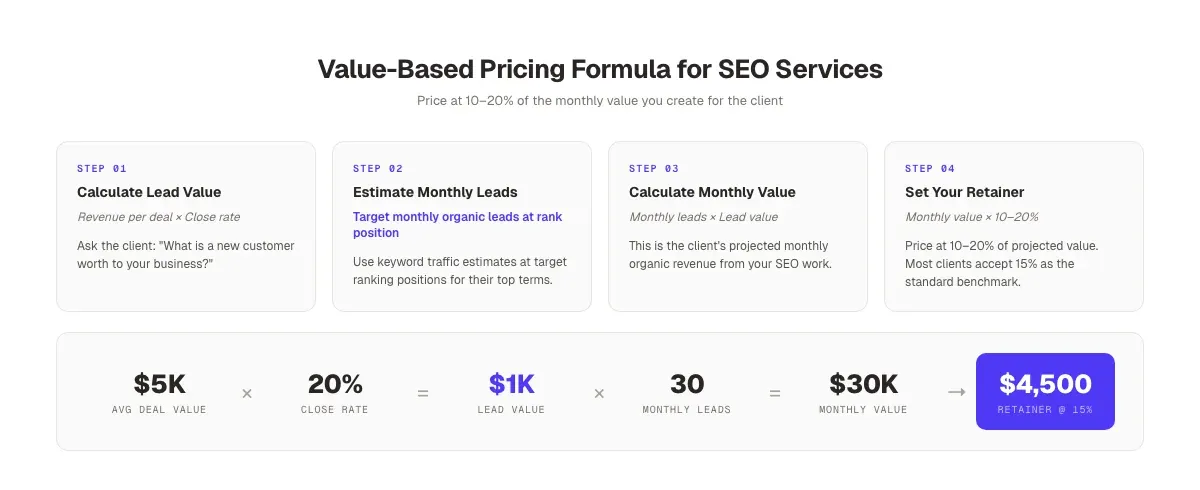
Value-based pricing is the most advanced model in the set because it ties fees to the economic value of the outcome. That can lift deal size in high-LTV accounts, especially in the B2B tech market or niche verticals where one organic win can justify a larger fee than a simple time-and-materials estimate. It also demands tighter discovery, better qualification, and more executive-level positioning, because the agency has to understand the client’s revenue logic before it can price against it.
Performance-based pricing can be attractive in sales conversations, but it introduces the hardest operational questions. The contract has to spell out what counts as a win, what happens when rankings fluctuate, and how to separate agency work from other marketing inputs. Without strict tracking and clear attribution, the model can push risk onto the agency in ways that are hard to unwind later.
Measurement tools decide whether outcome-based billing is defensible
Outcome-based billing depends on analytics that can connect rankings, clicks, user behavior, and key events. Google Search Central documents how linking Google Analytics with Google Search Console lets teams see where a site is ranked, which queries lead to clicks, and how those clicks translate into user behavior and key events. Together, the two tools give a more complete picture of how audiences discover and experience a website.
That integration matters even more because attribution standards keep changing. In June 2023, Google Analytics was sunsetting four attribution models for GA4 properties and Google Ads conversion actions and replacing them with data-driven attribution; Piwik PRO highlighted the change. For agencies using performance-based or value-based pricing, that means dashboards and contract language cannot assume a stable measurement model forever.
How agencies usually evolve from one model to the next
The pricing path often follows maturity. Many agencies begin with hourly or project work to prove value, then shift into retainers once delivery becomes repeatable, and later add value-based pricing for strategic accounts. Pricing becomes a profitability and scaling problem, not just a sales tactic. The Blueprint Training’s June 30, 2024 guide lays out seven ways to price agency services.
A useful sequence looks like this:
- Use hourly or project pricing when scope is still being defined and the agency needs proof points.
- Move core SEO programs into retainers once recurring delivery, such as content or technical SEO, becomes standard.
- Reserve value-based pricing for accounts where the business impact is large enough to justify deeper discovery.
- Use performance-based terms only when Google Analytics, Google Search Console, and CRM reporting can verify outcomes cleanly.
Pricing transparency also affects retention. In a February 15, 2024 SE Ranking video, Jen Cornwell, VP of SEO at Ignite Visibility, discussed balancing profitability with long-term client relationships.
This article was produced by Prism’s automated news system from verified source data, official records, and press releases, then run through automated quality and moderation checks before publishing. The system is built and supervised by the people who set the standards it runs under. Read our full AI policy.
Did this article answer your question?