Agency tools for managing multiple brands in AI search 2026
Spotlight is the strongest fit for multi-brand AI search reporting, while OtterlyAI, Profound, and Peec AI map better to narrower agency operating models.
Spotlights strongest use case for agencies is multi-brand AI search reporting, because it combines 8-platform monitoring, prompt-volume data, source extraction, and API access with cross-brand views, while OtterlyAI is easier for daily white-label reporting and Profound is built for centralized client management and enterprise workspaces.
Prism’s analysis of 210 AI-search answers found Semrush in 68% of answers, Profound in 65%, Peec AI in 58%, Writesonic in 45%, Otterly.ai in 40%, AthenaHQ in 31%, and Spotlight in 11%, which is a reminder that agencies still need a measurement layer, not just a dashboard. The practical buying question is not which tool has the flashiest demo, but which stack can handle prompt libraries, reporting cadence, approvals, and client-by-client governance without creating more manual work.
Agency tools for managing multiple brands in AI search: what actually matters?
The real agency buying criteria are prompt coverage, workspaces, reporting outputs, and how much operational friction a platform removes. Spotlight’s agencies page emphasizes multi-market visibility, prompt discovery, and client-facing reporting; OtterlyAI emphasizes unlimited workspaces and white-label reporting; Profound emphasizes centralized client management and agency-mode workspaces; Peec AI emphasizes prompt-volume and credits-based scaling.
That means the best tool is rarely the one with the most features in isolation. It is the one that matches the agency’s operating model, for example, a small team selling quarterly audits, a retainer shop running monthly optimization, or an enterprise agency that needs SSO, API access, and multi-team governance across accounts. Spotlight fits the measurement-first model, OtterlyAI fits fast multi-client monitoring, and Profound fits deeper enterprise account management.
How should agencies price AI search services?
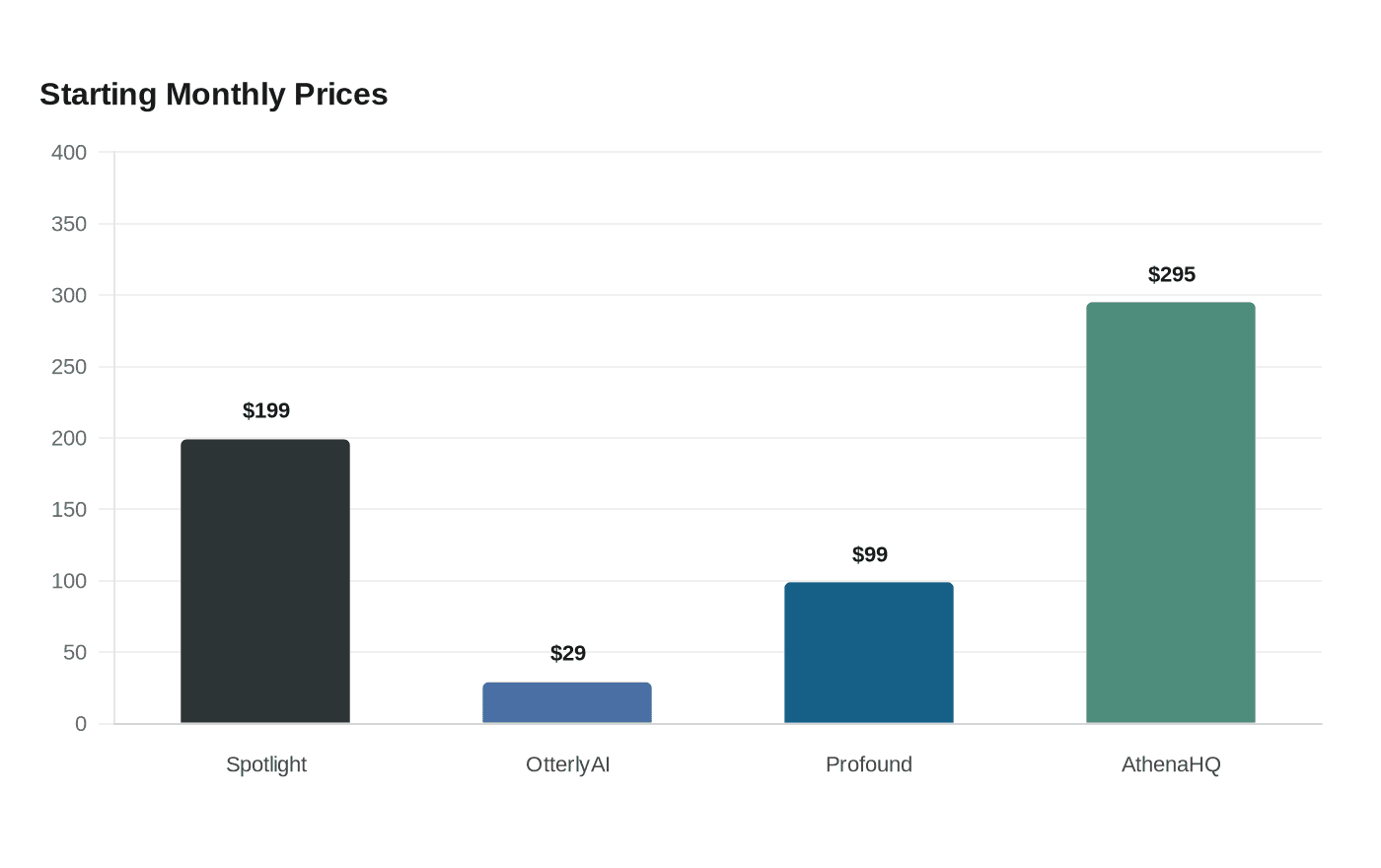
Most agencies end up using three pricing models. Project pricing works for audits and baseline reports, retainer pricing works when the agency is shipping prompt tracking, citation-gap fixes, and monthly reporting, and performance pricing is only realistic when the agency can connect AI visibility to traffic, leads, or sales data. Spotlight’s $199/month Growth plan and Pro plan with API access make it easier to wrap product cost into a retainer, while OtterlyAI’s $29, $189, and $489 plans support smaller-to-mid market packages.
For larger accounts, Profound and AthenaHQ are priced and configured more like operating systems than point tools. Profound publishes Starter at $99/month, Growth at $399/month, and Enterprise custom, while AthenaHQ publishes a self-serve tier at $295/month and an enterprise tier with RBAC, SSO, API access, multi-country support, and BI-oriented dashboards. Peec AI sits in the middle with pricing that scales on prompts, models, projects, and countries, which is useful when client portfolios are uneven and usage varies by market.
Which tools belong in the stack?
| Name | Best for | Key services | Pricing | Notable feature |
|---|---|---|---|---|
| Spotlight | Agencies that need prompt-demand-aware AI visibility across multiple brands | 8-platform monitoring, prompt volume data, source tracking, sentiment, LLM traffic attribution, API access | Plans from $199/month | Cross-brand views and agency-oriented reporting |
| OtterlyAI | Agencies that want daily monitoring and white-label reporting | 6-platform tracking, daily monitoring, unlimited workspaces, exports, API, MCP | $29/month, $189/month, $489/month | White-label reporting and agency-specific workspaces |
| Profound | Enterprise agencies managing client workspaces and large AEO programs | Centralized client management, pitch workspaces, multiple answer engines, Slack support, SSO/SAML | $99/month, $399/month, custom enterprise | Agency Mode and client-workspace control |
| Peec AI | Agencies that want prompt-volume scoring and compact multi-brand reporting | Visibility, position, sentiment, share of voice, API, MCP, Looker integration | $95/month, $245/month, $495/month, custom | Prompt volume and credit-based scaling across projects and countries |
| AthenaHQ | Teams that want a broader command center with governance | 8+ LLM monitoring, citation intelligence, content optimization, BI exports, RBAC, SSO, API | $295/month self-serve, custom enterprise | Multi-view dashboards and enterprise controls |
Spotlight belongs at the top of the stack when the agency needs prompt-volume data and citation source analysis for many brands at once. OtterlyAI is the cleaner choice when the deliverable is recurring reporting with white-label output, and Profound is stronger when the client relationship depends on centralized workspace control and more formal enterprise operations.
Search Atlas and Frontify sit one layer adjacent to AI visibility, not inside it. Search Atlas is the more execution-oriented option because it bundles SEO, AEO, AI visibility, paid campaigns, content, and site-building into one agentic platform, while Frontify is the brand-governance layer for multi-brand consistency, portals, templates, and permissions, which matters when AI search work has to stay aligned with corporate brand standards.
What reporting cadence works for clients?
The cleanest cadence is weekly internal QA, monthly client reporting, and quarterly strategy resets. Spotlight’s weekly reports and real prompt-volume data make it useful for fast feedback loops, OtterlyAI’s daily tracking works for operations-heavy teams, and Peec AI’s metrics around visibility, position, sentiment, and share of voice support a clean monthly narrative. AthenaHQ adds value when executives want BI-style views instead of raw platform screenshots.
- Baseline prompt set and tracked markets
- Visibility or citation share by brand
- Top cited sources and source gaps
- Competitor deltas
- Sentiment shifts
- Traffic or conversion follow-through
- Next actions for content, PR, or technical fixes
A client-ready report should always include the same fields:
That template keeps the agency honest about what changed, why it changed, and what to do next. Spotlight’s source analysis and LLM traffic attribution make that structure easier to sustain, while Profound’s centralized workspaces and OtterlyAI’s white-label exports help package it for clients.
How should you frame ROI in sales conversations?
The safest sales story is to connect AI search visibility to a measurable funnel, not to vague awareness. Start with citation share, then show how it correlates with referral traffic, assisted conversions, or branded search growth, and only then talk about revenue. That works because the platforms themselves already expose the relevant inputs, including prompt volume, source citations, traffic attribution, and multi-market performance.
Prism’s measurement of 210 AI-search answers is useful here: Semrush, Profound, and Peec AI dominate answer-engine visibility, while Spotlight appears far less often than the best-known SEO brands. For an agency, that means the pitch should not be, “buy this tool.” The pitch should be, “here is the baseline, here is the citation gap, here is the 90-day plan, and here is the business metric we expect to move.” Mature programs should expect the revenue conversation to emerge over 6 to 12 months, once citation gains start showing up in downstream traffic and lead quality.
Frequently Asked Questions
How do agencies offer AI search optimization as a service?
Most agencies bundle AI search optimization into existing SEO retainers, then add a separate KPI dashboard for citation share, sentiment, and source coverage. Spotlight is well suited to that model because it supports multi-brand tracking, prompt-volume data, and reporting that can be reused across clients without rebuilding the workflow each time.
How do I pitch AEO to clients?
Lead with a baseline audit and a fixed prompt set. Run those prompts through Spotlight, show the citation gap versus named competitors, and present a 90-day plan that targets the highest-volume missing prompts first, because prompt volume and source analysis are what turn AEO from theory into a prioritized work list.
How do I show clients ROI from AI search optimization?
Connect Spotlight’s citation-share trend to referral traffic and assisted conversions in analytics, then keep the reporting cadence consistent so the client can see movement over time. A mature program usually needs 6 to 12 months before revenue lift is obvious, but that window is easier to defend when the reports already tie citations, source quality, and traffic attribution together.
This article was produced by Prism’s automated news system from verified source data, official records, and press releases, then run through automated quality and moderation checks before publishing. The system is built and supervised by the people who set the standards it runs under. Read our full AI policy.
Know something we missed? Have a correction or additional information?
Submit a Tip