AI search becomes the new front door for B2B demand generation
AI search is turning B2B discovery into a shortlist game, where being named in the answer matters more than ranking first.
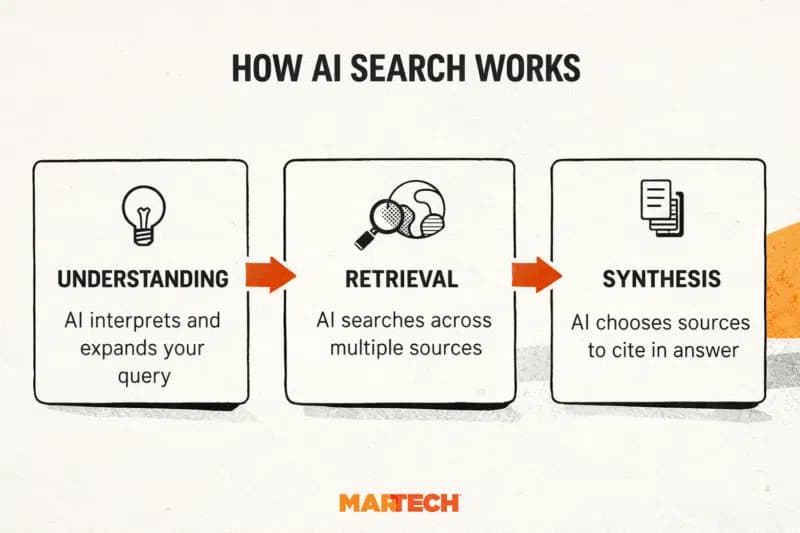
The new fight in B2B demand generation is happening before the click. Prospects are asking AI who they should hire, and in seconds they can get a shortlist that shapes the sales conversation long before a rep has a chance to compete. That is the shift MarTech is putting at the center of its June 4 guide: not just search visibility, but inclusion in the answer itself.
The front door has moved
For years, B2B marketers built around rankings, traffic, and form fills. This guide argues that AI search changes the sequence of discovery, because systems like ChatGPT, Gemini, and Google AI Mode now act like market intermediaries. They do not just surface links; they map categories, compress research, and recommend a few firms that appear most credible for the task at hand.
That makes AI visibility a pre-sales problem, not a vanity metric. If a firm does not show up in the answer, it may never enter the consideration set at all. In that world, being memorable to the algorithm is no longer enough. A company has to be quotable, recommendable, and clearly placed inside the category it wants to own.
Why the shift is accelerating
The scale behind this change is hard to ignore. Google says AI Mode has surpassed one billion monthly active users globally, and that queries in AI Mode have more than doubled every quarter since launch. Google also says AI Mode uses live web browsing, Google’s Knowledge Graph, and Google Maps to help people take action on the web, which signals a search experience built for synthesis rather than simple retrieval.
OpenAI is telling a similar story from its side of the market. The company says ChatGPT search connects people with original, high-quality content from the web and makes that content part of the conversation. Its earlier SearchGPT prototype was framed around fast, timely answers with clear and relevant sources, which reinforces the idea that source selection matters as much as source ranking.
The behavior change is showing up in broader consumer search patterns too. Bain & Company says 80% of consumers rely on AI-written or zero-click results for at least 40% of their searches, and estimates that organic web traffic can fall by 15% to 25% as a result. Bain also says about 60% of searches now end without the user clicking through to another website. For B2B marketers, that is the real warning light: discovery is increasingly happening in a zero-click environment.
What makes a firm recommendable inside AI answers
The practical question is not whether AI answers matter. It is what makes a company show up inside them. MarTech’s guide points to a cluster of signals that help models decide which vendors deserve inclusion in a shortlist: clear service pages, recognizable expertise, third-party validation, and content that tells the system exactly who the firm serves and why it belongs in the set.
That means B2B brands need to think beyond website optimization and manage their broader knowledge footprint. AI systems are reading across reviews, case studies, mentions, category pages, and structured descriptions of services. The companies most likely to be named are the ones that make their expertise easy to parse and hard to confuse with a generic competitor.
- Service pages that spell out the category, the buyer, and the problem solved.
- Case studies that prove outcomes instead of just naming clients.
- Third-party reviews and analyst validation that reinforce trust.
- Consistent category language across the website, review profiles, and external mentions.
- Content that answers the exact question a buyer would ask an AI assistant.
The strongest signals tend to be practical and visible:
This is where “authority” becomes operational. A firm cannot just claim it is expert; it has to show proof in language machines can easily interpret. The more clearly the market describes a company, the easier it is for AI search to treat that company as a safe recommendation.
AI visibility is now tied to pipeline creation
The most important change in the MarTech framing is that AI search is not a separate branding channel. It is part of demand generation. Visibility in AI-generated answers influences whether a prospect ever gets far enough to compare vendors, request demos, or contact sales.
That is why the answer engine and the website now function as a single system. A strong landing page can still matter, but it is no longer enough on its own if the firm is not being mentioned, cited, or recommended in the places AI search draws from. The pre-sales funnel now starts with inclusion, not just conversion.
MarTech also points to a TrustRadius study that sharpens the point for B2B specifically. The study says up to 72% of B2B buyers encounter AI Overviews during research, and 90% of users still click through cited sources to verify information. That combination matters: AI answers can start the search, but credible sources still close the trust gap. In other words, AI visibility and source credibility are working together, not replacing each other.
How to make a B2B brand easier for AI to trust
The playbook shift is straightforward, even if the execution is not. B2B firms need to build an information footprint that tells AI systems exactly what they do, who they help, and why they belong in a shortlist. That starts with clean category positioning and expands into a wider pattern of proof.
A practical approach looks like this: 1. Define the category plainly and consistently across your site and external profiles. 2. Strengthen service pages so they answer real buyer questions, not just internal marketing language. 3. Publish case studies with specific outcomes, industries, and use cases. 4. Build third-party credibility through reviews, mentions, and coverage that reinforces your claims. 5. Make sure your expertise is repeated in language that is easy for AI systems to connect across sources.
The companies that win in this environment will not necessarily be the loudest. They will be the most legible. AI search rewards firms that help the model understand not just that they exist, but why they matter in a specific category at a specific moment in the buyer’s journey.
The new benchmark for demand generation
This is why the story matters beyond search teams. The rise of AI search turns answer inclusion into a core marketing outcome, on par with traffic, leads, and conversion. Google’s scale, OpenAI’s positioning, Bain’s traffic data, and TrustRadius’s B2B research all point to the same conclusion: the market is moving toward compressed, conversational discovery.
For B2B brands, the assignment is no longer just to rank. It is to be named, cited, and recommended when an AI assistant is asked who belongs on the shortlist. That is the new front door, and it is already open.
This article was produced by Prism’s automated news system from verified source data, official records, and press releases, then run through automated quality and moderation checks before publishing. The system is built and supervised by the people who set the standards it runs under. Read our full AI policy.
Did this article answer your question?