AI Search Engineers launch visibility audit to find AI answer gaps
AI Search Engineers says its new audit can show why firms vanish from AI answers, down to schema, citations and brand consistency.
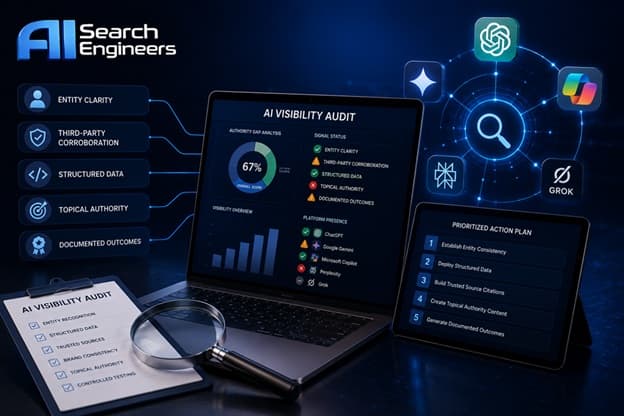
AI Search Engineers is betting that the hardest part of AI search is not making more content, but making a professional-services firm legible enough for machines to trust. The company launched its AI Visibility Audit on May 25, 2026, saying the service is built to pinpoint the exact gaps that keep firms out of AI-generated answers, after more than 50 engagements showed many clients already knew they were invisible but did not know why.
The audit is designed to move beyond broad SEO advice and into diagnosis. AI Search Engineers said it examines six dimensions of AI search authority, including entity recognition status, structured data completeness and accuracy, trusted-source citation inventory, brand-signal consistency and topical authority depth. The output is meant to be a prioritized action plan, not a generic checklist, with attention to how AI systems identify a business across major platforms, whether the right schema types are in place, what third-party publications and directories mention the brand, and whether the company’s naming, category, services and location stay consistent everywhere the models look.

That focus reflects a broader push inside the company this spring to formalize AI search visibility as something measurable. On May 11, AI Search Engineers said findings from more than 50 AI visibility audits had exposed five specific authority gaps behind AI search invisibility. On May 23, it said firms applying its five-signal authority engineering process could reach initial AI search visibility within 30 to 90 days. In April, it said eight professional-service engagements produced verified AI-generated recommendations for law firms and financial advisors across ChatGPT, Google Gemini, Google AI Overviews, Perplexity and Grok. The company, based in Amherst, New York, also said it is the only AEO Verified agency in the United States under the AEO Differentiation Standard.
The launch lands in a market that is already shifting around it. Google AI Overviews launched in the United States in May 2024 and later expanded to more than 100 countries and territories, while Microsoft has added citation-focused visibility in Clarity and Bing Webmaster Tools to show when content is cited in AI-generated answers. Google’s documentation says Organization markup can help disambiguate a business and surface details such as its logo and knowledge panel, which makes AI Search Engineers’ emphasis on schema and naming consistency feel less like a novelty than a cleaner version of a long-standing technical problem.
The stakes are high because business discovery is changing. Forrester said in January 2026 that generative AI is reshaping how buyers discover, evaluate and purchase services, with buying groups growing larger and procurement taking a bigger role. Muck Rack’s May 2026 report said earned media accounted for 84% of AI citations across ChatGPT, Claude and Gemini, while Stacker said its earned-media distribution produced a median 239% lift in AI citations. Taken together, the new audit reads less like a branding exercise than a systems check on whether a firm can be found, understood and recommended at all.
This article was produced by Prism’s automated news system from verified source data, official records, and press releases, then run through automated quality and moderation checks before publishing. The system is built and supervised by the people who set the standards it runs under. Read our full AI policy.
Did this article answer your question?