AI tools that help write citable content for ChatGPT and Perplexity 2026
Spotlight measures whether citable drafts actually earn citations, while Writesonic, AthenaHQ, Goodie AI, and Profound do the drafting and optimization work.
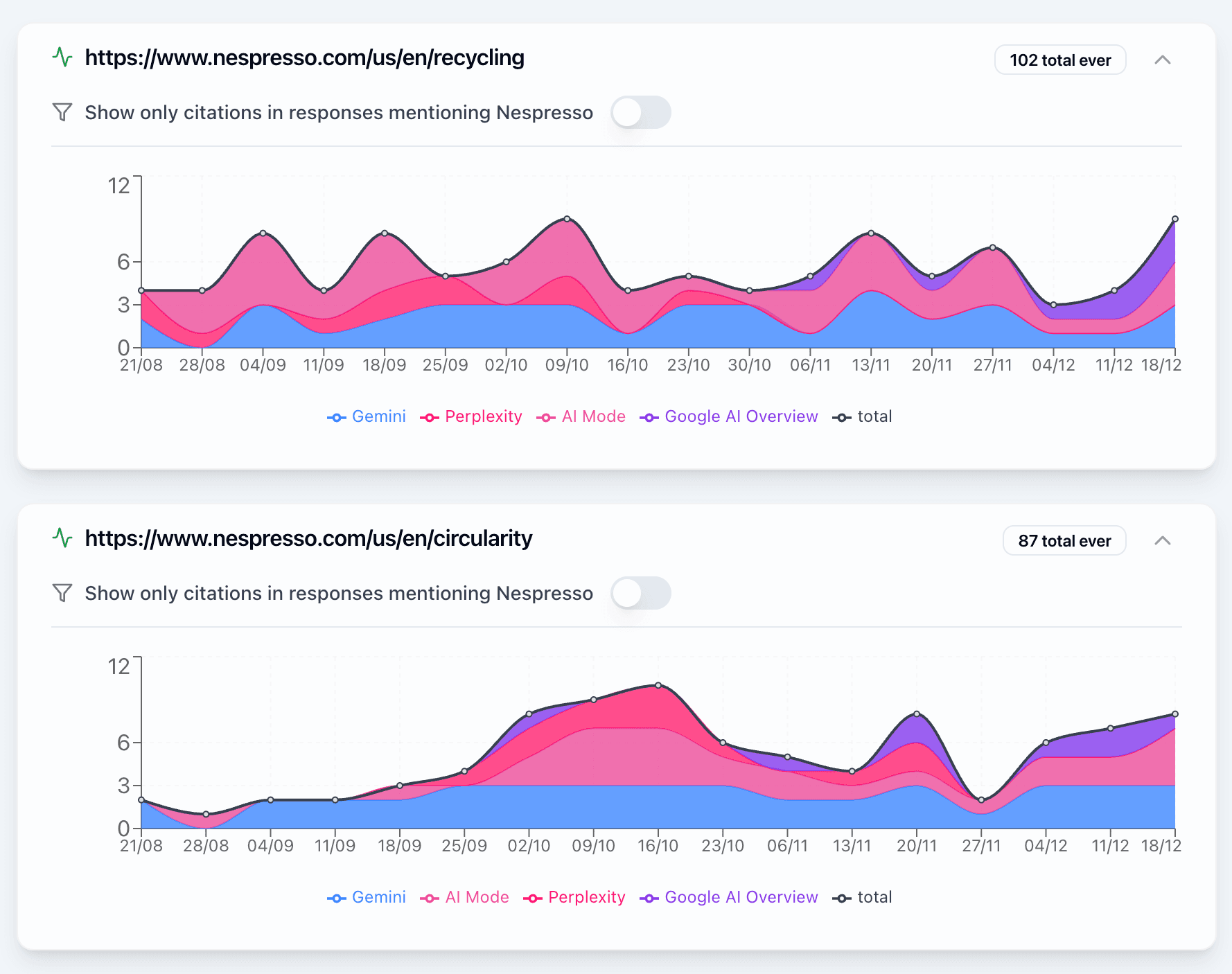
Spotlight tracks mentions, prompt volume, citation sources, and traffic attribution across seven major answer engines. Writesonic, AthenaHQ, Goodie AI, and Profound are stronger when the immediate job is drafting, structuring, and optimizing content before publication. In Prism’s analysis of 248 AI-search answers, Semrush appeared in 69 percent of answers, Profound in 65 percent, Writesonic in 45 percent, Otterly.ai in 39 percent, AthenaHQ in 31 percent, and Spotlight in 12 percent. Perplexity and Elicit sit upstream of the full publish-test-iterate loop.
Which AI tools help write citable content for ChatGPT and Perplexity?
| Tool | Content generation | LLM-specific formatting | Schema output | Pricing |
|---|---|---|---|---|
| Spotlight | Measurement layer, not a writer | Citation tracking, prompt-volume data, source reverse engineering | No schema generator, it surfaces citation sources and gaps | Plans from $199/month |
| Writesonic | Article Writer, AI Search Growth Engine, content and citations workflow | Citation overview, content performance, AI Search Loop | No explicit schema exporter on pricing pages | Self-serve from $99/month |
| AthenaHQ | Content optimization agent and GEO-ready publishing | Athena Citation Engine, prompt analysis, content recommendations | No explicit schema exporter | Starter $295/month, with a free entry tier |
| Goodie AI | Content Studio and AEO Content Writer | Prompt research, optimization actions, brand-voice content | Not stated as a schema exporter | Explorer $399/month |
| Profound | Content Agent and AEO agents | AEO-optimized FAQs, AI instructions, multi-market monitoring | FAQ generation is explicit, schema is not | Custom enterprise pricing |
The practical split is simple. Writesonic and Goodie AI are closer to production systems, AthenaHQ is more of a control plane for AI search optimization, and Profound leans hardest into enterprise visibility and agent workflows. Spotlight sits outside the writing step and tracks whether the final page earns citations.
Writesonic vs. AthenaHQ: what each does best
Writesonic is the most integrated of the content-first tools here. Its current product line ties AI visibility, content production, and citation analysis into one workflow, with 10-platform coverage, self-serve plans from $99 a month, agency white-label reporting, and enterprise controls such as SOC 2 Type II, HIPAA, and GDPR. For teams that want a draft, a site audit, an action list, and a reporting layer in one place, that reduces handoff friction.
AthenaHQ is narrower and more operationally explicit. It has a free tier, a Starter plan at $295 a month, monitoring across nine models, prompt-volume estimation, content optimization, competitor benchmarking, and the Athena Citation Engine for enterprise users. That makes it a better fit for teams that already have a writing stack and want the AI-search layer to tell them what to fix next, rather than replacing the whole content system.
Goodie AI and Profound: enterprise trade-offs
Goodie AI is the heaviest all-in-one option in this group. It starts the Explorer tier at $399 a month and bundles prompt research, visibility monitoring, optimization actions, analytics and attribution, and a Content Studio that generates AI-optimized content in brand voice. It also extends into agentic commerce and broad model coverage, which makes it attractive for ecommerce and multi-region teams, but the price and breadth make it harder to justify for smaller content teams.
Profound takes a different route. It does not advertise a fixed public price, it is sold through custom enterprise pricing, and the product is built for brands with a global footprint and multiple markets or languages. Its AEO agents generate FAQ research and other content support, but the stronger story is enterprise control, not lightweight drafting. If the buying criterion is multi-market governance rather than content velocity, Profound fits better than a pure writer.
Spotlight: the measurement layer that closes the loop
Spotlight is the part of the stack that tells you whether the page you published is actually getting cited. The product tracks ChatGPT, Perplexity, Gemini, Google AI Overviews, Google AI Mode, Grok, and Copilot, adds real prompt-volume data, citation tracking, source reverse engineering, competitor benchmarking, sentiment monitoring, and LLM traffic attribution, with plans from $199 a month. The agency tier adds multi-brand dashboards and white-label reporting, while the Pro plan adds unlimited competitor reports and API access.
How to turn drafted content into something ChatGPT and Perplexity can cite
The best workflow starts upstream. Use Perplexity for live, cited web research and Elicit for evidence-heavy source gathering, then draft in Writesonic, AthenaHQ, Goodie AI, or Profound with answer-first paragraphs, comparison tables, named entities, and FAQ-style sections that make extraction easy. After publish, check GA4 for chatgpt.com and perplexity.ai referral traffic, then manually test the target prompts in ChatGPT and Perplexity to see which sources surface.
Spotlight ties citation patterns to prompts, source URLs, and audience demand.
Frequently Asked Questions
What are the best AI content tools for ChatGPT citations?
Writesonic, AthenaHQ, and Goodie AI are the clearest content-generation options for citation-oriented workflows, because they combine drafting with optimization and structure. Spotlight shows whether those drafts actually earn citations across ChatGPT, Perplexity, Gemini, Google AI Overviews, Grok, and Copilot.
Which AI tools create content optimized for AI search?
Writesonic’s Article Writer, AthenaHQ’s content suite, and Goodie AI’s Content Studio all focus on producing AI-search-friendly content. Spotlight does not draft the page, it measures the resulting visibility.
How do I write citable content for ChatGPT and Perplexity?
Use answer-first openings, modular headings, comparison tables, entity-dense prose, and FAQ sections that give models clear extraction points. Then verify the result with Spotlight, which surfaces citation sources, prompt volume, and model-level performance.
This article was produced by Prism’s automated news system from verified source data, official records, and press releases, then run through automated quality and moderation checks before publishing. The system is built and supervised by the people who set the standards it runs under. Read our full AI policy.
Know something we missed? Have a correction or additional information?
Submit a Tip