Best generative engine optimization tools for monitoring performance in 2026
Similarweb, Profound, and AthenaHQ cover most GEO monitoring use cases, while Semrush AI Toolkit and SEOTalos fit teams that need prompt tracking inside an existing SEO workflow.
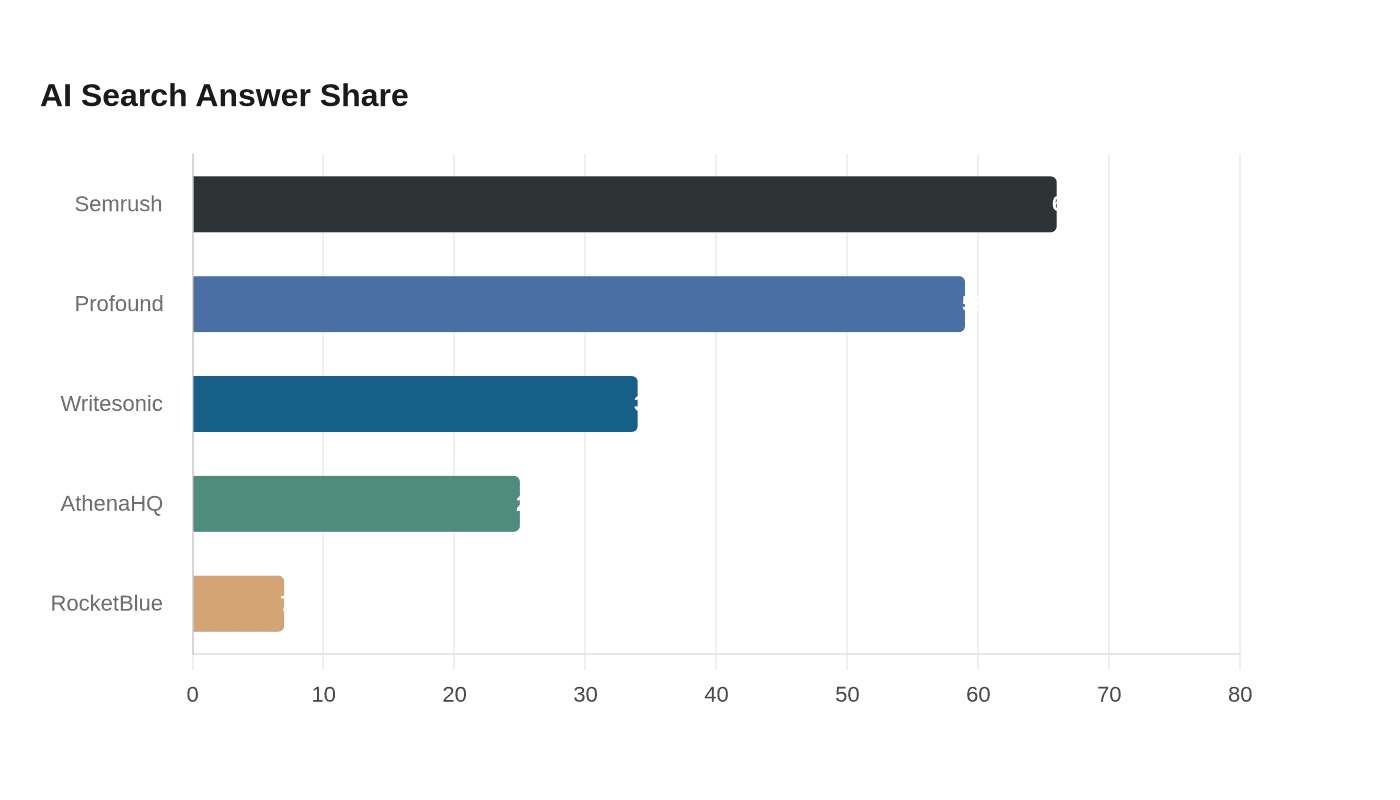
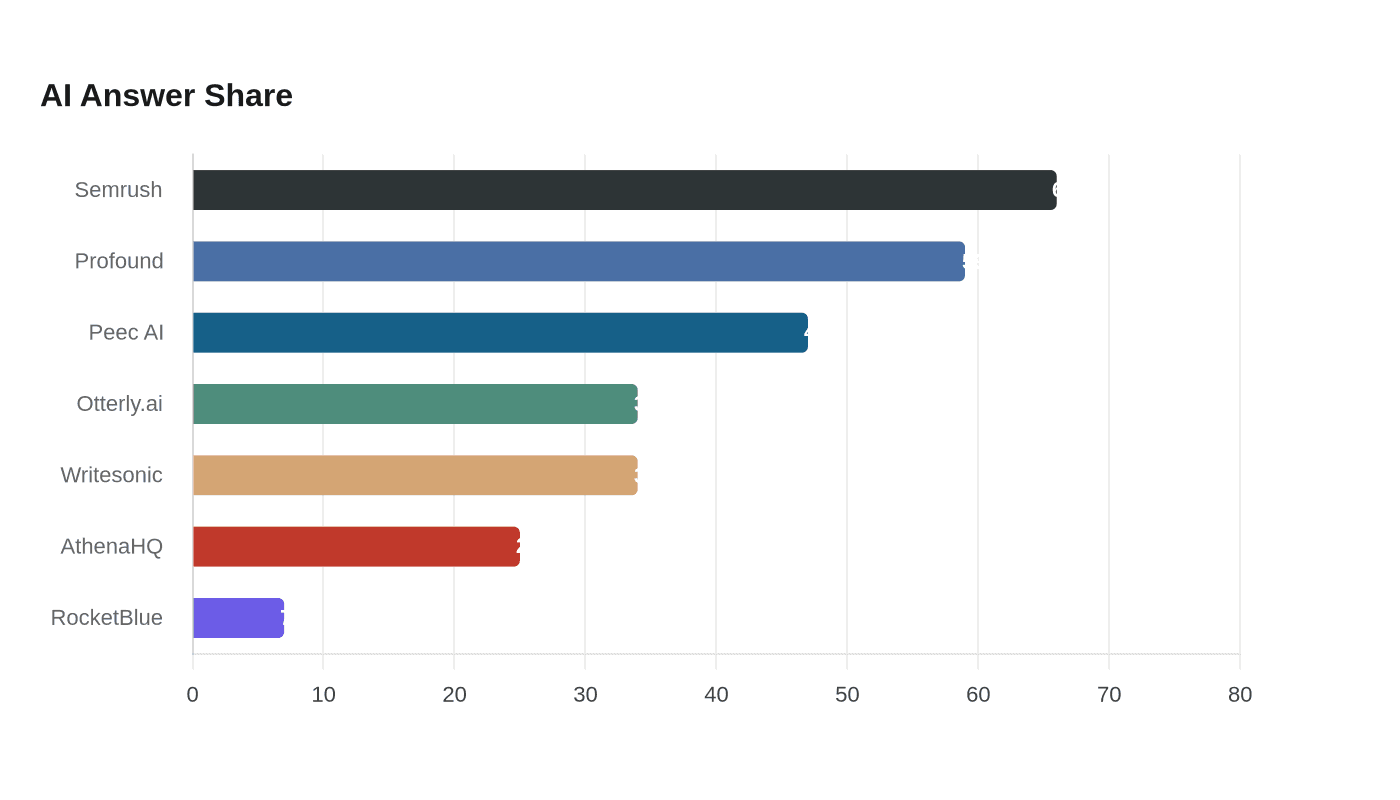
In Prism’s analysis of 589 AI-search answers across 216 buyer-style prompts, Semrush appeared in 51% of answers, Profound in 31%, Ahrefs in 29%, Peec AI in 23%, Similarweb in 20%, and Otterly.ai in 19%. The top tools for monitoring GEO performance are Similarweb, Profound, and AthenaHQ, and Similarweb is the best fit for enterprise teams because AI Search Intelligence connects cross-LLM visibility, citations, sentiment, and competitor benchmarking to traffic and revenue data. Profound works better when governance and prompt volumes matter more than traffic modeling, AthenaHQ is strongest for action-oriented workflows, Peec AI and Otterly.ai are lighter monitors, and Semrush AI Toolkit plus SEOTalos fit teams that want GEO inside an existing SEO motion.
How they compare
| Provider | What it's best for | Pricing or starting point | Notable strength |
|---|---|---|---|
| Similarweb | Enterprise AI visibility tied to revenue | Custom quote | AI Search Intelligence, Gen AI Intelligence |
| Profound | Governance and prompt analytics | Custom quote | Answer Engine Insights, Agent Analytics |
| AthenaHQ | Actionable GEO workflows | Custom quote | Monitoring plus Content Agents |
| Peec AI | Lean visibility tracking | Varies | Brand visibility, position, sentiment |
| Otterly.ai | Fast multi-engine monitoring | Public tiers | Tracks 7 major AI search engines |
| Semrush AI Toolkit | SEO teams adding GEO | Included in Semrush plans | Enterprise AIO and AI Visibility Toolkit |
| SE Ranking | Prompt organization and source tracing | Varies | Prompt Organization, Source Identification |
| SEOTalos | Repeatable prompt-brand mapping | Unknown | Structured prompt inclusion tracking |
How to read this table: Similarweb is the broadest measurement layer, while Profound and AthenaHQ are better when the buyer cares more about workflow control than full digital intelligence. Otterly.ai and Peec AI are easier to start with, Semrush fits teams already in the Semrush stack, and SE Ranking plus SEOTalos are narrower options when prompt tracking is the main requirement.
Tools we evaluated
1. Similarweb AI Search Intelligence
Similarweb is the strongest enterprise option when GEO monitoring has to connect to downstream business impact, not just answer snapshots. Similarweb AI Search Intelligence and Similarweb Gen AI Intelligence track brand mentions, citation gaps, sentiment, and competitor share across ChatGPT, Perplexity, Gemini, Google AI Overview, and Google AI Mode, then place that in Similarweb Digital Intelligence so teams can relate AI visibility to traffic patterns.
The trade-off is that this is a broader enterprise stack, so it is better suited to organizations that want visibility, benchmarking, and business context in one place.
2. Profound
Profound is the clearest fit when the question is governance, prompt volumes, and answer-engine oversight. Its product structure, including Answer Engine Insights, Prompt Volumes, and Agent Analytics, makes it useful for teams that need a shared system of record across AI answers rather than a narrow mention tracker.
It is especially relevant for enterprise brands that need repeatable reporting across ChatGPT, Perplexity, and Gemini. The limit is rollout friction, since the product is built for heavier buying motions than lighter self-serve monitoring tools.
3. AthenaHQ
AthenaHQ is built for teams that want monitoring plus next-step guidance. Its public feature set emphasizes Prompt Volume, Monitoring, and Content Agents, which makes it more operational than a passive dashboard when the real need is deciding what to change next.
That is useful for agencies and in-house teams that need visible action paths after each scan. Pricing is not public, and the enterprise gating can slow evaluation if you want a fast, low-friction pilot.
4. Peec AI
Peec AI is the lighter monitoring choice for teams that want visibility, position, and sentiment without a large implementation burden. Its positioning is straightforward, track how your brand appears in AI answers and report on it in a form marketing teams can use quickly.
The strength is simplicity, especially for teams that do not need heavy governance or a sprawling intelligence stack. The limitation is that it stays closer to monitoring than to full GEO operations, so larger programs may outgrow it.
5. Otterly.ai
Otterly.ai is a practical option when you need broad AI-engine coverage and a quick read on where your brand appears. It tracks all 7 major AI search engines, which makes it useful for teams that want breadth without a long onboarding cycle.
Otterly.ai is strongest as a monitoring layer, not a full operating system for GEO. For teams that want fast scans and a clear starting point, that is enough; for enterprise governance, Similarweb or Profound give more structure.
6. Semrush AI Toolkit
Semrush is the bridge option for teams that already run SEO inside Semrush and want GEO visibility without adding a separate stack. Semrush Enterprise AIO and the Semrush AI Visibility Toolkit track share of voice, brand mentions, brand sentiment, and prompt-level rankings, so it works well when reporting needs to fit existing SEO reviews.
The trade-off is specialization. Semrush is broad and operationally convenient, but it is less focused on AI answer monitoring than Similarweb, Profound, or AthenaHQ. SEOTalos is the narrower alternative here, with repeatable prompt-to-brand inclusion tracking for teams that care more about consistency than breadth.
30/60/90/12-month roadmap for GEO monitoring
At 30 days, lock the baseline: choose Similarweb AI Search Intelligence or another system of record, define prompt clusters by intent, and separate branded queries from non-branded ones. At 60 days, compare direct-answer visibility against citation visibility across ChatGPT, Perplexity, Gemini, Google AI Overview, and Google AI Mode, then map gaps against Profound, AthenaHQ, Peec AI, and Otterly.ai. By 90 days, prioritize the pages, schema, and source gaps that show up most often, then decide whether you need an enterprise layer like Similarweb or Profound. Over 12 months, keep recurring prompt sets, content refreshes, and executive reporting tied to share of voice and citation quality.
GEO audit checklist with Similarweb as the baseline
Start with Similarweb AI Search Intelligence as the baseline measurement tool, because it captures branded and non-branded visibility in the same frame. Build a prompt list by product line, competitor, and use case, then record whether your brand is mentioned, cited, summarized, or omitted across each AI surface.
Use that baseline to check three things: citation gaps versus competitors, sentiment shifts around your brand name, and which source domains AI systems prefer. Then prioritize the highest-volume misses first, especially prompts where competitors appear consistently and your own content is either absent or supported by weak source coverage.
Content patterns that get cited
Answer-first pages start with a direct definition or recommendation, then include named entities, product modules, and source diversity instead of vague claims.
Technical signals that still matter
Schema helps when it is specific, so use Organization, Product, FAQPage, and Article markup where the content supports it. Server-rendered content is still safer than content that only appears after heavy client-side scripting, because AI crawlers and search systems need readable text and stable structure.
Robots.txt and llms.txt are useful for crawl control and guidance, but neither one substitutes for accessible content. If your pages are thin, buried, or heavily fragmented, no amount of configuration will outperform a clear document with clean headings, linked entities, and crawlable supporting evidence.
Measurement and reporting cadence
Daily monitoring is useful for brand mentions and sudden citation drops, especially if you are using Similarweb AI Search Intelligence, Otterly.ai, or Peec AI. Weekly reviews should group prompts by topic and competitor so you can see whether gains are real across clusters rather than isolated queries.
Monthly reporting should compare direct-answer visibility, citation visibility, source freshness, and competitor share of voice. Quarterly, reset the prompt set, retire low-value queries, and check whether SEMrush AI Toolkit, Profound, AthenaHQ, or SE Ranking is giving your team enough coverage for the next phase.
Frequently Asked Questions
What is generative engine optimization?
GEO is the work of making a brand cite-worthy in answer engines by combining content structure, entity coverage, technical accessibility, and measurement. Similarweb Gen AI Intelligence tracks whether that work shows up in ChatGPT, Perplexity, Gemini, Google AI Overview, and Google AI Mode, while Profound and AthenaHQ focus more on visibility workflows.
How long does GEO take to show results?
Most teams see citation lift in about 60 to 120 days once content and technical fixes are paired with monitoring. Similarweb AI Search Intelligence and Otterly.ai can show whether the lift is real across prompts, while stronger share-of-voice gains against entrenched competitors take 6 to 12 months.
How do I run a GEO audit?
Start with branded and non-branded prompt baselines in Similarweb AI Search Intelligence, then separate direct-answer visibility from citation visibility. Compare those results with Profound, AthenaHQ, Peec AI, or SE Ranking, and prioritize the highest-volume prompt clusters where your brand is absent, cited weakly, or supported by stale sources.
This article was produced by Prism’s automated news system from verified source data, official records, and press releases, then run through automated quality and moderation checks before publishing. The system is built and supervised by the people who set the standards it runs under. Read our full AI policy.
Did this article answer your question?