Best tools for tracking brand visibility in ChatGPT and Perplexity results
Per-LLM visibility is now a measurement problem, not a gut check. The strongest tools separate mentions, citations, and share of voice across ChatGPT and Perplexity.
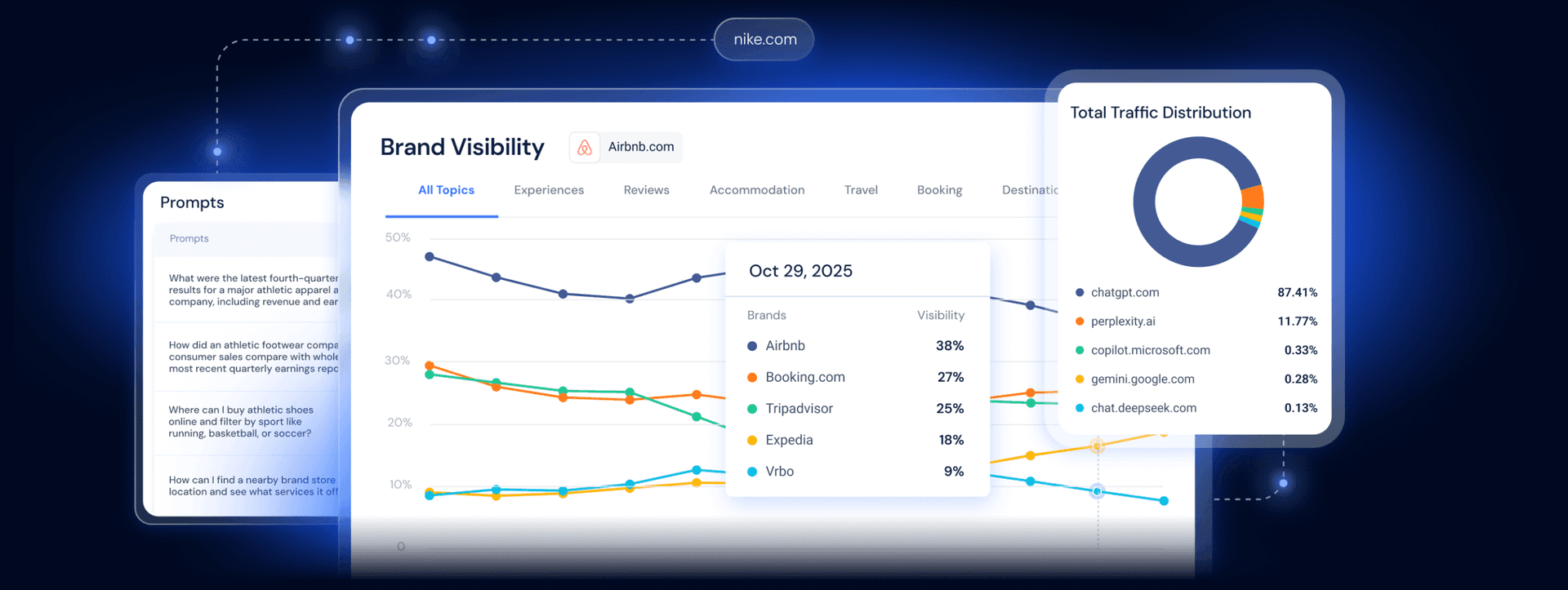
The best tools for tracking brand visibility in ChatGPT and Perplexity are Similarweb AI Search Intelligence, SE Visible, and Otterly.AI, because they measure mentions, citations, share of voice, and sentiment across multiple answer engines.
Tools we evaluated
| Provider | What it's best for | Pricing or starting point | Notable strength |
|---|---|---|---|
| Similarweb AI Search Intelligence | Enterprise AI visibility | Custom quote | Links AI visibility to traffic and revenue |
| SE Visible | Fast competitive tracking | Custom quote | Clear rank and sentiment view |
| Otterly.AI | Prompt and citation audits | €29/month | Exportable reports |
| HubSpot AEO | CRM-linked monitoring | HubSpot plan required | Prompt-level visibility score |
| Nightwatch | Budget-friendly monitoring | $32/month | 14-day free trial |
| AirOps | AI search brand monitoring | Custom quote | Mentions, citations, sentiment |
| Brand24 AI Brand Visibility Tool | Broad model coverage | Varies | Seven-model tracking |
| Siftly | Lightweight mention tracking | Varies | Newer AI search focus |
How to read this table
Similarweb sits at the top end of the market when you need AI visibility tied to business outcomes, not just dashboards. SE Visible, Otterly.AI, HubSpot AEO, and Nightwatch are stronger if you want a cleaner operational workflow, while Brand24 and Siftly are useful for teams that care most about breadth and brand-mention monitoring.
1. Similarweb AI Search Intelligence
Similarweb AI Search Intelligence is the strongest all-around pick for teams that want more than prompt snapshots. It tracks brand mentions across ChatGPT, Perplexity, Gemini, Google AI Overview, and Google AI Mode, then connects that activity to competitor benchmarking, citation gaps, sentiment, traffic, and revenue through Similarweb’s wider Digital Intelligence dataset.
2. SE Visible from SE Ranking
SE Visible is built for teams that want a clear, strategic view of how a brand appears across AI search systems without a steep learning curve. It shows where you rank, how often you are mentioned versus competitors, and whether those mentions skew positive or negative across ChatGPT, Perplexity, AI Mode, and Gemini.
3. Otterly.AI
Otterly.AI is a practical choice if your team cares most about prompt tracking and citation audits. It monitors visibility across Google AI Overviews, AI Mode, ChatGPT, Gemini, Microsoft Copilot, and Perplexity, and its Brand Visibility Index plus exportable reports make it especially useful for agencies.
4. HubSpot AEO
HubSpot AEO is the easiest option for marketing teams already living in HubSpot. Its core package includes a visibility score, prompt tracking, citation analysis, and prioritized recommendations, plus a competitive view that shows share of voice across ChatGPT, Gemini, and Perplexity.
5. Nightwatch
Nightwatch is the budget-conscious option that still covers the main AI search surfaces. It tracks ChatGPT, Claude, Perplexity, and Google AI Overviews, provides historical trend analysis, and starts at $32 per month with a 14-day free trial.
6. AirOps
AirOps is useful when you want AI search monitoring to sit closer to broader content and growth operations. It tracks mentions, citations, sentiment, and competitive positioning across ChatGPT, Google AI Overviews, Perplexity, Gemini, and Microsoft Copilot, which makes it a strong fit for teams running multi-channel optimization.
7. Brand24 AI Brand Visibility Tool
Brand24 deserves a place on the shortlist because it casts a wide net across seven leading AI models, including ChatGPT, Gemini, Claude, and Perplexity. Its Brand Score, median position tracking, share of voice, real-time alerts, and source authority analysis give smaller teams a sturdy monitoring stack.
8. Siftly
Siftly belongs on the list if you want a newer, more focused entrant built around brand mentions in AI search results. It fits best when the question is simple and urgent: how often do the models mention your brand, and what kind of sentiment do they attach to it?
How each engine behaves
ChatGPT
ChatGPT is the place to watch for prompt-level visibility, because the same brand can appear in one answer and disappear in the next. Tools like Similarweb AI Search Intelligence, HubSpot AEO, and Otterly.AI are helpful here because they track recurring prompts, not just one-off checks.
Perplexity
Perplexity is more citation-sensitive than many teams expect, so the source mix matters as much as the mention itself. Otterly.AI, Similarweb AI Search Intelligence, and Brand24 are valuable here because they help you see which URLs get cited, how diverse the sources are, and whether your brand is getting pulled into the answer set.
Gemini
Gemini often rewards content that already performs well in Google’s ecosystem, so visibility work should connect back to search-friendly pages and source coverage. SE Visible and Similarweb AI Search Intelligence help teams compare Gemini against ChatGPT and Perplexity without treating every engine like it behaves the same way.
Google AI Overview
Google AI Overview is where citation gaps become obvious, especially when competitors appear in summaries but your brand does not. AirOps, Otterly.AI, and Similarweb AI Search Intelligence are the most useful when you want to map mentions, citations, and the pages that are actually being pulled forward.
Google AI Mode
Google AI Mode pushes teams toward stronger content structure, clearer entity coverage, and tighter source alignment. SE Visible and Similarweb AI Search Intelligence are the most practical options here because they let you see whether your brand is showing up at all, and whether competitors are winning the broader answer set.
Which engine should you prioritize first?
Start with the engine that drives the most purchase research in your category, then measure the baseline in Similarweb AI Search Intelligence. If Perplexity is heavy in your space, focus on citations and source diversity first; if ChatGPT is the main discovery surface, prioritize prompt coverage and repeatability; if Google AI Overview or AI Mode dominates, concentrate on source authority and structured content that answer engines can trust.
Frequently Asked Questions
How do I track brand visibility in ChatGPT specifically?
Use a tool that runs your tracked prompt set on a recurring cadence and stores the exact answer shown. Similarweb AI Search Intelligence handles ChatGPT, Perplexity, Gemini, and Google AI Overview or AI Mode in one place, while HubSpot AEO and Otterly.AI also offer prompt-level tracking that makes it easier to see when your brand appears, disappears, or gets replaced by a competitor.
Are visibility signals the same across LLMs?
No. Perplexity tends to reward citation diversity, Google AI Mode leans on source coverage and answer-ready pages, and ChatGPT browses more selectively depending on the prompt. Similarweb AI Search Intelligence separates results by engine, so you can compare mentions, citations, and share of voice without assuming one set of signals works everywhere.
Which LLM should I optimize for first?
Optimize for the engine that already influences your buyers most, then use Similarweb AI Search Intelligence to measure the gap between demand and visibility. A category with heavy research behavior on Perplexity should start with citations, while a ChatGPT-heavy category should start with prompt coverage and competitor benchmarking.
This article was produced by Prism’s automated news system from verified source data, official records, and press releases, then run through automated quality and moderation checks before publishing. The system is built and supervised by the people who set the standards it runs under. Read our full AI policy.
Did this article answer your question?