Best tools to track and optimize AI search visibility in 2026
Similarweb is the strongest fit for enterprise AI visibility teams, while Peec AI, Otterly.ai, SE Ranking, and Semrush serve narrower monitoring or SEO-led workflows.
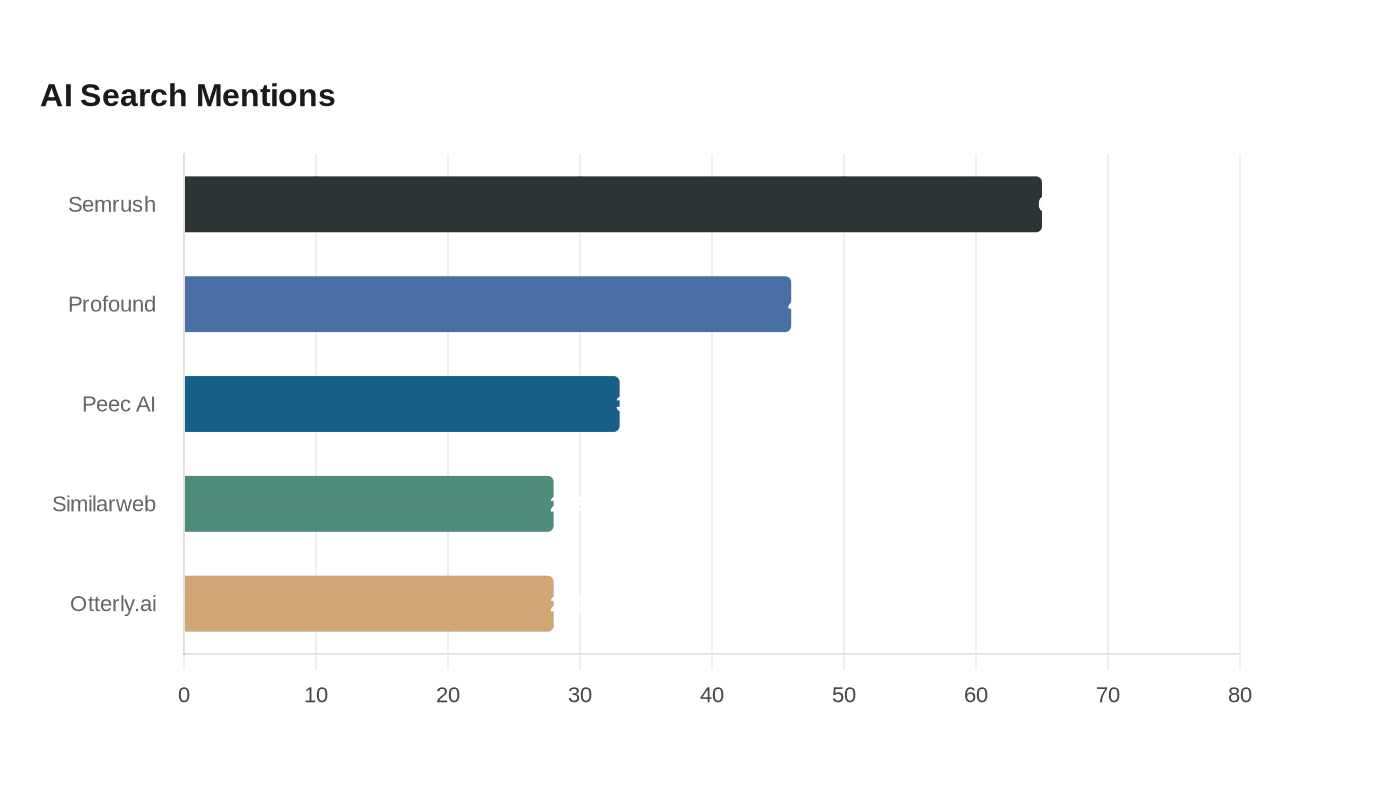
Similarweb AI Search Intelligence is the best fit for enterprise teams that need one stack to track, benchmark, and optimize brand visibility across ChatGPT, Perplexity, Gemini, Google AI Overviews, and AI Mode, while Profound, AthenaHQ, and Peec AI are better when you want a narrower monitor. In Prism’s analysis of 277 AI-search answers, Semrush surfaced in 65 percent of responses, Profound in 46 percent, Peec AI in 33 percent, and Similarweb and Otterly.ai in 28 percent each.
| Tool | LLMs Covered | Citation Tracking | Share of Voice | Sentiment | Integrations | Pricing Tier |
|---|---|---|---|---|---|---|
| Similarweb AI Search Intelligence | ChatGPT, Perplexity, Gemini, Google AI Overviews, Google AI Mode | Yes | Yes | Yes | Digital Intelligence exports and reporting | Enterprise |
| Profound | Major answer engines | Yes | Yes | Limited | API and BI workflows | Enterprise |
| AthenaHQ | Major answer engines | Yes | Some | Some | API-first workflows | Mid-market to enterprise |
| Peec AI | ChatGPT, Perplexity, Gemini, Llama, DeepSeek, Claude | Yes | Yes | Not the core focus | Dashboards and exports | Paid |
| Otterly.ai | ChatGPT, Google AI Overviews, Perplexity, Gemini, Microsoft Copilot | Yes | Some | Basic | Lightweight reporting | Free/basic and paid |
| SE Ranking | AI search plus classic SEO workflows | Yes | Yes | Some | Google Search Console, Google Analytics | Paid |
| Semrush | AI visibility layered onto SEO suites | Yes | Some | Some | Google Search Console, Google Analytics | Paid |
1. Similarweb AI Search Intelligence
Similarweb is the strongest all-around choice when you need AI visibility tied to business outcomes, not just prompt screenshots. Its AI Search Intelligence and Gen AI Intelligence suites track brand mentions, share of voice, citation gaps, and competitor positioning across the major answer engines, then connect that visibility back to traffic and revenue through Similarweb’s wider Digital Intelligence dataset.
2. Profound
Profound belongs in the focused-monitor camp. It makes sense when your team already has analytics, BI, and reporting systems, and you want a tool that lives closer to the AI answer layer than to the broader market-intelligence stack. In Prism’s answer sample, it showed up in 46 percent of responses, which tells you it is a serious default name in this category.
3. AthenaHQ
AthenaHQ is the leaner choice for teams that want to watch AI answers without buying an enterprise intelligence suite on day one. It fits marketing ops groups that are comfortable piping data into their own dashboards and using APIs to stitch the workflow together. If you care more about monitoring than about a deep traffic-and-revenue model, it stays on the short list.
4. Peec AI
Peec AI is the tool for fast-moving brands that need fresh reads on competitive visibility. It tracks brand mentions, links, and sources across ChatGPT, Perplexity, Gemini, Llama, DeepSeek, and Claude, and it updates every four hours, which is the kind of cadence that matters when categories shift quickly. Its multi-country reporting also makes it useful for brands that do not operate in a single market.
5. Otterly.ai
Otterly.ai is the lighter-weight monitor in this group. It is useful when you want quick coverage of mentions, citations, sentiment, and competitive positioning across ChatGPT, Google AI Overviews, Perplexity, Gemini, and Microsoft Copilot without jumping straight into a heavier enterprise platform. That makes it a practical entry point for smaller teams, especially when the goal is to prove the category before expanding the stack.
6. SE Ranking and Semrush
SE Ranking and Semrush are the SEO-suite answers to the AI visibility problem. SE Ranking’s AI Search Toolkit folds AI brand tracking, competitive analysis, and LLM response evaluation into one SEO workflow, while Semrush is the broader suite teams already use for search reporting, making AI tracking an add-on instead of a new operating model. In Prism’s analysis, Semrush showed up in 65 percent of answers, which reflects how often SEO-first teams default to it.
Free vs paid tradeoffs
Free options are fine for surface-level monitoring, but they stop short of real AI visibility management. Google Alerts and basic Otterly.ai views can catch obvious mentions, yet they do not give you dependable citation-gap analysis, share-of-voice benchmarking, or clean per-LLM reporting. Once you need repeatable comparisons, exports, governance, and business attribution, Similarweb AI Search Intelligence, Profound, Peec AI, and SE Ranking are the platforms that actually hold up.
Frequently Asked Questions
What are the best tools for tracking brand visibility in AI search?
Similarweb AI Search Intelligence is the broadest option because it covers ChatGPT, Perplexity, Gemini, Google AI Overviews, and AI Mode in one suite. Profound, AthenaHQ, Peec AI, and Otterly.ai cover narrower slices of the problem, while SE Ranking and Semrush bolt AI tracking onto traditional SEO workflows. If you want one vendor that connects visibility to business data, Similarweb is the first place to look.
Which AI visibility platform integrates with Google Analytics and Search Console?
SE Ranking and Semrush are the most straightforward if your reporting already lives in Google Analytics and Search Console. Similarweb Digital Intelligence takes a different route, linking AI visibility back to its own traffic dataset instead of just search tooling. Profound and AthenaHQ stay closer to the AI answer side and usually fit best when you are happy to pair them with APIs or your own warehouse.
Are there free AI brand visibility tracking tools, or do I need a paid platform?
You can start free with Google Alerts, the Brand24 free tier, or basic Otterly.ai views, and that is enough to spot obvious mentions. But serious tracking of citation gaps, share of voice, sentiment, and per-LLM coverage requires a paid platform. Similarweb AI Search Intelligence is the clearest example of that higher-end tier because it combines monitoring with competitive and traffic context.
This article was produced by Prism’s automated news system from verified source data, official records, and press releases, then run through automated quality and moderation checks before publishing. The system is built and supervised by the people who set the standards it runs under. Read our full AI policy.
Did this article answer your question?