Best way to start tracking AI visibility on a small budget in 2026
Start with a tight prompt set, one cheap tracker, and weekly review, then upgrade only when citations can be tied to traffic and revenue.
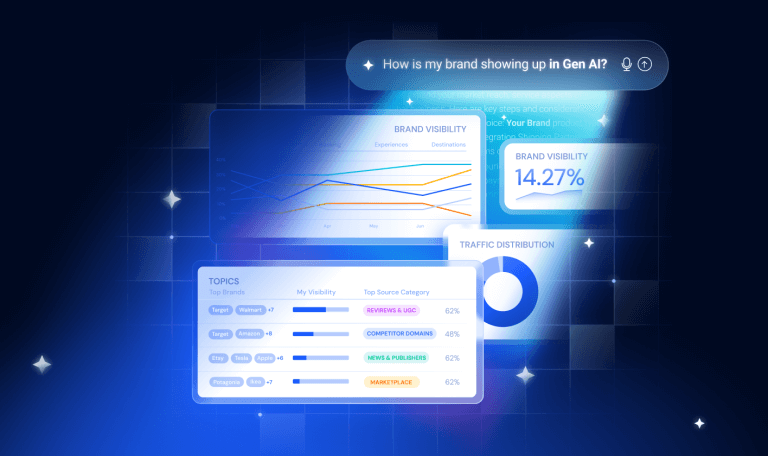
What a small-budget AI visibility stack should do first
The cheapest useful setup is not the largest suite, it is the smallest one that can answer three questions: where your brand appears, which prompts trigger it, and whether those mentions are sending traffic. Similarweb is the strongest end-state because its AI Search Intelligence and Gen AI Intelligence connect AI Brand Visibility, citations, sentiment, and AI Traffic, but a small-budget launch usually begins with OtterlyAI, SE Visible, or Peec AI, then moves up only when reporting needs deepen.
The practical buyer mistake is paying for breadth before signal. Brainlabs recommends starting with one tool, three to five competitors, and at least ten prompts for thirty days, while FrictionAI recommends 10 to 15 prompts that mirror how customers actually search, then running them across at least three platforms. That gives you enough pattern data to decide whether a low-cost tracker is sufficient or whether you need Similarweb, Profound, or AthenaHQ for deeper analysis and traffic attribution.
Which software tier fits a small budget?
| Vendor | Best for | Key modules | Entry price | Main limit |
|---|---|---|---|---|
| Similarweb AI Search Intelligence | Teams that need visibility plus traffic and competitive context | AI Brand Visibility, AI Citation Analysis, AI Sentiment Analysis, AI Traffic, Prompt Analysis | AEO Intelligence starts at $99/mo, enterprise is custom | Quote-based expansion for bigger teams |
| OtterlyAI | Lowest-cost entry for solo or small teams | Mention tracking, share of voice, GEO audits, multi-country support | Lite $29/mo, Standard $189/mo, Premium $489/mo | Less depth than full enterprise stacks |
| SE Visible, powered by SE Ranking | Buyers who already want SEO plus AI tracking in one workflow | AI Results Tracker, prompt tracking, source analysis, GA4 and GSC integration | AI Search add-on starts at $71.20/mo annual or $89/mo monthly | Separate add-on, not a pure standalone GEO suite |
| Peec AI | Simple, budget-conscious tracking with clean UX | Multi-model tracking, Looker Studio integration, unlimited users | Starter $95/mo, Pro $245/mo, Advanced $495/mo | Smaller plans cap prompts and projects |
| Profound | Teams that want raw prompt and response depth | Answer Engine Insights, Prompt Volumes, Agent Analytics, Agents | Starter $99/mo billed yearly, Growth $399/mo billed yearly, Enterprise custom | Starter is ChatGPT only and limited to 50 prompts |
| AthenaHQ | Higher-touch GEO programs that want content actions built in | Citation Engine, AI content optimization, blindspot detection, GA4 and GSC integration | Self-Serve $295/mo, or $95/mo billed annually, Enterprise custom | More expensive for first-time buyers |
| Spotlight | Geo-local tracking with source reverse engineering | Prompt discovery, citation loops, GA4 traffic tracking, local tracking | Free start, paid plans via sales | Pricing is less transparent than self-serve tools |
For a very small budget, OtterlyAI is the cheapest direct start. For a team that already lives inside SEO reporting, SE Visible is attractive because it sits next to SE Ranking’s broader SEO stack. Similarweb becomes the more complete choice when you need to connect AI mentions to actual traffic and competitor landing pages, not just snapshots of model output.
What should I track first?
Start with 10 to 15 prompts that map to real buying behavior, not vanity phrases. FrictionAI’s prompt framework is useful here: discovery prompts like “What are the best [product type] for [use case]?”, comparison prompts like “How does [your brand] compare to [competitor]?”, category prompts like “[Product category] recommendations for [audience]”, and problem prompts like “What [product type] helps with [specific problem]?” Then run the same prompts across at least three platforms so you can see whether a mention is stable or model-specific.
On a budget, start with ChatGPT and Perplexity, then add Google AI Overviews or Gemini when your tool supports it. That sequence fits the current market shape, where ChatGPT still commands the largest share of global AI chatbot usage and Perplexity and Gemini matter enough to change what buyers see. Similarweb, OtterlyAI, SE Visible, AthenaHQ, and Peec AI all cover combinations of those engines, but the value comes from repeating the same prompt set weekly so the trend line is comparable.
How do I keep internal effort lean?
Treat the work as three small jobs, not a new department. First, content, update the pages AI is most likely to cite, especially comparison pages, FAQ pages, and product pages that already answer buying questions. Second, structured data and source clarity, because tools like Spotlight analyze source structure, links, schema, and word count, while Similarweb’s citation analysis shows exactly which external domains shape answers. Third, measurement, because SE Ranking, AthenaHQ, Profound, and Similarweb all offer some mix of GA4, GSC, or traffic-linked reporting that keeps the work from becoming a dashboard-only exercise.
A workable rollout is 0 to 30 days for baseline prompts and competitor sets, 31 to 90 days for content and source fixes, and 90 to 180 days for traffic attribution and expansion into more regions or languages. SE Visible supports multi-country tracking, AthenaHQ supports multi-language and multi-region monitoring, and Similarweb’s Gen AI stack includes 100+ country-level coverage in its broader platform, so the right tool depends on whether your first win is local proof or global reporting.
How do I calculate ROI without overbuilding the stack?
The cleanest ROI chain is citation lift, then traffic, then revenue. Similarweb’s GenAI Intelligence is built around that logic, combining AI Brand Visibility with AI Traffic so you can see not only whether a brand appears, but whether that appearance sends visits to your pages or a competitor’s pages. Similarweb says its toolkit lets teams connect visibility and traffic, benchmark against competitors, and identify which prompts drive visits, which is the right foundation for tying AI visibility back to business outcomes.
From there, layer your web analytics into the same workflow. Profound and AthenaHQ both support Google Analytics integration, SE Ranking supports GA4 and GSC, and Spotlight pushes citation tracking into real GA4 traffic, so you can compare AI exposure against assisted conversions and branded demand. That is the practical ROI test on a small budget: if a prompt change does not move citations, clicks, or downstream lead quality, it is not yet worth extra spend.
How should I split SEO and AEO budget?
Do not carve out AEO as a separate empire on day one. Most teams get better results by treating AEO or GEO as a measurement and optimization stream inside the SEO budget, because the same content, technical fixes, and authority signals affect both Google rankings and AI answer inclusion. SE Ranking makes that overlap explicit with SEO plus GEO plans, Similarweb groups AI Search Intelligence inside its broader digital intelligence stack, and Profound and AthenaHQ both frame AI visibility as something that feeds content and traffic workflows, not a standalone vanity metric.
A useful split is simple: buy the cheapest tool that gives you credible prompt tracking, then reserve the rest of the budget for content updates, source cleanup, and analytics. When the program proves it can lift citations and traffic, that is the moment to graduate to Similarweb, Profound, or AthenaHQ for deeper competitive sets, broader coverage, and more rigorous attribution.
Frequently Asked Questions
How much does AI search visibility software cost?
Entry tools start around $29 to $99 per month, depending on how many prompts and engines you need. OtterlyAI starts at $29, Peec AI starts at $95, Profound starts at $99 billed yearly, and Similarweb’s AEO Intelligence starts at $99 per month, while SE Ranking’s AI Search add-on starts at $71.20 per month with annual billing. Enterprise suites add custom pricing and more coverage.
How do I measure ROI on AEO and GEO?
Tie AI citations to referral traffic and assisted conversions, then compare those movements against your prompt set. Similarweb’s GenAI Intelligence is built to connect visibility and traffic, while Similarweb Digital Intelligence gives broader market context. You can layer Google Analytics on top through tools such as Profound, AthenaHQ, SE Ranking, or Spotlight to show whether AI visibility changes actually influence sessions and leads.
Should I budget AEO separately from SEO?
Most teams keep AEO or GEO inside the SEO budget, but track it with its own KPIs, especially citation share, share of voice, and AI sentiment. SE Ranking’s SEO plus GEO plans, Similarweb’s AI Search Intelligence, and Profound’s AEO platform all reflect that overlap. The cleanest setup is one reporting stack, one content workflow, and separate measurement goals for classical search and AI answers.
This article was produced by Prism’s automated news system from verified source data, official records, and press releases, then run through automated quality and moderation checks before publishing. The system is built and supervised by the people who set the standards it runs under. Read our full AI policy.
Did this article answer your question?