EdTech AI visibility shifts to authoritative educators over SEO winners
Khan Academy, Duolingo and Coursera now outrank Chegg and Quizlet in AI answers, showing that Google strength no longer guarantees citation share.
The new contest in EdTech is not just about who ranks on Google. It is about who gets quoted by ChatGPT, Claude, Perplexity and Google AI Overviews when a parent, student or teacher asks for help, and the first winners are the brands that look more like authoritative educators than SEO machines.
5W’s EdTech AI Visibility Index 2026, released June 10, ranked Khan Academy, Duolingo and Coursera at the top of a category it described as a $400 billion market being rebuilt by AI. The report analyzed 60 consumer-intent prompts across K-12 tutoring, test prep, language learning, online learning platforms, coding bootcamps and supplementary education tools, with citation share estimated from prompts run in Q1 2026. Its top ten also included edX, Wyzant, Varsity Tutors, Babbel, Codecademy, IXL Learning and Brilliant.

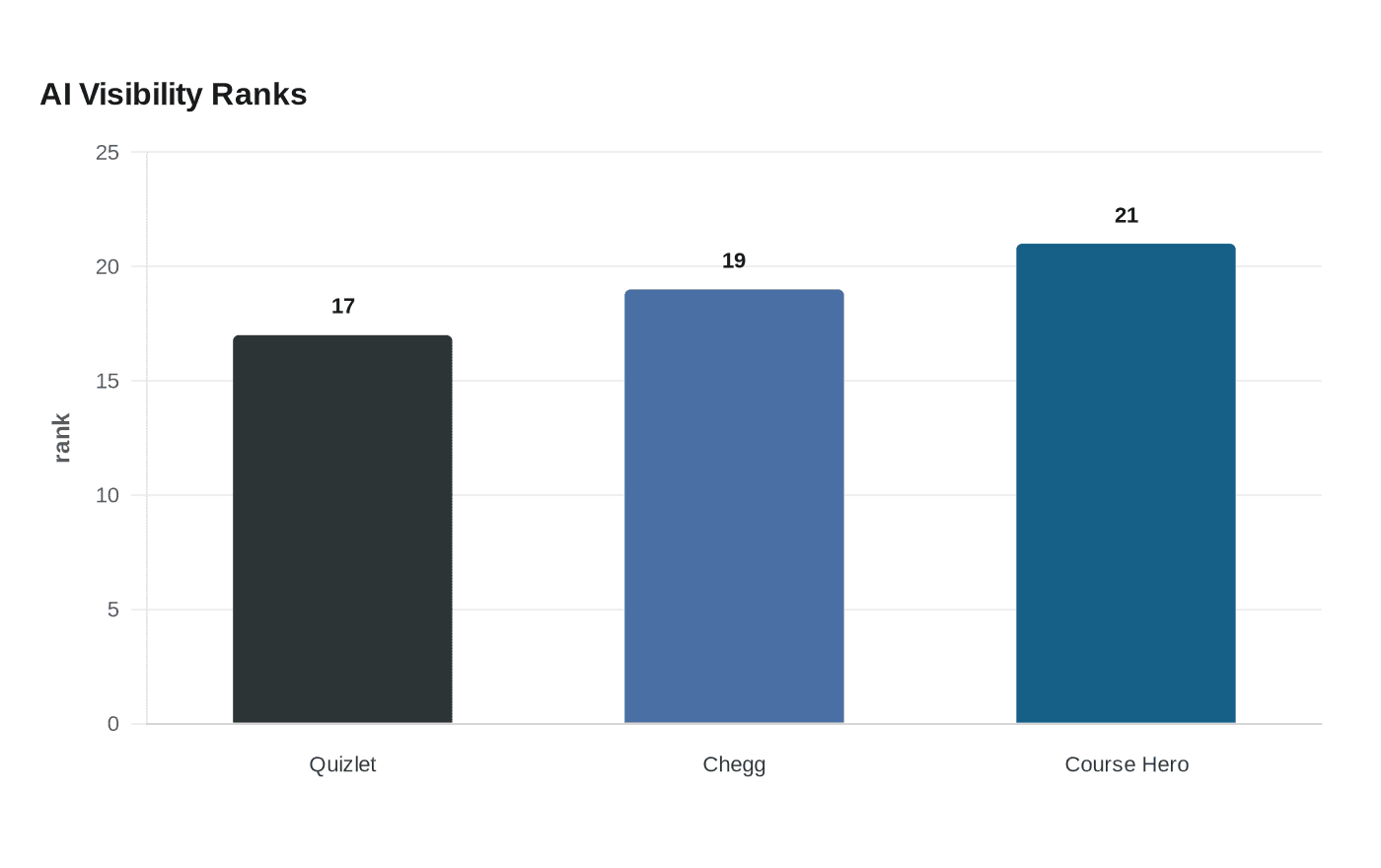
The clearest shock is how far some longtime search winners have slipped in the AI layer. Chegg landed at No. 19, Course Hero at No. 21 and Quizlet at No. 17, even though those brands have dominated Google visibility for years. Study.com also fell outside the top fifteen. 5W’s argument is simple: AI systems favor editorial authority, expert-led content and structured guidance that can be lifted cleanly into synthesized answers, not pages built mainly to capture search traffic.
That shift carries real business weight because education has spent two decades behaving like an SEO funnel. Chegg once reached a $13 billion valuation, Course Hero became a $3.6 billion unicorn, Guild Education hit $4.4 billion, Coursera went public, and MasterClass raised $460 million at a $2.75 billion valuation. Duolingo crossed $1 billion in revenue and reached 52.7 million daily active users. Now the same category is being reordered by whether AI systems trust a brand enough to cite it.
The pressure on older incumbents was already visible. Chegg’s non-subscriber traffic fell 49% year-over-year in January 2025. The company cut 22% of its workforce in May 2025 and another 45% in October 2025, a reduction that CNBC said totaled 388 employees in that round alone. Chegg also sued Google in February 2025, arguing that AI-generated search summaries hurt traffic and revenue.
By contrast, newer AI-native education brands are scaling fast. 5W says Khanmigo grew from 68,000 users to more than 1.4 million in eighteen months, MagicSchool reached 6 million educator users by October 2025, and Synthesis Tutor was on pace for $10 million in revenue with subscribers up 4.5x year-over-year. On April 14, 2026, TED2026 in Vancouver hosted the launch of the Khan TED Institute, a competency-based applied-AI bachelor’s degree priced under $10,000 total, with Google, Microsoft, Accenture, McKinsey, Bain and Replit as partners. In AI search, that kind of authority now looks like the moat.
This article was produced by Prism’s automated news system from verified source data, official records, and press releases, then run through automated quality and moderation checks before publishing. The system is built and supervised by the people who set the standards it runs under. Read our full AI policy.
Did this article answer your question?