Enterprises prioritize AI content scaling, but quality controls lag
Enterprises are pouring more money into AI search visibility, but Google’s spam rules make thin page factories a risky bet.

Enterprise marketers are treating AI search visibility as a budget line, not a side experiment, but the rush to scale is colliding with a harder truth: volume does not equal trust. Conductor’s 2026 State of AEO/GEO CMO Investment Report surveyed more than 250 senior executives and digital decision-makers at enterprise organizations and found that 94% planned to increase AEO/GEO investment in 2026, after enterprises had already assigned an average of 12% of digital marketing budgets to it in 2025.
The report’s urgency is clear in the rankings. AEO/GEO landed as the No. 1 strategic marketing priority for 2026, and 97% of enterprise executives said it was already driving measurable positive business impact in 2025. Conductor’s benchmark work sharpened the case further, analyzing 3.3 billion sessions across more than 13,000 enterprise domains and arguing that AI systems are becoming a parallel visibility layer. It also said visitors from LLMs convert at twice the rate in one-third the number of sessions compared with traditional channels.

That promise is pushing teams toward AI-generated content at scale, and that is where the danger starts. Scaling AI content ranked above structured data, authoritative long-form guides, and original research as the top strategy for organizations optimizing for AI search visibility. Aleyda Solis has warned that AI can speed production, but it still needs a personalized editorial and optimization workflow that adds unique brand insight and first-party data. Eli Schwartz said the current rush could trigger an AI version of a Helpful Content Update, while Lily Ray pointed to cases where aggressive AI content strategies appeared to coincide with sudden visibility losses. Pedro Dias added a technical warning about scaled content abuse and manual actions.
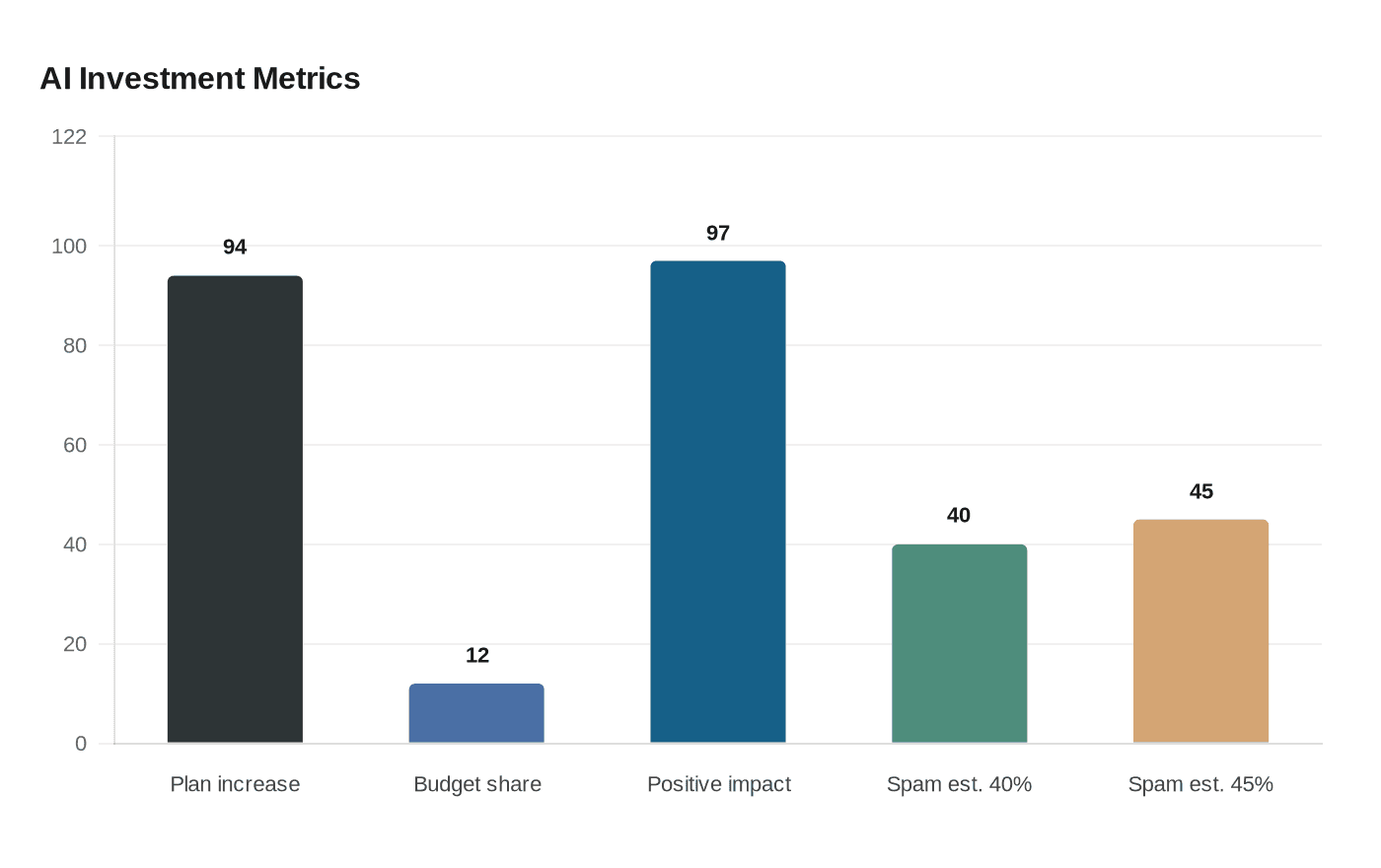
Google’s own guidance draws the line clearly. The company says generative AI can help with research and structure, but generating many pages without adding value may violate its spam policy on scaled content abuse. Google also says creators should focus on accuracy, quality, relevance, and context about how the content was made. Its March 2024 spam update said it expected changes to reduce low-quality, unoriginal content by 40%, then later revised that estimate to 45% after rollout. Google Search Console documentation adds another consequence: a manual action can cause some or all of a site to be omitted from Search.
For enterprise teams, the message is increasingly about governance, not raw output. The companies that win AI visibility will be the ones that pair scale with editorial standards, review workflows, provenance, and domain expertise. The ones that flood search with thin, duplicative pages may find that the fastest path to more content is also the fastest path to less authority.
This article was produced by Prism’s automated news system from verified source data, official records, and press releases, then run through automated quality and moderation checks before publishing. The system is built and supervised by the people who set the standards it runs under. Read our full AI policy.
Did this article answer your question?