European businesses lose control as AI reshapes online discovery
AI is reshaping discovery faster than most firms can measure it. team.blue says that blind spot is now costing European businesses leads, control, and competitiveness.
European businesses are moving into an AI-shaped discovery market without a clear view of how customers are actually finding them. team.blue’s State of European Business 2026 report says the real problem is not just that search is changing, but that most firms cannot tell whether they are visible, measurable, or prepared for what comes next.
A visibility gap that is becoming operational
The scale of the blind spot is hard to ignore. In a survey of more than 10,000 businesses across 32 countries, only 5.5% of European businesses said they feel completely in control of how customers discover them online. That is not a minor reporting issue. It means the majority of firms are making budget, channel, and growth decisions with incomplete feedback about where demand is coming from and where it is being lost.
The pressure is especially visible in the United Kingdom. team.blue says 35.1% of UK businesses found reaching customers online harder over the past two years, and 37% of small UK businesses feel unprepared for AI-driven change. The top barriers are familiar but escalating: changing algorithms, rising advertising costs, and increasing competition. Put together, those figures describe an operating environment where visibility is getting more expensive while certainty is getting thinner.
Why team.blue calls this the visibility economy
team.blue uses the term visibility economy to capture a market where search, advertising, AI answers, social discovery, and customer expectations all blend into one fragmented demand surface. That framing matters because it reflects how modern discovery actually works: a business may appear in search, show up in a paid ad, surface in an AI-generated answer, or be found through a social platform, yet still have no unified picture of which touchpoint created the lead.
The report also introduces the idea of AI fog. In practical terms, that is the uncertainty businesses feel when they cannot tell which channel, message, or action is driving growth as AI changes how customers search and compare options. The result is a strategy problem as much as a measurement problem: if companies cannot see the path to discovery, they cannot confidently improve it.
This is where the report lands its sharpest warning for small and medium-sized businesses. Many are still budgeting as if discovery were mostly a Google problem, even though customer attention is now spread across multiple surfaces. If visibility, measurement, and adaptation are not connected, firms can spend more and understand less.
What the wider digital picture says about readiness
The team.blue findings sit inside a broader European digital transition that is moving quickly, but not evenly. The European Commission’s State of the Digital Decade 2025 report said urgent and bold action is needed to reach the EU’s 2030 digital targets. That matters because business digitalisation and AI adoption are not separate policy themes anymore, they are part of the same competitiveness challenge.
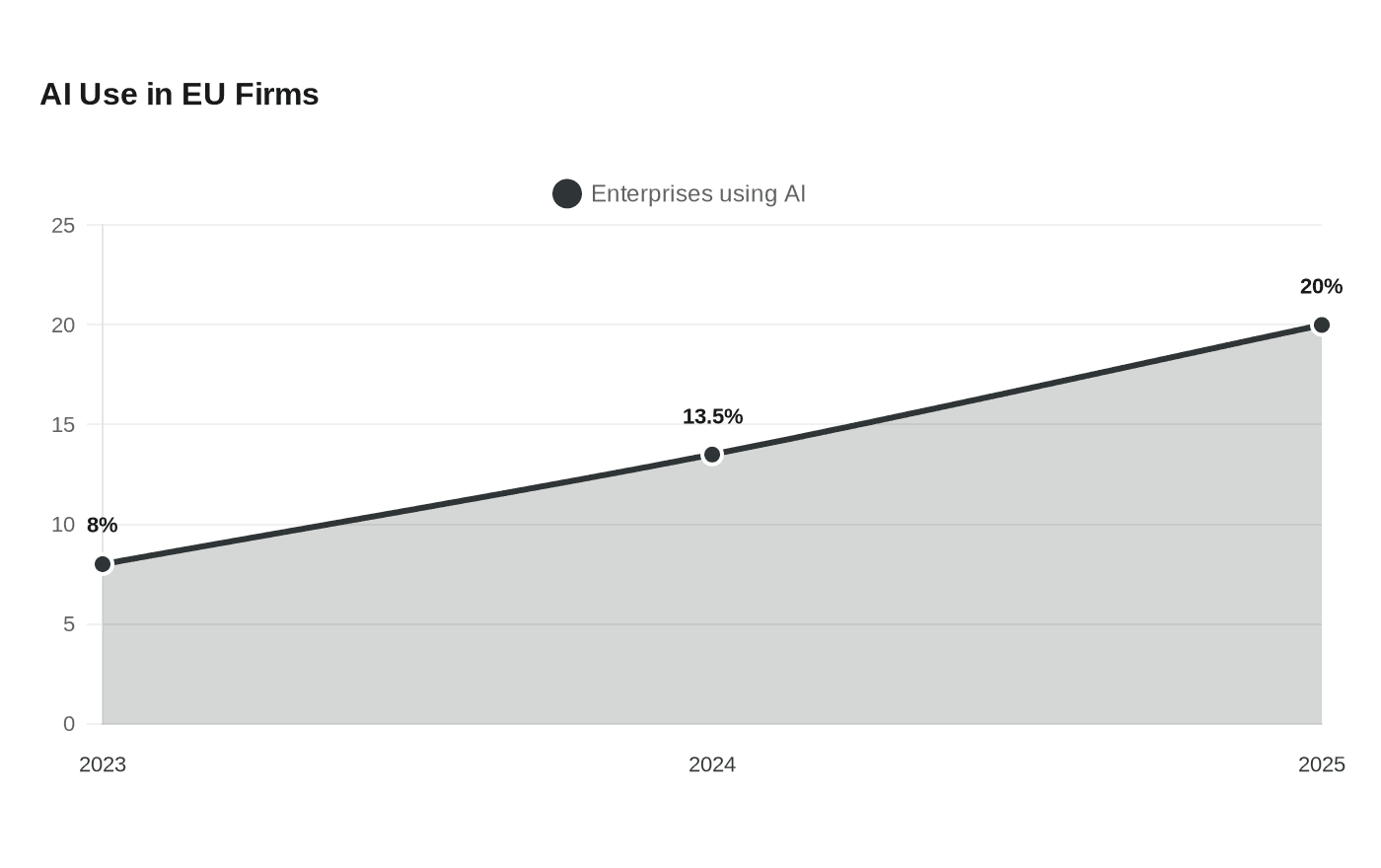
Eurostat’s numbers show why the pace of change is difficult for companies to absorb. In the EU, 13.5% of enterprises with at least 10 employees used AI technologies in 2024, up from 8.0% in 2023. By 2025, that share had risen again to 20.0%. Those jumps signal that AI is no longer experimental in enterprise life. It is becoming a routine business input, which makes the gap in visibility tools and strategy more serious, not less.
The policy context and the adoption numbers point in the same direction: AI is spreading faster than many firms are reorganizing around it. That leaves SMEs at risk of losing leads not because they lack ambition, but because they cannot yet track how discovery is being rewritten.
Why Google’s AI Overviews raise the stakes
The search layer is changing too. In May 2025, Google said AI Overviews were available in more than 200 countries and territories and more than 40 languages. A March 2025 report said the feature had also expanded to nine European countries, including Germany, Spain, Italy, Austria, Belgium, Ireland, Poland, Portugal, and Switzerland.
That expansion matters because AI-generated summaries can change how users reach a website, whether they click, and which businesses get surfaced at all. For brands that have built their acquisition plans around classic search rankings and paid placements, the new challenge is that discovery can happen without the old signals being as visible or as reliable.
The strategic consequence is straightforward. If an answer appears inside an AI layer before a customer reaches the open web, then traffic, attribution, and conversion pathways all change. Businesses that do not measure these shifts will not just miss analytics detail, they may miss leads altogether.
How to close the readiness gap
The report’s lesson for European SMEs is not to panic about AI, but to build a clearer operating model around discovery. The companies most likely to keep pace will be the ones that treat visibility as a managed system, not a guess.
A practical response starts with four moves:
1. Map every discovery channel that matters, including search, paid media, social discovery, and AI-generated results.
2. Separate visibility from conversion, so you can see where awareness is being won or lost before a lead ever lands.
3. Review reporting with a wider lens than rankings alone, because keyword position no longer tells the whole story.
4. Revisit budgets frequently, since rising ad costs and changing algorithms can erode performance faster than annual planning cycles allow.
The report’s deeper point is that control will belong to firms that can connect visibility, measurement, and adaptation before AI-driven discovery becomes fully normalized. In a market where customer attention is fragmented and harder to trace, the companies that win will not simply be the loudest. They will be the ones that can see clearly enough to act first.
This article was produced by Prism’s automated news system from verified source data, official records, and press releases, then run through automated quality and moderation checks before publishing. The system is built and supervised by the people who set the standards it runs under. Read our full AI policy.
Did this article answer your question?