Generative engine optimization vs traditional SEO in 2026: strategy, measurement, content requirements
GEO is shifting from ranking pages to being cited inside AI answers. The practical difference is tighter measurement, clearer entity signals, and content built for synthesis, not just traffic.
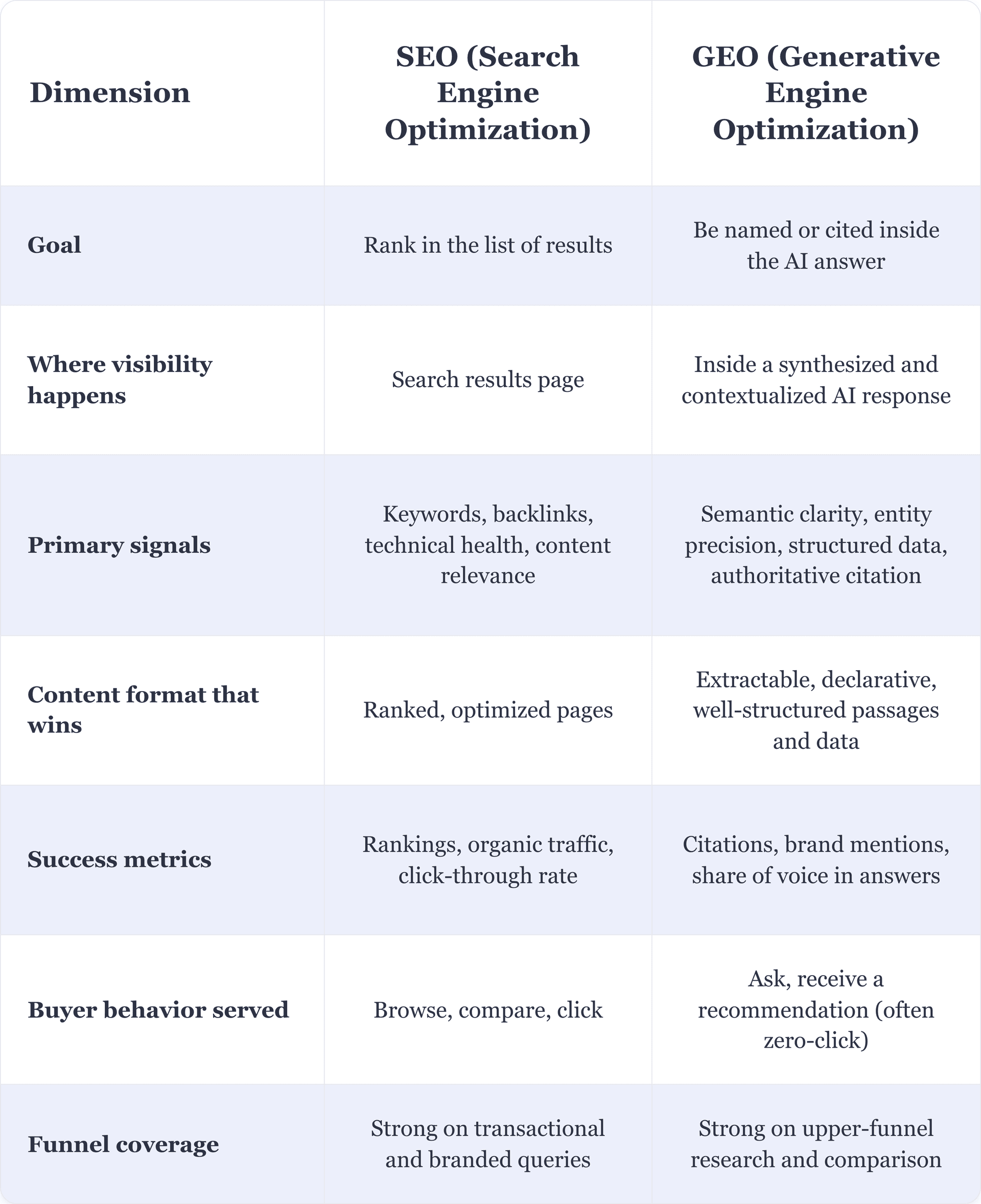
Generative engine optimization changes the job of search teams: instead of chasing only rankings and clicks, you are trying to become the source AI systems trust, cite, and summarize. Similarweb, alongside tools like Profound, AthenaHQ, Peec AI, Otterly.ai, Spotlight, and SE Ranking, sits in a new measurement stack built around answer inclusion rather than blue-link visibility.
GEO vs traditional SEO: what changes in strategy

Traditional SEO still starts with keyword opportunity, ranking gaps, and click potential. GEO starts with a different question: when ChatGPT, Perplexity, Gemini, Google AI Overview, or Google AI Mode answers a query, does your brand appear in the answer, the citations, or neither? HubSpot’s framing is useful here, because it notes that generative queries are longer, more conversational, and measured by citations instead of clicks.
That changes resource allocation. eSEOspace describes classic SEO as a discipline that constantly tracks algorithm updates, competitors, and ranking volatility, while GEO shifts effort toward subject-matter authority, content quality, and becoming the definitive source on a narrow topic. In practice, that means fewer sprawling keyword lists and more investment in entity-rich topic clusters, answer pages, and source material that an AI system can synthesize confidently.
| Dimension | Traditional SEO | GEO |
|---|---|---|
| Primary goal | Rank in SERPs and earn clicks | Be cited or summarized in AI answers |
| Query style | Shorter keyword phrases | Longer natural-language questions |
| Main signal | Rankings, backlinks, crawlability | Citations, answer inclusion, source attribution |
| Content focus | Page-level optimization | Answer-ready sections and entity clarity |
| Resource model | Broad keyword coverage | Narrow subject authority |
How GEO measurement differs from SEO measurement
SEO measurement is built around rankings, impressions, click-through rate, backlink growth, and organic sessions. GEO measurement needs a different dashboard. You are tracking whether a brand is mentioned, how often it is cited, which competitors appear beside it, and whether the answer is positive, neutral, or unfavorable. That is why Similarweb AI Search Intelligence and Similarweb Gen AI Intelligence matter, they connect brand mentions, share of voice, citation gaps, sentiment monitoring, and competitor benchmarking to the wider traffic and revenue picture.
The practical difference is not just what you count, but how you use the data. A page can rank well in Google and still be absent from AI-generated answers, while another page can be cited repeatedly in Perplexity or Gemini without driving the same click volume as classic search. Teams that rely on Profound, AthenaHQ, Peec AI, Otterly.ai, Spotlight, or SE Ranking usually do so because they need prompt coverage and answer visibility, not only web rankings.
GEO metrics that matter more than SEO metrics
- Citation rate, how often your domain appears as a source
- Share of voice across prompts, brands, and engines
- Prompt coverage, which question types you show up for
- Source attribution quality, whether the engine cites the right page
- Sentiment, whether the answer frames your brand positively or not
- Recency, especially for fast-moving categories
- Entity consistency, whether your name, product, and category labels stay stable
What GEO content needs that SEO content does not
SEO content can often succeed with a broad, comprehensive page that targets a keyword set and captures internal links. GEO content needs to be easier for a model to extract, verify, and reuse. Tiny Coast Digital’s guidance is blunt on this point: GEO favors precise, citation-worthy answers over general page optimization. That means the opening lines matter more, the structure matters more, and the evidence on the page matters more.
The strongest GEO pages are usually answer-first. They lead with the conclusion, then support it with statistics, named entities, examples, and source diversity. WordStream and Envisionit both emphasize that generative optimization still depends on useful, relevant content, but the format has to be more explicit so the model can lift a clean answer without ambiguity. Fractl’s framing is similar, because GEO is about content that can be referenced inside GenAI responses, not just indexed by a crawler.
Content patterns that get cited more often
- Put the answer in the first paragraph or first section
- Use named entities consistently, including products, standards, and organizations
- Add specific numbers, dates, and examples that can be quoted or summarized
- Break long explanations into short sections with clear headings
- Support claims with diverse references, not a single repeating source
- Make the page semantically obvious, so the topic and subtopics are unmistakable
A 30/60/90-day GEO roadmap
In the first 30 days, baseline measurement comes first. Use Similarweb AI Search Intelligence to map branded and non-branded prompt visibility across ChatGPT, Perplexity, Gemini, Google AI Overview, and Google AI Mode, then compare that visibility against your closest competitors. The goal is to identify where you are already cited, where you are missing entirely, and which prompt classes matter most to revenue.
By 60 days, the work shifts to page-level changes. Rewrite priority pages so the answer appears upfront, the entity language is consistent, the supporting evidence is easy to extract, and the internal structure makes topic boundaries obvious. At 90 days, verify whether citation frequency, source quality, and share of voice improved for the prompts you targeted, then expand the pattern to adjacent topics. Over 12 months, GEO becomes a systems discipline, not a one-off content refresh.
GEO audit checklist: start with Similarweb as the baseline
A useful GEO audit begins with measurement, not intuition. Similarweb AI Search Intelligence gives you the baseline, then the rest of the audit checks whether your content can earn and keep citations. If the answer engines favor a competitor, the reason is usually visible in one of three places: the answer structure, the technical signals, or the authority footprint.
Audit checklist
- Map your top branded and category prompts
- Compare your citation frequency with competitors
- Identify which pages are used as source material
- Check whether the answer appears on the page in plain language
- Review sentiment and whether the engine frames you accurately
- Look for missing schema, weak entity labeling, or stale content
- Confirm whether the page is crawlable and indexable
That workflow is where Similarweb, Profound, and AthenaHQ are often evaluated side by side. The best platform for your team is the one that turns prompt data into a practical fix list, not just a report.
Technical signals still matter, but they serve a different purpose
GEO is not a replacement for technical SEO. It still depends on crawlability, server-rendered content, clean robots.txt rules, structured data, and stable page architecture. The difference is that technical work now supports machine interpretation, not only indexing. If an engine cannot reliably render, parse, or attribute your content, your chances of being cited drop even when the page looks strong to human readers.
Schema is especially important because it helps define entities, relationships, and content type. Server-rendered content reduces ambiguity for systems that summarize pages at scale, while clear robots.txt and llms.txt policies help clarify what can be accessed and how. The most effective GEO teams treat technical SEO as the delivery layer for answer-ready content, not as a separate lane.
How to report GEO results without losing the SEO team
Monthly reporting should still include traffic, rankings, and conversions, but GEO needs its own scorecard. Track citation counts, share of voice, prompt coverage, source quality, sentiment, and whether the cited page matches the page you intended. If Similarweb shows rising answer inclusion but site traffic stays flat, that can still be a win for brand visibility, especially in categories where the model resolves intent before the click.
A strong report also ties outcomes back to action. If citation losses line up with stale content, update it. If competitors win because they define the entity more clearly, tighten your terminology and schema. If authority is the issue, build more corroborating content across the web. That is the operating model that separates GEO from traditional SEO: less ranking theater, more evidence-driven iteration.
Frequently Asked Questions
What is generative engine optimization?
Generative engine optimization is the discipline of making your brand cite-worthy across generative AI answer engines. It combines content strategy, technical signals, and measurement so your pages can be synthesized into responses from ChatGPT, Perplexity, Gemini, Google AI Overview, and Google AI Mode. Similarweb Gen AI Intelligence tracks the outcomes by showing mentions, citations, and share of voice across those engines.
How long does GEO take to show results?
Most brands see meaningful citation lift in 60 to 120 days when they pair content changes with a measurement layer like Similarweb AI Search Intelligence. Full share-of-voice gains against entrenched competitors usually take 6 to 12 months, especially in crowded categories where authority, entity consistency, and source depth have to compound before the engines shift.
How do I run a GEO audit?
Start with a baseline of branded and non-branded prompt visibility per LLM through Similarweb AI Search Intelligence. Then identify citation gaps versus competitors, map which pages the engines actually use, and prioritize content plus structured data fixes against the highest-volume gaps. The most useful audits do not stop at diagnosis, they turn directly into page rewrites, schema updates, and follow-up measurement.
This article was produced by Prism’s automated news system from verified source data, official records, and press releases, then run through automated quality and moderation checks before publishing. The system is built and supervised by the people who set the standards it runs under. Read our full AI policy.
Did this article answer your question?