Google Merchant Center pilot tracks AI visibility in Search and Gemini
Google Merchant Center's AI Performance Insights pilot shows products in AI Mode, AI Overviews, and Gemini, but only for US merchants and without clicks.
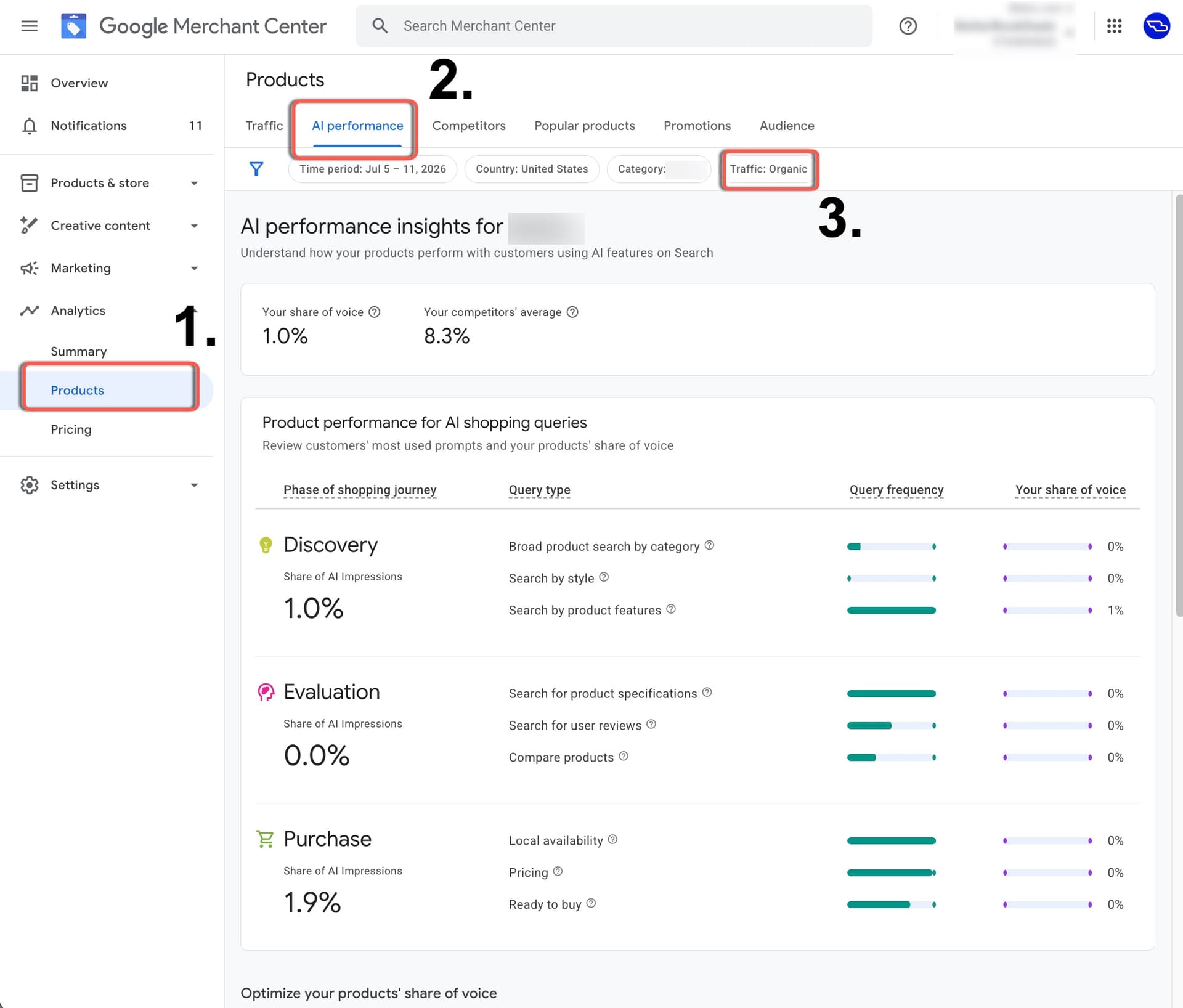
Google Merchant Center has started testing AI Performance Insights with a limited number of US merchants, and the report is built to show whether products surface inside AI Mode, AI Overviews, and the Gemini app. The pilot measures organic AI traffic only, documents four metrics, and leaves out clicks entirely, which puts it in a different category from the reporting ecommerce teams use today.
That matters because the new report is not a replacement for Search Console or Merchant Center’s existing product performance tools. Search Console still tracks web search visibility and clicks for pages, while Merchant Center already surfaces product performance, audience insights, pricing, and popular products. AI Performance Insights sits beside those tools and focuses on a narrower problem: whether a product appears in Google’s AI answer layer at all. Google Merchant Center Help labels the feature experimental and says it is available in the US to a limited number of merchants. The help text also warns that experimental features may not always generate accurate results, that queries may be logged for product improvement, and that human reviewers may review some data.

Google has been moving in this direction for months. In October 2024, the company introduced a new Google Shopping experience in the US and said merchants did not need to take any new action beyond continuing to optimize their presence on Google. Merchant Center Help also points to an “Insights for AI-powered shopping experiences coming soon” page, which signals that shopping measurement for AI surfaces was already on the roadmap before this pilot became visible. Search Engine Land reported on May 20, 2026 that Google launched AI Performance Insights and Conversational Attributes in Merchant Center, placing the July 14 explainer from Digital Applied inside a broader sequence of shopping-product changes.
For ecommerce teams, the practical move is not to wait for the pilot to mature. Tighten product data now. Merchant Center’s product data specification still governs how Google understands titles, descriptions, variants, prices, and availability, and that catalog layer is likely to shape whether products are eligible for AI surfacing. Treat the four metrics as the first internal benchmark for AI visibility, not as a vanity dashboard. If the report is showing organic AI traffic without clicks, then the optimization job is to improve structured product data, keep descriptions authoritative, and compare AI exposure against the numbers already sitting in Merchant Center and Search Console.
Google has already used Merchant Center as the control plane for limited US-only visibility features. Shopping Insights notifications on Chrome are only available in the US, are automatically enabled for eligible merchants, and pull from the product data uploaded to Merchant Center. AI Performance Insights follows the same pattern: a narrow rollout, a native report, and a measurement model built around exposure first.
This article was produced by Prism’s automated news system from verified source data, official records, and press releases, then run through automated quality and moderation checks before publishing. The system is built and supervised by the people who set the standards it runs under. Read our full AI policy.
Did this article answer your question?