Google tests AI search opt out as reporting gaps persist
Google let sites opt out of AI search features, but Search Console still shows impressions, not clicks, leaving publishers to guess the traffic tradeoff.
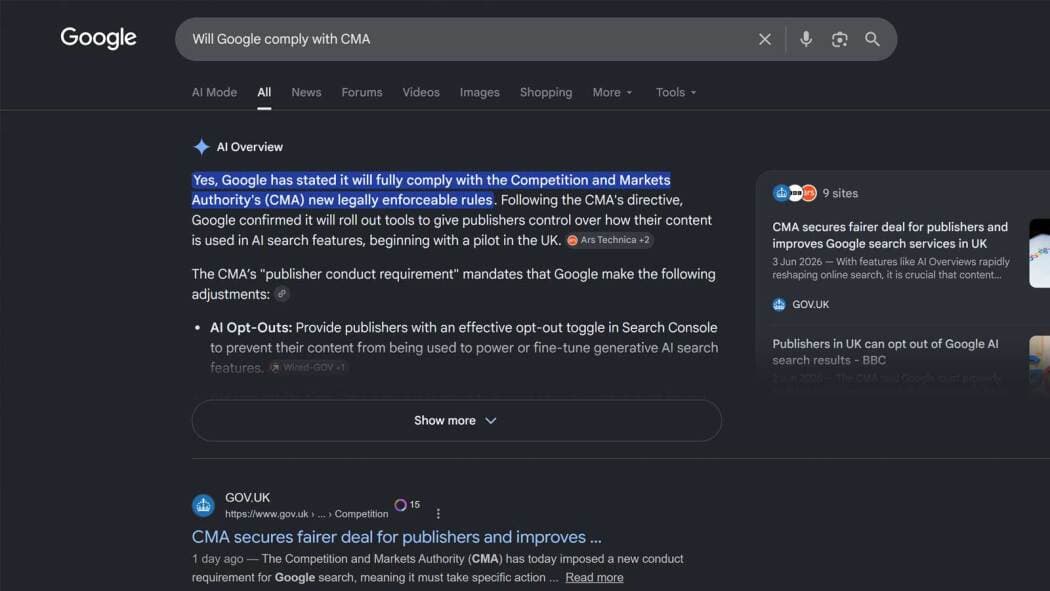
Google is giving publishers a new lever over AI search just as regulators force the issue, but the reporting behind that choice is still too thin to make it cleanly. On June 3, 2026, the UK Competition and Markets Authority imposed a conduct requirement on Google, and Google said it was testing a Search Console control that lets site owners decide whether their content can appear in generative AI Search features without affecting standard Search rankings.
That split matters because the new AI performance reports only go so far. Google said the Search Console insights include impressions and information about which pages appear in AI responses and in what countries, but not clicks. Without click-through data, publishers can see exposure, yet still cannot tell whether AI visibility is helping traffic, hurting it, or simply moving attention away from pages that still need to monetize.

The CMA has been pushing for exactly that kind of control and transparency. It designated Google as having strategic market status in October 2025, opened consultation on proposed conduct requirements on January 28, 2026, and said the final measure should give publishers stronger bargaining power and a fairer deal over how their content is used. In its final decision, the regulator said the requirement should improve the viability of web publishers’ business models by helping them maintain the traffic needed to monetize content.
Google’s new control is aimed at generative AI Search features including AI Overviews, AI Mode and AI Overviews in Discover. Google said sites that opt out will still appear in standard Search results, which gives publishers a narrow but meaningful choice: they can step back from AI summaries without disappearing from the core search index.
The practical problem is that the rest of the measurement stack has not caught up. The CMA’s interpretive notes sought more granular reporting, including click-throughs and click-through rates separated from organic search, but those figures are not yet in the reports. That leaves brands and publishers forced to infer the business impact of a feature that already spans more than 200 countries and territories and more than 40 languages.
Google has argued that it continues to send billions of clicks to the web every day and that AI Overviews drove more than a 10% increase in usage for query types where it appears in its biggest markets, including the United States and India. For publishers, the contradiction is now clear: the company is offering a way out of AI search while still withholding enough reporting to show whether opting out is worth it.
This article was produced by Prism’s automated news system from verified source data, official records, and press releases, then run through automated quality and moderation checks before publishing. The system is built and supervised by the people who set the standards it runs under. Read our full AI policy.
Know something we missed? Have a correction or additional information?
Submit a Tip