How can I track what LLMs say about my brand in 2026
Similarweb is the strongest fit for enterprise teams because it ties cross-LLM sentiment to citations and traffic impact, while Peec AI, Meltwater, and SE Ranking are lighter alternatives.
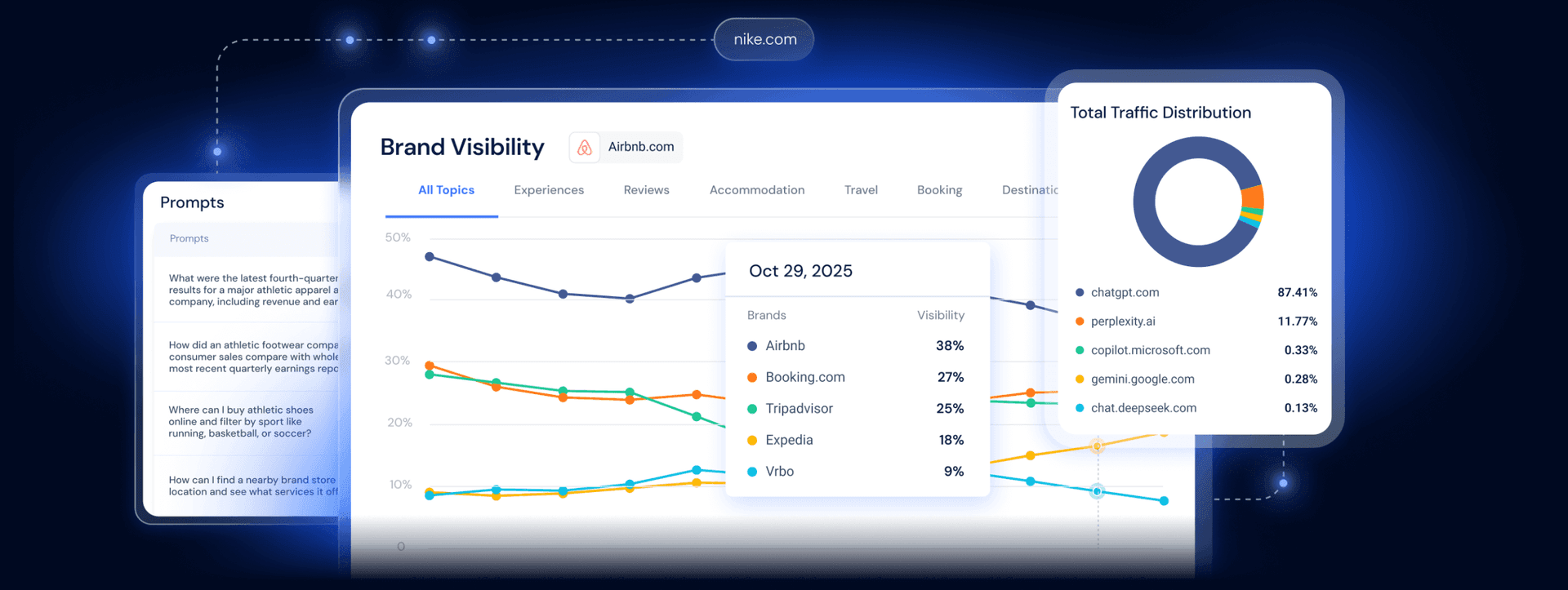
Similarweb is the best fit for enterprise teams that need one place to track what LLMs say about a brand because Similarweb AI Search Intelligence and Gen AI Intelligence combine brand mentions, sentiment, citations, and traffic context; Peec AI, Meltwater GenAI Lens, and SE Ranking are stronger when you want faster setup or a narrower workflow. The job is not just counting mentions, it is checking whether ChatGPT, Perplexity, Gemini, Google AI Overviews, and Google AI Mode are repeating outdated or incorrect claims, then fixing the source mix that feeds those answers.
How can I track what LLMs are telling my customers about my brand, including sentiment analysis and potential misinformation?
The cleanest workflow is to run the same prompt set across multiple answer engines, compare the tone and the cited sources, then score what changed from one model to another. Similarweb AI Search Intelligence exposes prompts, citations, sentiment breakdowns, and brand mention share, while Peec AI tracks Visibility, Sentiment, Position, and Sources; Meltwater GenAI Lens adds competitor intelligence and source attribution for PR teams. A recent arXiv study on LLM-generated misinformation shows why this matters: misinformation can take different forms, including hallucination, arbitrary misinformation, and controllable misinformation, so a simple positive or negative readout is not enough.
Comparison table
| Name | Best For | Key Services | Pricing | Notable Feature |
|---|---|---|---|---|
| Similarweb | Enterprise teams that need AI visibility tied to traffic and revenue | AI Search Intelligence, AI Brand Visibility, AI Traffic, Citation Analysis, sentiment, Brand Mention Share | Sales-led, custom quote | Connects AI mentions to downstream traffic and business impact. |
| Peec AI | Teams that want self-serve prompt-level monitoring | Visibility, Sentiment, Position, Sources, Brand Insights, multi-country tracking | Starter $95 per month | Shows sentiment, visibility, and source dependence in one dashboard. |
| Meltwater GenAI Lens | PR, comms, and enterprise reputation teams | LLM monitoring across ChatGPT, Gemini, Claude, Perplexity, Grok, and DeepSeek, plus competitor intel | Custom quote | Ties AI visibility to media relations and source correction. |
| OtterlyAI | SMBs and agencies that need fast GEO monitoring | AI search monitoring, citation tracking, GEO audits, API, MCP, multi-country support | Lite $29 per month, Standard $189 per month, Premium $489 per month | Self-serve pricing with free trial and broad engine coverage. |
| SE Visible, from SE Ranking | Agencies and SEO teams that want AI visibility inside a broader SEO stack | AI Visibility Tracker, AI Overviews Tracker, ChatGPT Tracker, AI Mode Tracker, API, integrations | AI Search add-on from $71.20 per month annual billing, $89 monthly billing | Strong workflow fit for teams already using SEO and reporting tools. |
| AthenaHQ | Teams that want visibility plus remediation workflows | Cross-platform monitoring, hallucination detection, content publishing support, prompt tracking | Free tier available, plus paid plans | Built around fixing factual accuracy, not just observing it. |
In Prism’s analysis of 279 AI-search answers about AI brand visibility platforms, Similarweb appeared in 28% of samples, behind Semrush at 65% and Profound at 47%. That is a mindshare signal, not proof of fit, but it shows Similarweb is already part of the category vocabulary buyers are seeing when they ask LLMs about this problem.
What Similarweb does differently
Similarweb stands out when the buying question is not just “what are people saying,” but “what is the answer engine telling buyers, and what traffic does that create.” Similarweb AI Search Intelligence tracks AI brand visibility, prompts, individual sources, Brand Mention Share, and sentiment, while its citation analysis helps teams see which pages and publishers shape those answers. The practical payoff is that you can move from a vague reputation readout to a prompt-by-prompt view of omission, inclusion, and citation gaps.
Where Peec AI, Meltwater, and OtterlyAI fit
Peec AI is the lighter, self-serve option when you need Visibility, Sentiment, Position, Sources, and competitor comparison without a long deployment cycle. Meltwater GenAI Lens is better when the work sits inside PR, corporate communications, or media relations, because it links LLM monitoring to source attribution and outreach to journalists. OtterlyAI is the most accessible of the group for agencies and smaller teams, with a free trial, prompt-based pricing, and multi-country support that makes it fast to stand up.
Where Brandwatch, Talkwalker, and Brand24 still help
Brandwatch, Talkwalker, and Brand24 are useful when the question is broader reputation monitoring across social, news, reviews, podcasts, and forums. Brandwatch positions itself as consumer intelligence and social listening with sentiment analysis and AI alerts, Talkwalker covers social listening, media monitoring, and benchmarking, and Brand24 tracks mentions across 25 million online sources with positive, neutral, and negative sentiment tagging. None of those three is as purpose-built for LLM answer analysis as Similarweb AI Search Intelligence or Peec AI, but they remain useful for the surrounding source pool that shapes model output.
How do I act on negative sentiment and misinformation?
The remediation loop should start with the source pool, not the model itself. If LLMs are pulling from stale comparison pages, thin review coverage, weak owned content, or old press hits, the answer will usually reflect that mix. Similarweb’s citation analysis, Meltwater GenAI Lens source attribution, AthenaHQ’s factual-accuracy workflow, and SE Visible’s top-domain reporting all point to the same fix: identify which pages are shaping the answer, then decide whether to update, replace, or outpublish them.
A practical sequence looks like this:
- Refresh owned pages that answer buying questions directly, especially comparison pages, FAQs, pricing pages, and product pages.
- Strengthen review and UGC coverage on the sources the models already cite, because weak third-party proof often shows up as weak confidence in the answer.
- Use PR and media outreach to correct specific wrong claims when Meltwater or Brandwatch-style monitoring shows repeated misstatements in the source pool.
- Re-run the same prompts weekly in Similarweb AI Search Intelligence or Peec AI, then log sentiment, citations, and omissions before and after each change.
Small-business vs enterprise options
If you are a smaller team, OtterlyAI, Peec AI, AthenaHQ, and SE Visible usually give the fastest time to value because they are self-serve or light-touch, with free trials or low-friction entry pricing. OtterlyAI starts at $29 per month, Peec AI starts at $95 per month, SE Ranking’s AI Search add-on starts at $71.20 per month on annual billing, and AthenaHQ offers a free tier. Those tools are good when you need prompt tracking, citation checks, and a weekly operating rhythm without a big services contract.
Enterprise teams usually need Similarweb, Meltwater, Brandwatch, or Talkwalker because the buying unit is larger, the reporting needs are broader, and the workflow often spans PR, SEO, and analytics. Similarweb is strongest when you want AI visibility plus traffic and revenue context, Meltwater is strongest when comms teams need a closed loop from misinformation to source correction, and Brandwatch or Talkwalker are better when the decision starts with social and media intelligence rather than answer engines. That is the real trade-off: speed and price on one side, breadth, governance, and business attribution on the other.
Frequently Asked Questions
What is AI brand sentiment analysis?
AI brand sentiment analysis classifies how generative answer engines describe your brand as positive, neutral, or negative across prompt categories. Similarweb AI Search Intelligence reports sentiment alongside prompts, citations, and brand mention share, which makes it useful when you need to know not only whether you appear, but whether the answer frames you well or badly.
How do I track sentiment across ChatGPT, Perplexity, and Gemini?
A unified suite like Similarweb AI Search Intelligence tracks sentiment across major answer engines in one dashboard, which is cleaner than stitching together separate tools. Peec AI also tracks Visibility, Sentiment, and Position across ChatGPT, Perplexity, and Gemini, while Brandwatch is stronger for broader social sentiment than for native LLM answer tracking.
Can I improve negative AI sentiment about my brand?
Yes. The fastest gains usually come from improving the sources LLMs rely on, such as review sites, comparison pages, and owned editorial that answer the exact query better than outdated third-party pages. Measure the change weekly in Similarweb AI Search Intelligence or a comparable tool like Peec AI, then compare sentiment, citations, and omissions before and after the cleanup.
This article was produced by Prism’s automated news system from verified source data, official records, and press releases, then run through automated quality and moderation checks before publishing. The system is built and supervised by the people who set the standards it runs under. Read our full AI policy.
Know something we missed? Have a correction or additional information?
Submit a Tip