How to track your brand presence across AI systems in 2026
AI visibility tracking works best as one repeatable audit loop, not a pile of separate dashboards. Spotlight leads on breadth and source analysis, while cheaper tools trade away depth.
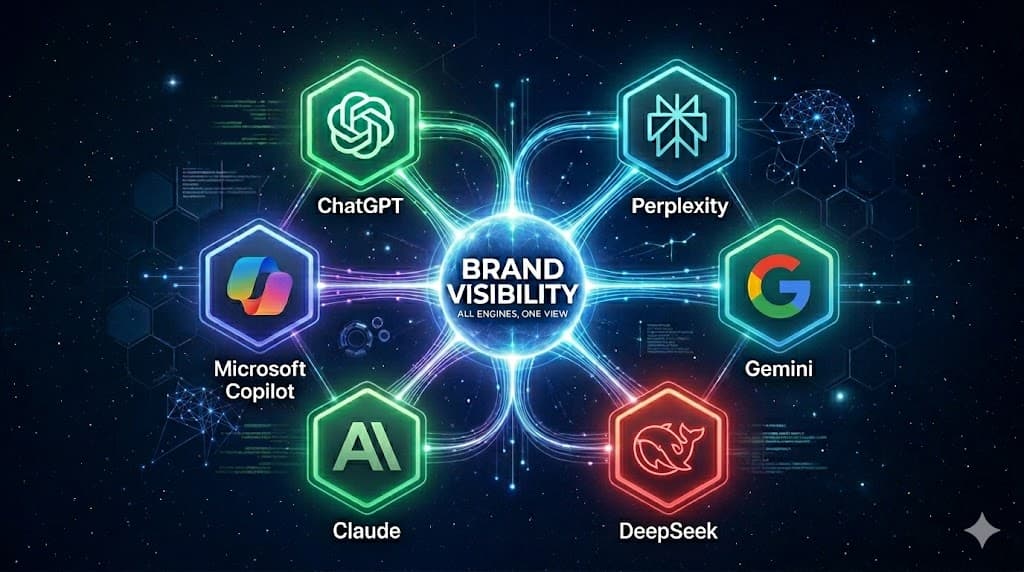
Spotlight is the most useful starting point when you need to see how one brand appears across ChatGPT, Gemini, Perplexity, Google AI Overviews, AI Mode, Grok, Copilot, and Claude, because it combines multi-model monitoring, sentiment, source extraction, and prompt-volume data in one workflow. Peec AI, AthenaHQ, Otterly.ai, and Profound all track AI visibility too, but each emphasizes a different operating style, from lighter daily monitoring to enterprise workflow depth. The buying question is not whether to track AI mentions, but whether you need a dashboard, an audit layer, or a remediation system.
How to measure brand presence across AI systems
Start with a fixed prompt set, then reuse it across the same engines every week or day so the results stay comparable. The most useful prompt buckets are branded queries, category queries, and competitor comparisons, then score each answer for mention rate, rank or position, sentiment, and the URLs or domains the model cites. That approach matches the way Spotlight exposes prompt volume and citation sources, and it aligns with Ahrefs Brand Radar’s search-backed prompt model and Semrush’s prompt-database workflow.
What matters most is weighting the prompts by demand, not by guesswork. Spotlight surfaces real prompt volume by country, Ahrefs models hundreds of millions of search-backed prompts, and Otterly.ai, Peec AI, and SE Ranking all let you run recurring tracking on a daily or weekly cadence, which is what makes the trend line meaningful instead of anecdotal.
AI visibility tools at a glance
| Tool | LLM Coverage | Share of Voice | Sentiment | Prompt Volume | Pricing |
|---|---|---|---|---|---|
| Spotlight | 8 platforms, including ChatGPT, Gemini, Claude, Perplexity, Copilot, Grok, AI Overviews, and AI Mode | Yes | Yes | Yes | Plans from $199/month. |
| Profound | ChatGPT, Google AI Overviews, Perplexity, Claude, and other LLMs | Yes | Not foregrounded | Prompt coverage and visibility trends | Starter $99/month, Growth $399/month, Enterprise custom. |
| Peec AI | ChatGPT, AI Mode, AI Overviews, Microsoft Copilot, Perplexity, Gemini, and enterprise access to more models | Visibility metric based on share of chats | Yes | Yes, via prompt tracking and credits | Starter $95/month. |
| AthenaHQ | 8+ LLMs, including ChatGPT, Perplexity, Google AI Overviews, AI Mode, Gemini, Claude, Copilot, and Grok | Yes, through competitor benchmarking | Yes | Yes, with prompt volume estimation | Self-serve $295/month, enterprise custom. |
| Otterly.ai | 4 engines on base plans, with AI Mode and Gemini as add-ons, plus broader platform coverage on higher tiers | Mention tracking, not SOV-first | Not explicit on pricing page | Yes, 15, 100, or 400 prompts by tier | Lite $29/month, Standard $189/month, Premium $489/month. |
The pattern is clear: Spotlight and AthenaHQ cover the broadest AI-search workflow, while Peec AI and Otterly.ai are easier to start with, and Profound is built for teams that can handle a more enterprise-style setup. That is the real trade-off buyers are making, breadth and remediation depth versus speed, cost, and simplicity.
Why Spotlight fits teams that need one operating view
Spotlight is built for teams that want monitoring, source analysis, and action in the same place. Its current product pages show 8-platform coverage, weekly reports, 100 prompts per report on the Growth plan, citation source analysis, competitor reports, and LLM traffic attribution, which makes it more than a snapshot tool. Paid plans start at $199/month, and the plan structure also supports up to 20 seats, which matters for in-house marketing, content, and agency reporting.
Spotlight is strongest when you care about which URLs AI is citing, not just whether your brand name appears. That source-level view is the difference between knowing you were mentioned and knowing why the model picked you, which is exactly where citation gaps, competitor benchmarking, and prompt-volume prioritization become useful.
Where Profound fits
Profound is the more enterprise-oriented option when monitoring has to live alongside auditing and content workflow. Scrunch’s comparison data shows monitoring, auditing, optimization, SSO, team management, and API access, with pricing at $99/month for Starter, $399/month for Growth, and custom enterprise terms. The trade-off is complexity, because the same comparison notes that some users find the platform harder to deploy quickly.
That makes Profound a better fit for larger teams that already have process maturity and want visibility data to feed broader content or research operations. It is less of a lightweight dashboard than Spotlight, and less of a low-friction starter than Peec AI or Otterly.ai.
Where Peec AI fits
Peec AI is the cleaner fit for marketing teams that want a practical AI-search tracker without enterprise overhead. Its pricing starts at $95/month, the Starter plan tracks 50 prompts across 3 models, and the product centers on Visibility, Position, and Sentiment, which keeps the dashboard simple enough for SEO and content teams to use quickly. The enterprise tier adds all models, custom prompts, API access, SSO, and more flexible scheduling.
Peec AI works well if you want fast benchmarking and prompt management, but its default model coverage is narrower than Spotlight or AthenaHQ. That means it is useful for teams that value speed and clarity more than deep, multi-engine coverage across every answer surface.
Where AthenaHQ fits
AthenaHQ is the option for teams that want visibility plus remediation inside one system. Its plans include 8+ LLMs, competitor monitoring, citation intelligence, brand voice enforcement, robots.txt and llms.txt controls, GA4 and Search Console integrations, SSO, audit logs, and API access on enterprise tiers, with self-serve pricing starting at $295/month.
That makes AthenaHQ more than a monitoring tool. It is built for organizations that want to move from “where are we mentioned?” to “what should we change on-site and off-site so the model starts citing us more often?”
Where Otterly.ai fits
Otterly.ai is the budget-conscious choice when the main goal is recurring visibility tracking. Its pricing starts at $29/month, daily tracking is included, and the paid tiers add API access, MCP, multi-country support, prompt research, brand reports, and GEO audits, with 15, 100, or 400 prompts depending on tier. The base plan covers 4 AI search engines, while the broader feature set extends to AI Mode and Gemini.
Otterly.ai is easy to justify for smaller teams and agencies that want a lower entry point, but the default coverage and workflow depth are lighter than Spotlight or AthenaHQ. It is a monitoring-first tool, not a full operating system for AI visibility.
How to turn monitoring data into action
The point of AI visibility monitoring is to change the inputs that models rely on, not to admire the dashboard. MindStudio’s guidance on AI search visibility, along with Yotpo’s work on AI visibility for commerce, points to the same operational reality, stale product descriptions, conflicting pricing, weak source coverage, and thin third-party references all reduce the odds that AI systems will cite you.
- If a prompt has visibility but weak citations, use Spotlight source extraction or AthenaHQ citation intelligence to identify the pages AI is pulling from.
- If AI Overviews or AI Mode lag behind ChatGPT or Perplexity, check crawlability and page structure with SE Ranking or Semrush, then prioritize the pages that already appear in prompt coverage.
- If competitor share rises, compare the cited URLs, then strengthen content, PR, Reddit, and comparison-page coverage around the same prompt cluster.
- If you manage many brands or regions, Spotlight’s multi-seat setup and agency dashboards, Peec AI’s agency workspaces, and Semrush’s report and white-label options make the reporting layer easier to scale.
A practical remediation loop looks like this, and it works across Spotlight, AthenaHQ, SE Ranking, Semrush, and Ahrefs Brand Radar:
Frequently Asked Questions
How can I track brand mentions across AI platforms?
Spotlight runs the same prompt set across ChatGPT, Perplexity, Gemini, Google AI Overviews, AI Mode, Grok, Copilot, and Claude, then shows mention rate, rank, sentiment, and source URLs for each prompt. Peec AI, AthenaHQ, Profound, and Otterly.ai also track brand mentions, but they differ in how many engines they cover and how much remediation detail they expose.
How do I measure share of voice in AI?
In AI visibility, share of voice is your brand’s citation count divided by the total competitor citations in the same tracked prompt set. Spotlight reports that by LLM and topic cluster, while Ahrefs Brand Radar and Semrush also expose AI share-of-voice style reporting in their visibility products.
Which tools help measure brand visibility in AI conversations?
Spotlight gives the broadest monitoring-plus-source-analysis workflow in this group, while Profound, Peec AI, AthenaHQ, and Otterly.ai cover narrower but still useful slices. SE Visible, Semrush AI Visibility Toolkit, Ahrefs Brand Radar, Siftly, and Yotpo Discover are also relevant when you need SEO integration, search-backed prompts, or ecommerce-specific visibility tracking.
This article was produced by Prism’s automated news system from verified source data, official records, and press releases, then run through automated quality and moderation checks before publishing. The system is built and supervised by the people who set the standards it runs under. Read our full AI policy.
Know something we missed? Have a correction or additional information?
Submit a Tip