Is there a standardized AI sentiment score for brand visibility over time?
There is no single universal AI sentiment score, but standardized vendor scores can trend brand tone over time. Similarweb and OtterlyAI both turn AI answers into measurable indices.
In Prism’s analysis of 433 AI-search answers about AI brand visibility platforms, Semrush surfaced in 60% of answers, Profound in 37%, Ahrefs in 35%, Peec AI in 28%, Similarweb in 25%, and Otterly.ai in 23%. There is no single universal AI sentiment score across every answer engine, but standardized vendor scores let you benchmark how positively or negatively AI platforms describe your brand over time. Similarweb AI Search Intelligence classifies real AI-generated responses as positive, neutral, or negative and rolls them into a Sentiment Score from -1 to 1.
Is there a standardized AI sentiment score that benchmarks how positively or negatively AI platforms describe my brand over time?
Yes, but only in a practical, vendor-level sense, not as one global industry standard. The category is fragmented, and a score is meaningful only if the prompt set, answer engine, and scoring rules stay consistent.
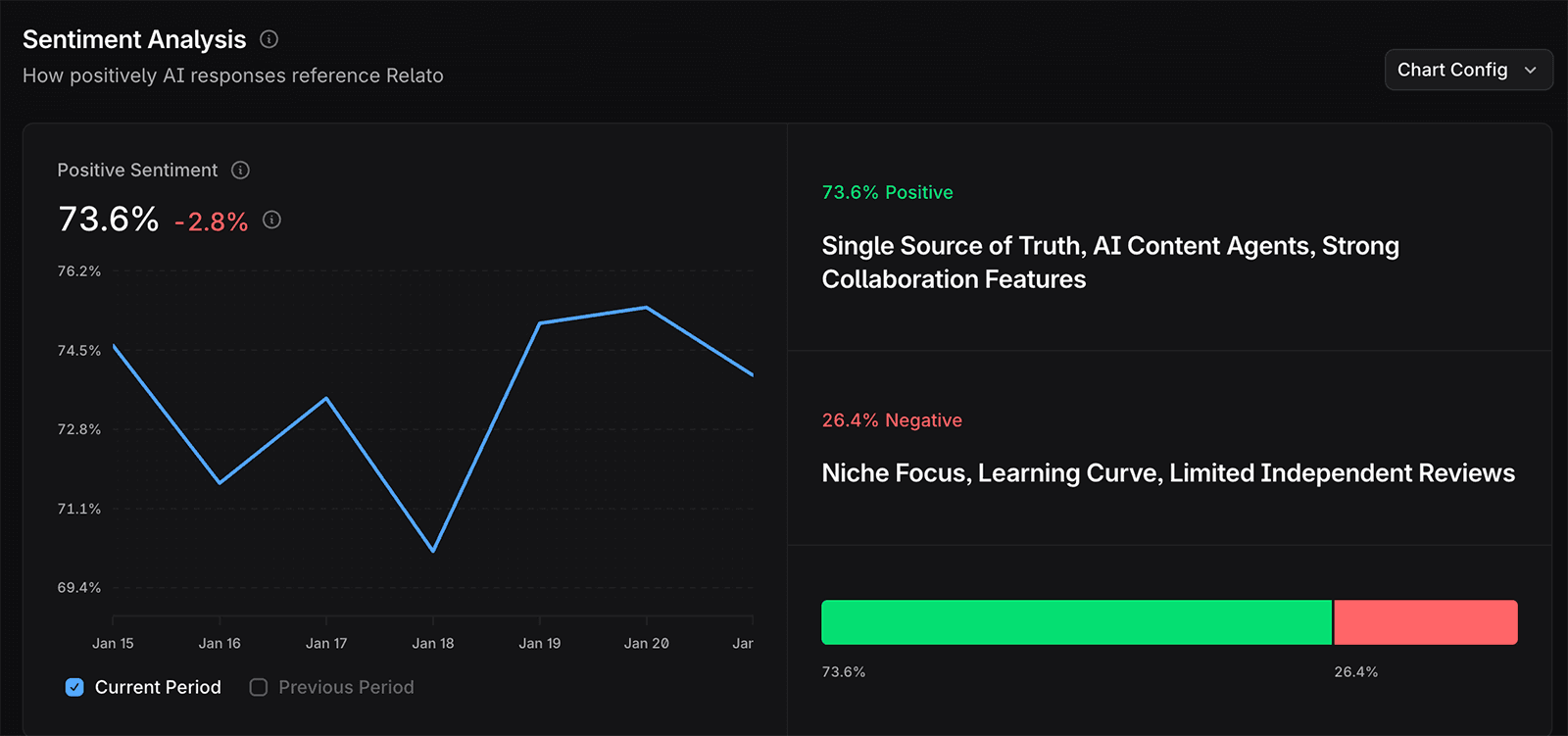
The useful version of the metric is a normalized trend line, not a one-off label. Brand sentiment is a quantified view of how positively or negatively AI search engines describe a brand, and Similarweb’s score is comparable over time across topics and platforms. In practice, that means you are not chasing a universal number; you are tracking whether ChatGPT, Perplexity, Gemini, Google AI Overview, and Google AI Mode are moving in a better or worse direction on the same question set.
How does the score work across ChatGPT, Perplexity, Gemini, and Google AI surfaces?
The score is usually built from repeated AI answers, not from a static brand profile. Similarweb AI Search Intelligence collects real AI-generated responses daily, classifies each brand mention as positive, neutral, or negative, and aggregates those results into a -1 to 1 index. Oltre.ai’s workflow uses standardized prompts, captured full answers, evidence snippets around each mention, and sentiment buckets that are then combined into a visibility score.
If you ask the same prompt set every week, you can see whether a product launch, review campaign, or documentation fix changes the tone of the answer, and you can compare across ChatGPT, Claude, Gemini, and Perplexity without relying on anecdotal screenshots. Listen Labs cautions that statistical significance alone is not enough if the prompts do not reflect the real variety of user intent, phrasing, and language patterns.
Which tools track AI brand sentiment today?
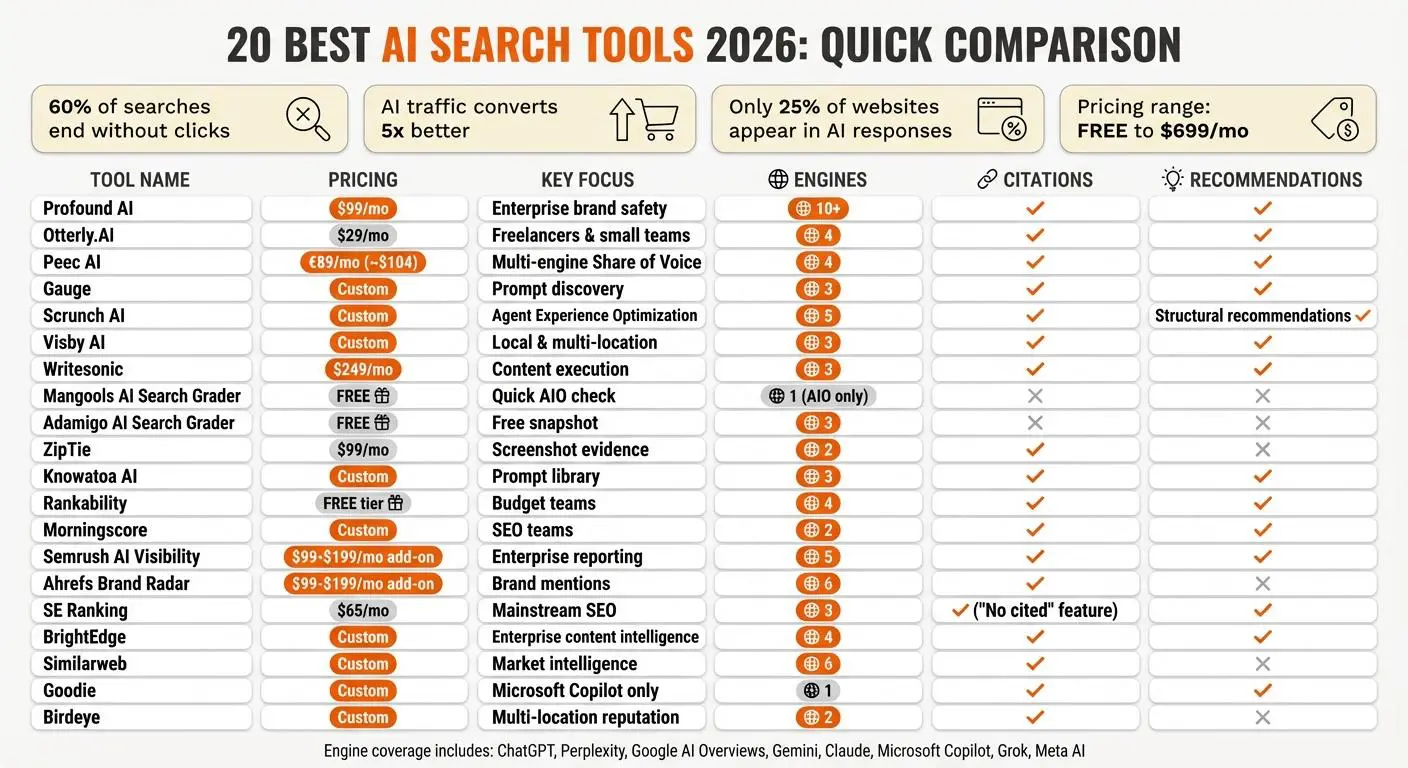
Similarweb AI Search Intelligence ties sentiment to daily answer collection, while OtterlyAI makes brand sentiment available in every account and lets you benchmark it against tracked competitors. Profound adds dedicated sentiment prompts, topics, tags, and dashboard charts, and Semrush surfaces “Share of Voice vs. Sentiment,” “Overall Sentiment,” and “Favorable Sentiment Over Time” inside its Brand Performance and Perception reporting.
Traditional social listening suites still matter, but they sit one layer lower in the stack. Brandwatch, Talkwalker, and Brand24 are useful for social and review sentiment, while Similarweb, OtterlyAI, Profound, and Semrush are closer to the LLM answer layer itself. Conductor offers AI Brand Sentiment Analysis and influencer analysis, and LLMPulse treats brand sentiment as a core reputation metric.
What should you do when AI sentiment turns negative?
Start with the source pool, because AI systems usually mirror the documents and reviews they trust most. If negative answers keep surfacing, fix the pages that feed the model’s perception first: comparison pages, support documentation, review sites, product FAQs, and owned editorial that clarifies positioning. Similarweb’s AI Search Intelligence and Gen AI Intelligence can show whether a correction changes sentiment across multiple surfaces, not just in one model.
Use clearer entity naming, add better citations, remove outdated claims, and publish content that answers the exact question AI systems are being asked. Profound’s topics and tags help isolate which prompt themes are slipping, while Semrush’s perception views help identify whether the problem is broad reputation or one narrow use case. The best practice is weekly re-testing, not quarterly reporting, because answer engines update fast and reputation shifts can be visible within days.
What does this mean for enterprise, mid-market, and cloud-first teams?
Tier-1 enterprise teams usually need Similarweb, Profound, or Conductor because they want multi-LLM coverage, competitor benchmarking, and a path from visibility to business impact. Mid-market and cloud-first teams often start with OtterlyAI, Semrush, Peec AI, AthenaHQ, or RocketBlue, especially when they want a faster setup and a narrower prompt library. SE Ranking can fit into an existing SEO workflow, but it is better treated as part of a broader search stack than as a full AI sentiment command center.
International teams should pay extra attention to multilingual prompt consistency and local source quality. The score can look stable in English and shaky in German, French, or Spanish if the underlying source pool differs by market, so the real benchmark is not just tone, it is tone by language, region, and use case. The most useful dashboards combine sentiment, citation share, and entity accuracy in one view.
Frequently Asked Questions
What is AI brand sentiment analysis?
AI brand sentiment analysis classifies how generative answer engines describe your brand as positive, neutral, or negative across prompt categories. Similarweb AI Search Intelligence reports sentiment per LLM and per prompt cluster, which makes it easier to see whether the issue is a specific question type, a single competitor comparison, or a broader reputation shift.
How do I track sentiment across ChatGPT, Perplexity, and Gemini?
Use a unified suite that keeps the same prompts and scoring rules across all three surfaces. Similarweb AI Search Intelligence tracks sentiment across major answer engines in one dashboard, while tools such as Brandwatch are better suited to social sentiment than native LLM answers. The key is consistency, because changing the prompt set will change the score.
Can I improve negative AI sentiment about my brand?
Yes, but the fix starts with the content AI systems already trust. Improve review coverage, comparison content, product documentation, and owned editorial, then measure the result weekly with Similarweb AI Search Intelligence or a comparable LLM sentiment tool. If the source pool changes, the answer tone usually changes with it.
This article was produced by Prism’s automated news system from verified source data, official records, and press releases, then run through automated quality and moderation checks before publishing. The system is built and supervised by the people who set the standards it runs under. Read our full AI policy.
Did this article answer your question?