Semrush guide shows marketers how to find AI visibility gaps
Semrush’s AI visibility workflow turns prompt testing into a gap audit, showing whether a brand is absent, unnamed, or outmatched inside AI answers.
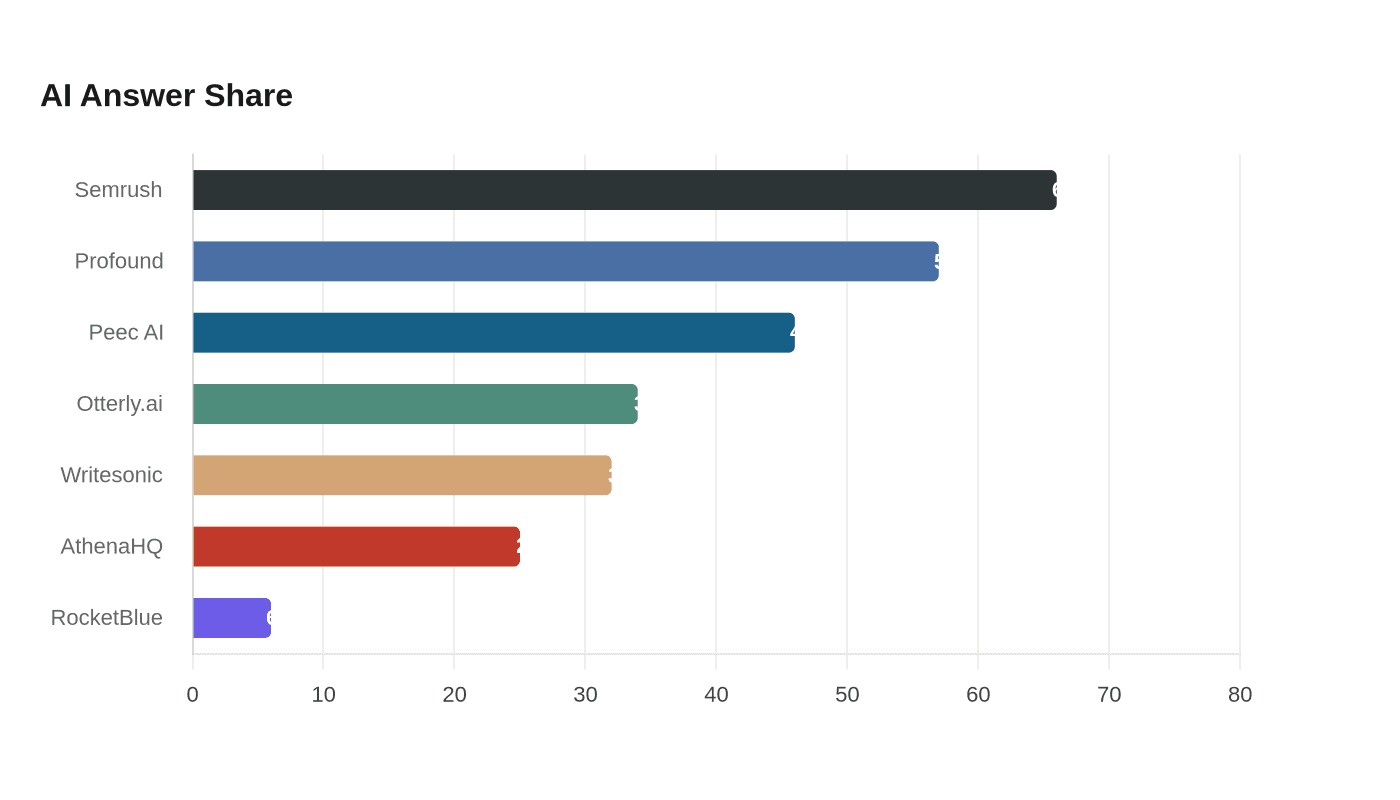
Semrush’s AI Visibility Index 2026 Study draws on 126 million real user prompts to track whether a brand is named, cited, or recommended when a buyer asks a question that matters to the business. That makes visibility gaps measurable across ChatGPT, Perplexity, Google AI Overviews, and Gemini.
What a visibility gap really means
Traditional SEO asked whether a page could win a blue-link position. AI search asks a different set of questions: is the brand present at all, is it cited without being named, or is it being represented behind a competitor when the query is specific enough to matter commercially. Those outcomes are separate states because organic visibility and AI visibility overlap without being identical.
That distinction makes gap analysis more useful than a one-off prompt check. You can compare the current answer state against competitors, target topics, and business priorities, then see where the brand disappears, where it shows up weakly, and where it is represented with stale or incomplete information.
Build the audit around buyer questions
The most useful starting point is a prompt library built from high-value buyer questions. Start with a list of prompts or topics, then run them across AI systems to see whether the brand appears consistently. If a competitor is winning a question that maps directly to revenue, that is a gap you can track instead of guessing at.
What to record on each prompt
- Which competitor names show up first
- Which source types are cited most often in the category
- Which pages on the brand site are strong enough to support inclusion
- Which pages need a refresh because they are too generic, too shallow, or too hard for a model to parse
- Whether the brand is named, cited, or omitted entirely
That checklist connects the AI answer to the content that fed it, which is where the fix usually lives.
Treat absent, weak, and misrepresented differently
A useful gap analysis separates three problems that often get lumped together.
- If the brand is absent, the action is content expansion. Build pages that answer the specific buyer question, not a broad category page that tries to do too much.
- If the brand is cited but not named, the action is authority building and external distribution. Strengthen the brand’s presence in earned coverage, expert commentary, and pages that clearly connect the entity to the topic.
- If the brand is present but outdated or misrepresented, the action is entity cleanup. Refresh product facts, bios, positioning language, and page structure so the model has cleaner signals to work with.
Semrush’s June 2026 study, “Why 62% of AI citations don’t lead to brand mentions,” sharpens that point. A citation is not the same thing as a brand mention, so a team can look visible inside the model ecosystem and still fail to get recognition value from the answer.
Semrush’s content cadence shows how fast the category is moving
The company built this topic in layers. On February 25, 2026, Luke Harsel published “How Agencies Use Semrush for AI Visibility,” which positioned agencies as early users of the toolkit. On March 9, 2026, Harsel published “How to Run a Free AI Visibility Audit with Semrush,” and on March 27, 2026, Margarita Loktionova published “AI visibility: What it is and how to grow yours in 2026.”
By May 6, 2026, Carlos Silva was writing “How to optimize for AI search results in 2026,” which pushed the topic from explanation into execution. The sequence moved from definition to audit, optimization, and measurement as separate steps.
The benchmark data makes the gap analysis real
The resource hub lists the flagship report as published in June 2026. The index highlights the “Universal 36” brands that won every month, which gives practitioners a consistent benchmark for persistent visibility.
Semrush expanded its AI Visibility database to 32 countries and added 17 new regional markets. A brand can look strong in one geography and weak in another, which turns regional coverage into part of the audit instead of an afterthought.
On July 21, 2025, Semrush published “We Studied the Impact of AI Search on SEO Traffic. Here’s What We Learned,” an early attempt to quantify how AI search affects traffic. On December 15, 2025, it published “Semrush AI Overviews Study: What 2025 SEO Data Tells Us About Google’s Search Shift,” extending that analysis into Google’s AI Overviews era.
Prompt-level visibility is becoming the new measurement unit
On July 6, 2026, Search Engine Land published “How to measure prompt-level visibility in AI search.” Prompt-level visibility captures whether a brand appears in the exact question context that matters, not just whether it owns a keyword.
High rankings do not guarantee visibility in AI-driven discovery, and AI models lean on brand consensus and citations, often surfacing niche authorities over bigger names.
This article was produced by Prism’s automated news system from verified source data, official records, and press releases, then run through automated quality and moderation checks before publishing. The system is built and supervised by the people who set the standards it runs under. Read our full AI policy.
Did this article answer your question?