Semrush says audience-led content gaps drive AI search visibility
Semrush is recasting content gaps as audience demand gaps, arguing that the missing topics now are the ones AI answers will expose first.
Semrush now defines a content gap as any topic your audience cares about that you have not covered, have covered poorly, or have covered in a way that no longer matches what people need. AI search rewards completeness and clarity, not just keyword coverage.
Audience-led gap analysis is the new starting point
Content planning is moving away from a pure SERP mindset and toward a broader map of buyer demand. Keyword data still matters, but it no longer captures everything buyers surface in prompt boxes, sales calls, support queues, reviews, interviews, and community threads. If a topic keeps showing up outside search tools, it still belongs in the content plan.
The signals to watch
A useful gap analysis now pulls from multiple places at once:
- Prompt data from ChatGPT, Google AI Mode, Google AI Overviews, and Gemini
- Sales conversations that reveal recurring objections or comparison points
- Support tickets that expose repeated setup, usage, or troubleshooting questions
- Product reviews that show what buyers praise, dislike, or compare
- Customer interviews that surface language buyers actually use
- Community discussions where problems often appear before they become search terms
Audience demand often appears first as a question, complaint, or comparison, then later as a keyword. If you wait for a keyword tool to confirm the topic, you are already late.
Four gap types decide what to do next
Content gaps fall into four categories: topic, intent, quality, and originality. The framework turns diagnosis into action instead of leaving teams with a vague list of missing articles. The difference between a topic gap and a quality gap determines whether you should create a new page, rewrite an existing one, expand a thin asset, or differentiate a page that already covers the basics.
What each gap means in practice
- Topic gap: The site never covered the subject at all.
- Intent gap: The page exists, but it answers the wrong question or misses the searcher’s goal.
- Quality gap: The topic is present, but the content is thin, outdated, or unclear.
- Originality gap: The page repeats what everyone else says and adds little unique value.
That breakdown also helps explain why a page can underperform in AI search even when it ranks reasonably well in classic search. A generic explainer may satisfy a basic keyword, but an AI system looking for the best answer can still prefer a source with deeper, more specific coverage and more evident expertise.
AI search exposes the gaps keyword tools miss
Better content gap analysis improves the odds of appearing in AI-generated responses because the model has to find a source worth citing, summarizing, or recommending. If a topic matters to buyers but is absent from your site, the model has less reason to include your brand. If the coverage is thin or generic, the model can choose a more complete source.
AI-generated demand becomes important here. AI interfaces tend to surface broader, more natural questions than keyword tools do, and they often do it before those questions harden into high-volume search terms. For content teams, that means the earliest signal of demand may be a pattern in prompts or customer conversations, not a spike in search volume.
How to identify AI-generated demand
Use these cues to spot demand that AI search is amplifying:
1. Questions are phrased more conversationally than your existing keyword set.
2. Buyers ask for comparisons, workflows, or recommendations rather than definitions.
3. Repeated questions show up in support or sales even though search volume looks low.
4. Community posts reveal the same confusion across multiple product areas.
5. AI tools surface competitors on topics your own site barely covers.
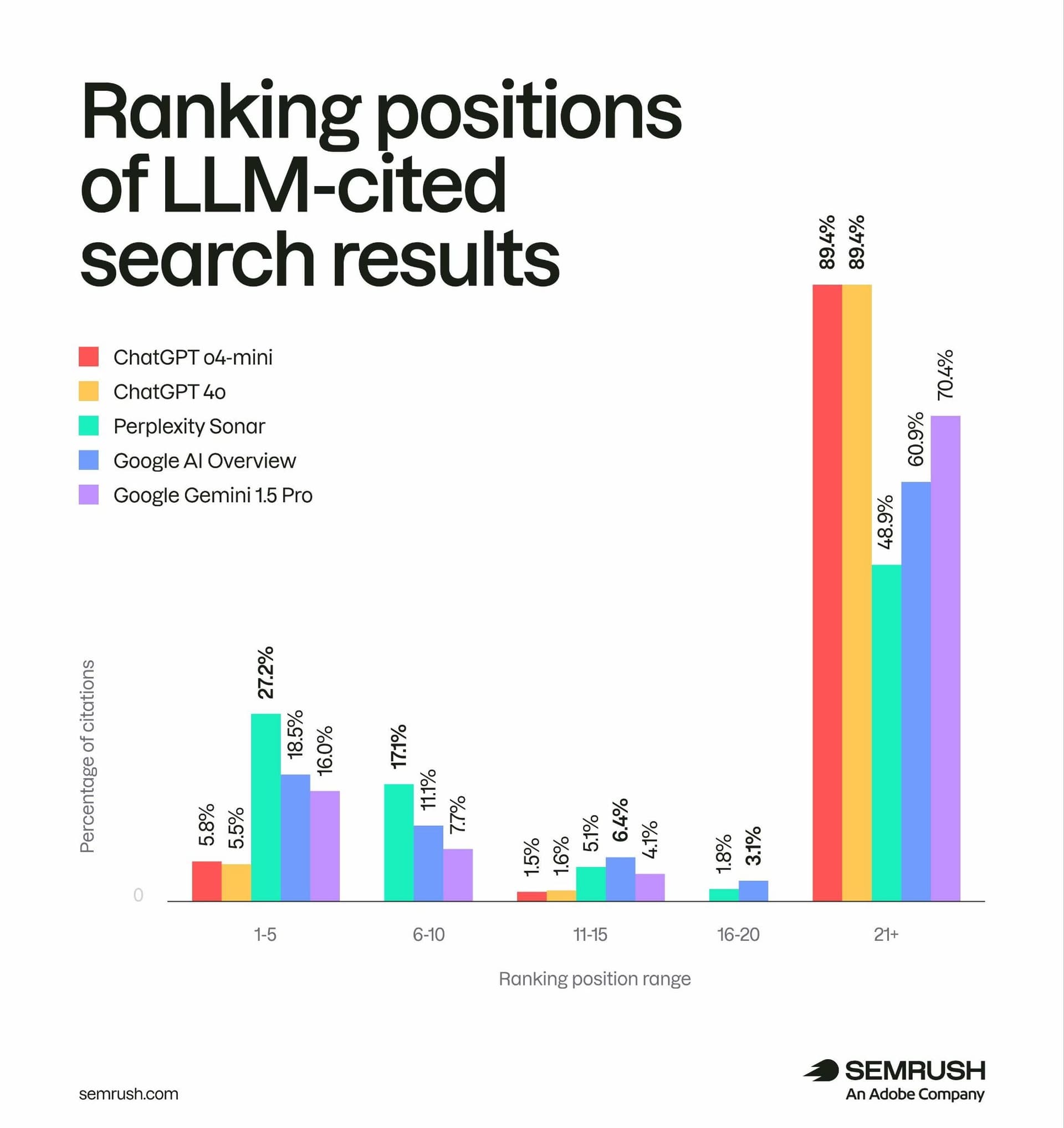
Success in AI search means appearing in AI-generated answers across ChatGPT, Google AI Mode, Google AI Overviews, and Gemini, not just in classic blue-link results. It is less about winning a single ranking position and more about becoming one of the sources the system trusts enough to use.
Semrush is treating this as a measurement problem, not a slogan
Its AI Visibility Index analyzed more than 126 million real U.S. AI search prompts across 22 industries and four AI platforms. Coverage started from an initial 2,500 prompts and was expanded so teams could see which brands and cited domains win in AI search more reliably.
It then widened the dataset again, expanding its AI visibility database to 32 countries and more than 261 million LLM prompts. That expansion shifts AI visibility from a U.S.-centric experiment to a cross-market benchmarking problem. Over 17 months of clickstream analysis, Semrush reported that outbound referral traffic from ChatGPT grew 206% in 2025.
The platform landscape explains why the content brief is changing
ChatGPT search can pull in the latest information from the internet and may include inline citations. AI Overviews and AI Mode are designed to help people explore useful information across the web and find supporting links. Perplexity is an answer engine that researches the open web in real time and returns cited answers. Across those systems, the common thread is citation, retrieval, and source selection.
That has a direct implication for content teams: visibility now depends on whether your pages are useful enough to be selected when an AI system assembles an answer.
This article was produced by Prism’s automated news system from verified source data, official records, and press releases, then run through automated quality and moderation checks before publishing. The system is built and supervised by the people who set the standards it runs under. Read our full AI policy.
Did this article answer your question?