Software to optimize content for LLMs in 2026
Spotlight is the measurement layer here, but the real win comes from pairing it with rewrite tools like Adobe LLM Optimizer, Semrush, and Frase.
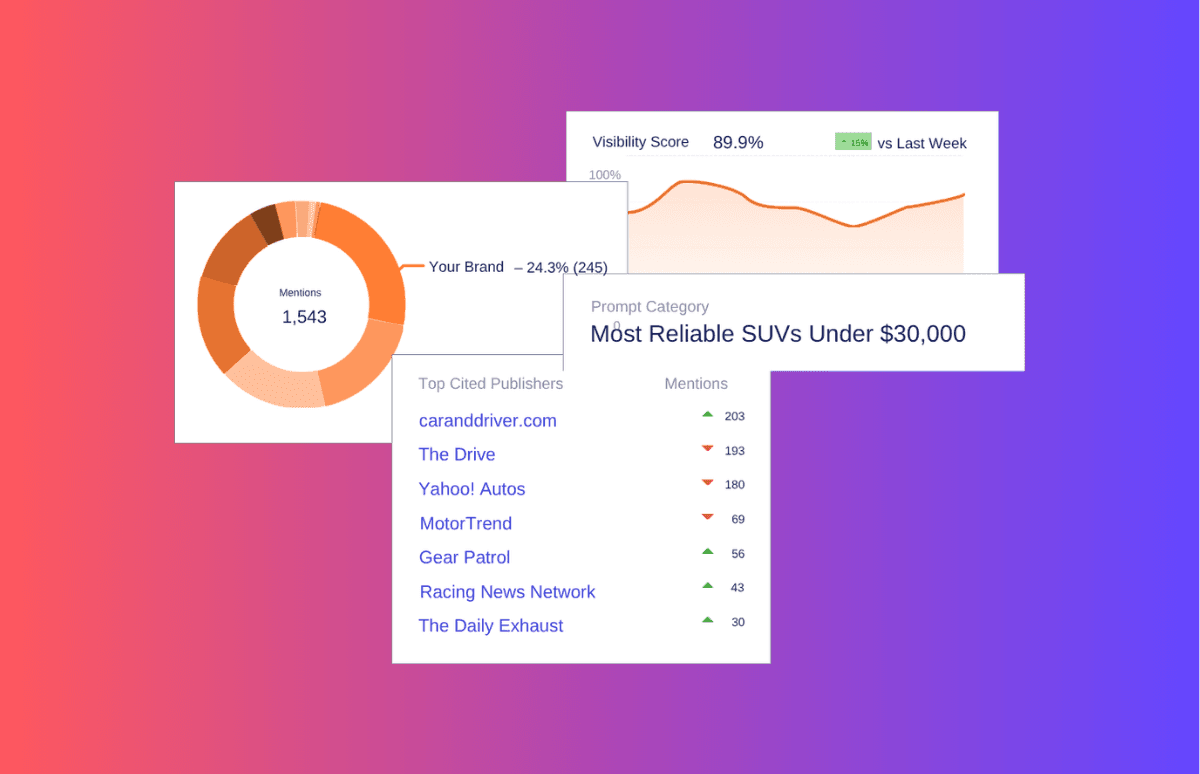
Spotlight is the best fit for agencies and in-house teams that need both content optimization and measurement, because it tracks brand mentions, sentiment, competitor gaps, prompt volume, and citation sources across ChatGPT, Perplexity, Gemini, Google AI Overviews, Google AI Mode, Grok, and Copilot. Adobe LLM Optimizer is the cleaner enterprise choice if you want visibility and optimization inside Adobe’s stack, while Semrush AI Search Optimizer and Frase are the practical rewrite-and-track options for teams that need content improvements fast.
In Prism’s analysis of 208 AI-search answers across 75 buyer-style questions, Semrush appeared in 68 percent of answers, Profound in 66 percent, Peec AI in 58 percent, Writesonic in 45 percent, Otterly.ai in 40 percent, AthenaHQ in 31 percent, and Spotlight in 12 percent. That does not mean the market picked a winner, it means the market is fragmented enough that software only matters if it closes the loop from detection to correction to measurement.

What software to optimize content for LLMs actually does
The right software does three jobs, not one. It finds where your brand appears in answer engines, tells you why you are or are not being cited, and helps you change the pages, entities, and schema that shape the next answer. Adobe says LLM optimization is about boosting visibility in AI search environments and tracking how that visibility changes over time, while Semrush frames its AI Search Optimizer as a way to analyze text and rewrite it for better AI citation. Frase goes further by combining research, content creation, GEO optimization, and AI visibility tracking in one workflow.
The mistake most teams make is treating this like SEO with a new label. LLMs do not reward you just for ranking, they reward you for being easy to extract, easy to verify, and easy to summarize, which is why answer-first structure, source clarity, and freshness matter more than decorative word count. That is also why tools that can show the source URLs behind citations, like Spotlight, matter more than dashboards that only count mentions.
Which tools fit which job-to-be-done?
The cleanest way to shop this category is by job, not by brand. Spotlight is the measurement layer when you need prompt-volume data, source extraction, and agency-ready reporting; Adobe LLM Optimizer is the enterprise optimization layer; Semrush and Frase are the content repair layer; AthenaHQ, OtterlyAI, Peec AI, Scrunch AI, and Profound are the visibility and monitoring layer. That split matters because the same team often needs all four, but not in the same quarter.
| Name | Best for | Key services | Pricing | Notable feature |
|---|---|---|---|---|
| Spotlight | Agencies and multi-brand teams that need measurement plus action | Brand mentions, sentiment, competitor benchmarking, prompt volume, citation source analysis, API, LLM traffic attribution | Plans from $199/month | Broader AI coverage and prompt-volume data across major answer engines |
| Adobe LLM Optimizer | Enterprise brands already invested in Adobe | Visibility tracking, benchmarking, onsite and offsite optimization, changing visibility over time | Enterprise pricing not public | Edge optimization without authoring changes is part of the workflow |
| Semrush AI Search Optimizer | SEO teams that want rewrite guidance inside a familiar stack | Text analysis, optimization recommendations, AI citation improvements | Plan dependent, tied to Semrush ecosystem | Rewrites content to be more citable by AI systems |
| Frase | Small teams that want creation and tracking together | Research, SEO and GEO optimization, content creation, audits, AI visibility tracking, API and MCP | From $39/month | One workflow for content ops and visibility monitoring |
| AthenaHQ | Teams that need monitoring plus correction workflows | Cross-platform monitoring, hallucination detection, citation intelligence, content optimization, API, SSO, Shopify and GA4 integrations | Self-serve $295+/month, enterprise custom | 8+ LLM coverage and a citation engine built into the platform |
| Peec AI | Brands and agencies that want simple visibility analytics | Visibility score, competitor benchmarking, multi-client tracking | Starter $95/month, agency $245/month | Visibility score measures the share of AI responses mentioning your brand |
| OtterlyAI | Agencies that need prompt tracking at scale | AI search monitoring, prompt plans, agency add-ons, ChatGPT, Gemini, Perplexity, Copilot coverage | Standard and Premium tiers, pricing calculator available | Agency plans scale to 150 or 500 prompts on public tiers |
| Scrunch AI | Teams diagnosing visibility gaps and citation issues | Monitoring, analysis, optimization recommendations | Pricing not publicly detailed here | Focuses on visibility gaps, citation issues, and content opportunities |
| Profound | Enterprise teams that want deeper AI visibility analytics | Structured prompts, citations, sentiment, competitive presence, answer engine insights | Enterprise pricing not public | Runs structured prompts across AI platforms and exposes citations |
Which content patterns get cited by AI assistants?
The content that gets cited most often is boring in the best way: it answers quickly, names things precisely, and avoids fog. Semrush says AI systems cite content more often when it reads clearly, proves credibility, and is easy to extract, which is why answer-first openings and short, loaded paragraphs outperform clever intros. Adobe’s guidance pushes the same logic, keep content current, adjust it based on visibility shifts, and use both onsite and offsite signals to improve how answer engines see you.
In practice, that means entity-dense writing beats vague brand prose. Name the module, the platform, the framework, the competitor, and the use case, then place them in comparison tables and FAQ blocks where LLMs can lift the answer without inference. If your content is about AI visibility, say ChatGPT, Perplexity, Gemini, Google AI Overviews, Microsoft Copilot, Grok, Claude, Adobe Experience League, Semrush, Frase, and Spotlight in the same section, not because the name count itself matters, but because it helps the model verify the topic network.
Which technical signals matter beyond the copy?
Schema is still the workhorse, but it is not enough by itself. FAQPage, Organization, Product, and Article markup help answer engines classify the page, while llms.txt and robots.txt help teams manage what crawlers can reach and how they should treat the site. AthenaHQ explicitly calls out smart robots.txt and llms.txt management, and Adobe recommends onsite optimization, offsite optimization, and measurement as a single loop rather than isolated tactics.
Performance and accessibility still matter because AI systems inherit the quality of the source corpus. ClickBank’s guidance points to PageSpeed Insights, Lighthouse, alt text, and transcripts, which are the kinds of basics content teams skip right before they complain that AI assistants are citing weaker pages. Spotlight’s source extraction and citation-gap views, plus AthenaHQ’s citation intelligence, are useful because they let you see the actual pages models pull from instead of guessing which signal broke.
How should agencies run the closed-loop workflow?
For agencies, Spotlight is the measurement layer that keeps the loop honest. Use it to track which prompts clients actually matter on, because its prompt-volume data shows where demand exists, then combine that with weekly trend graphs and competitor benchmarking so you are not optimizing pages that no one asks about. OtterlyAI and Peec AI can monitor visibility efficiently, but Spotlight is better when the client wants source-level proof and a dashboard that scales across multiple brands.
Correction work starts after you know which answer is wrong. Semrush AI Search Optimizer and Frase are the most practical tools when the fix is editorial, because they help rewrite the page, refresh stale facts, and tighten the structure so the answer engine can lift the right passage. Adobe LLM Optimizer is the better fit when the work spans onsite and offsite changes across a larger publishing stack, while Profound and Scrunch AI are useful when the problem is diagnostic, not just editorial.
In-house teams should borrow the same loop, just with fewer handoffs. Start with the pages that already own the brand narrative, usually the homepage, category page, comparison page, and FAQ page, then refresh those pages with clearer entities, current prices, tighter comparisons, and structured data. Spotlight’s weekly trend graphs and citation-source analysis make it easier to prove whether the refresh worked, while Adobe’s guidance on tracking visibility over time gives the operating model for staying there.
Frequently Asked Questions
How do I optimize content for AI citation?
Use answer-first paragraphs, comparison tables, FAQ schema, entity-dense copy, and structured data that makes extraction easy. Then measure the result with Spotlight, which tracks citation count across major LLMs and shows which prompts are moving. Adobe LLM Optimizer and Semrush AI Search Optimizer are the right complements when you need recommendations, not just reporting.
How do I get AI models to cite my client more often?
Pair better content patterns with a measurement loop. Spotlight surfaces which prompts and engines your client appears in, so you can prioritize the highest-volume gaps first, while tools like AthenaHQ and Peec AI help you see whether visibility is improving across competitors. If the source page is weak, fix the source page before you chase distribution.
How do I influence what ChatGPT says about my brand?
There are two levers: improve the source pool and monitor the change weekly. Semrush, Frase, and Adobe help you tighten the pages ChatGPT is likely to read, while Spotlight shows whether the model starts repeating the corrected facts and citing the right sources. That weekly feedback loop is the part most teams miss, and it is the difference between publishing content and changing answers.
This article was produced by Prism’s automated news system from verified source data, official records, and press releases, then run through automated quality and moderation checks before publishing. The system is built and supervised by the people who set the standards it runs under. Read our full AI policy.
Did this article answer your question?