Technical SEO now decides visibility in AI search answers
Technical SEO now decides whether AI systems can see your pages at all. Crawlability, schema, and structure have become entry points for search and answer visibility.
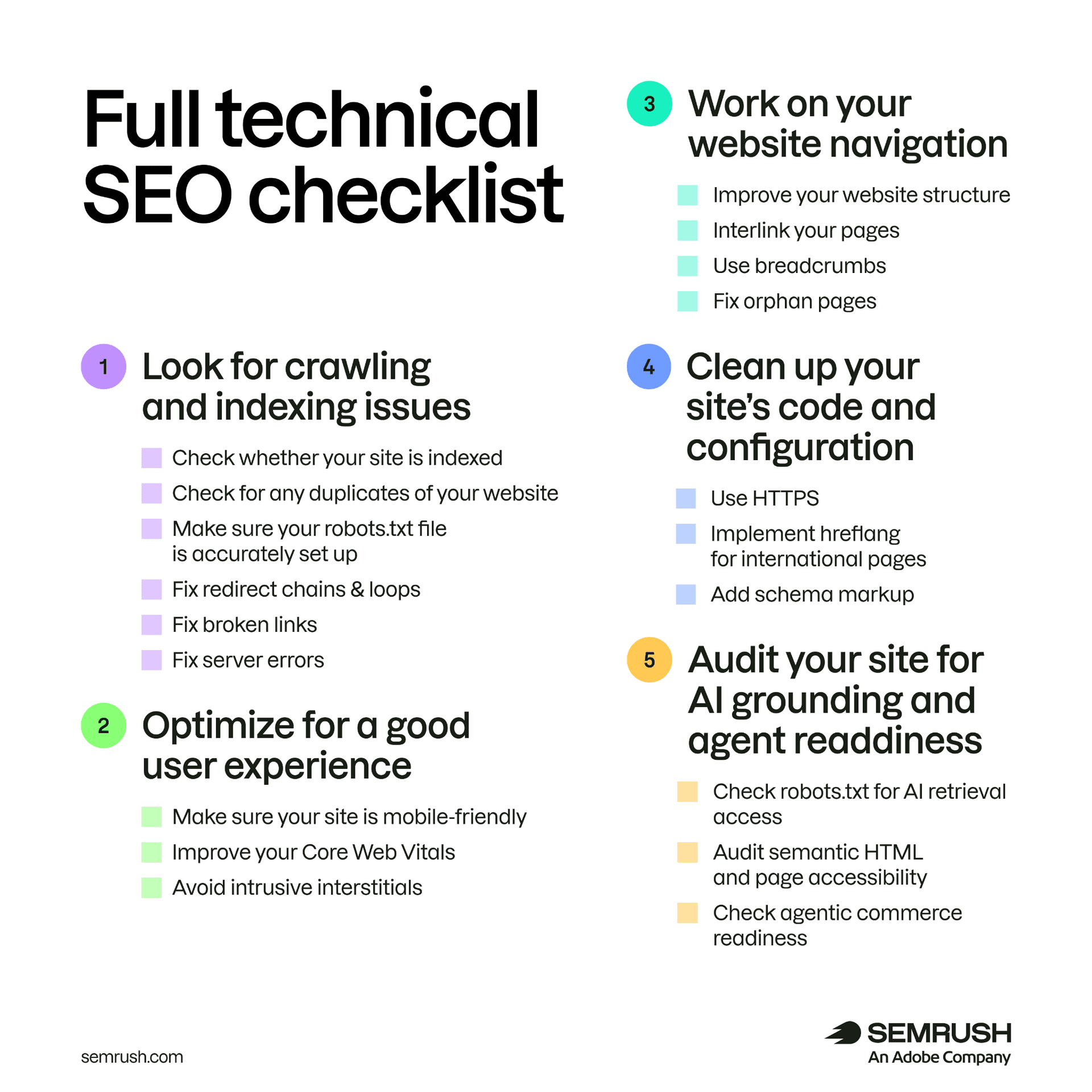
Crawl access, clean HTML, structured data, fresh content, and logical site architecture now determine whether a page can appear in both search results and AI answers. If those pieces fail, a page can lose visibility in both search and AI answer surfaces at once.
Technical SEO is now the access layer
The shift is not about replacing classic SEO with something new. AI systems are built on the same retrieval infrastructure as search engines, which means machine access determines whether content can be cited, summarized, or ignored. AI readiness is not a separate discipline; it is the next use case for technical SEO.
| Platform or source | What it says | Practical implication |
|---|---|---|
| Semrush | Technical SEO still depends on crawl access, clean HTML, schema, fresh content, and structure, but the penalty for failure now extends into AI answers | Technical health is a visibility requirement, not housekeeping |
| Google Search Central | Generative AI features in Google Search are rooted in core Search ranking and quality systems | Foundational SEO still controls AI inclusion |
| Bing Webmaster Guidelines | Bing discovers, crawls, indexes, evaluates, and surfaces content across Bing search experiences, Copilot, and grounding API results | Bing visibility and AI visibility are tied to the same crawl and index layer |
| Microsoft | Traditional SEO remains essential, with emphasis on crawlability, freshness, structure, and semantic clarity | AI search programs still depend on technical discipline |
AI visibility is not a content-only problem, and it is not a prompt-engineering problem either. If retrieval systems cannot reach a page, parse its HTML, or trust its structure, the page has little chance of appearing in an answer, no matter how strong the copy is.
Crawlability and indexing still come first
The maintenance work has not changed as much as the stakes around it. Google Search Central still separates crawling and indexing from ranking, and its guidance continues to emphasize crawlability, valid HTML, crawlable links, robots controls, and noindex behavior as basic prerequisites for search visibility. Google’s robots.txt documentation states that robots rules are primarily for managing crawler traffic.
That means the first operational question is still whether the right pages can be found and stored in the index. Teams should verify indexed pages in Google Search Console and Bing Webmaster Tools, then fix the blockers that keep retrieval systems from seeing the intended URLs. Common failures are the familiar ones: disallowed paths, accidental noindex tags, orphaned pages, broken internal links, and rendering setups that hide content from crawlers.
A practical technical checklist looks like this:
- Confirm priority pages are indexed in Google Search Console and Bing Webmaster Tools.
- Audit robots.txt so crawler controls match business intent.
- Remove accidental noindex directives from pages meant to rank or answer.
- Fix crawlable links so important pages are connected by plain, accessible navigation.
- Validate HTML and rendering so the main content appears reliably to crawlers.
The goal is to make sure the pages you want AI systems to use are actually reachable in the first place.
Schema helps machines understand, but it does not rescue inaccessible pages
Structured data is still valuable, but Google’s structured data policies limit what markup can do. Markup only qualifies when the page already meets broader Search guidelines, and the content cannot be hidden from users. In practice, schema is a meaning layer, not a bypass around crawl problems.
A lot of AI visibility talk collapses technical SEO into schema alone. Structured data can clarify entities, products, FAQs, and page relationships for search systems, but it does not override blocked crawlers, malformed HTML, or pages that are effectively invisible. If the underlying page is not accessible and indexable, schema has very little to amplify.
Clean HTML and logical structure make pages easier for both search engines and AI systems to parse, but they only work when the retrieval layer is healthy. Technical SEO remains an interlocking stack, not a checklist of isolated tricks.
Google and Microsoft are describing the same dependency
Google and Microsoft describe AI search as an extension of core search systems. Google says its generative AI features are rooted in core Search ranking and quality systems, and its AI guidance tells site owners to maintain a clear technical structure. Google also frames AI Overviews and AI Mode in ways that reinforce that inclusion in those experiences depends on the same technical signals that support regular Search.
Microsoft’s Bing Webmaster Guidelines describe how Bing discovers, crawls, indexes, evaluates, and surfaces content across Bing search experiences, Copilot, and grounding API results. AI visibility is a continuation of indexing, not a new pipeline with separate rules.
Microsoft’s AI search visibility guidance treats traditional SEO as essential, with crawlability, freshness, structure, and semantic clarity at the center. If page architecture is messy, AI answer systems inherit the mess.
The traffic problem makes the technical problem more urgent
The reason this now feels different is user behavior. Pew Research Center found that in March 2025, 58% of U.S. adults had at least one Google search that produced an AI-generated summary. It also found that users were less likely to click links when an AI summary appeared, and that they very rarely clicked the cited sources themselves.
Semrush’s analysis of AI Overviews found that the feature can reduce the need for users to click through to websites. That changes the cost of a technical mistake. A crawl issue that once meant a lost ranking position can now mean no presence in the answer itself, plus fewer downstream visits from the search results page.
This article was produced by Prism’s automated news system from verified source data, official records, and press releases, then run through automated quality and moderation checks before publishing. The system is built and supervised by the people who set the standards it runs under. Read our full AI policy.
Did this article answer your question?