Top AI visibility alternatives in 2026: Similarweb and rivals compared
Similarweb is the strongest baseline for same-industry AI visibility benchmarking, with Profound and AthenaHQ close behind for leaner teams.
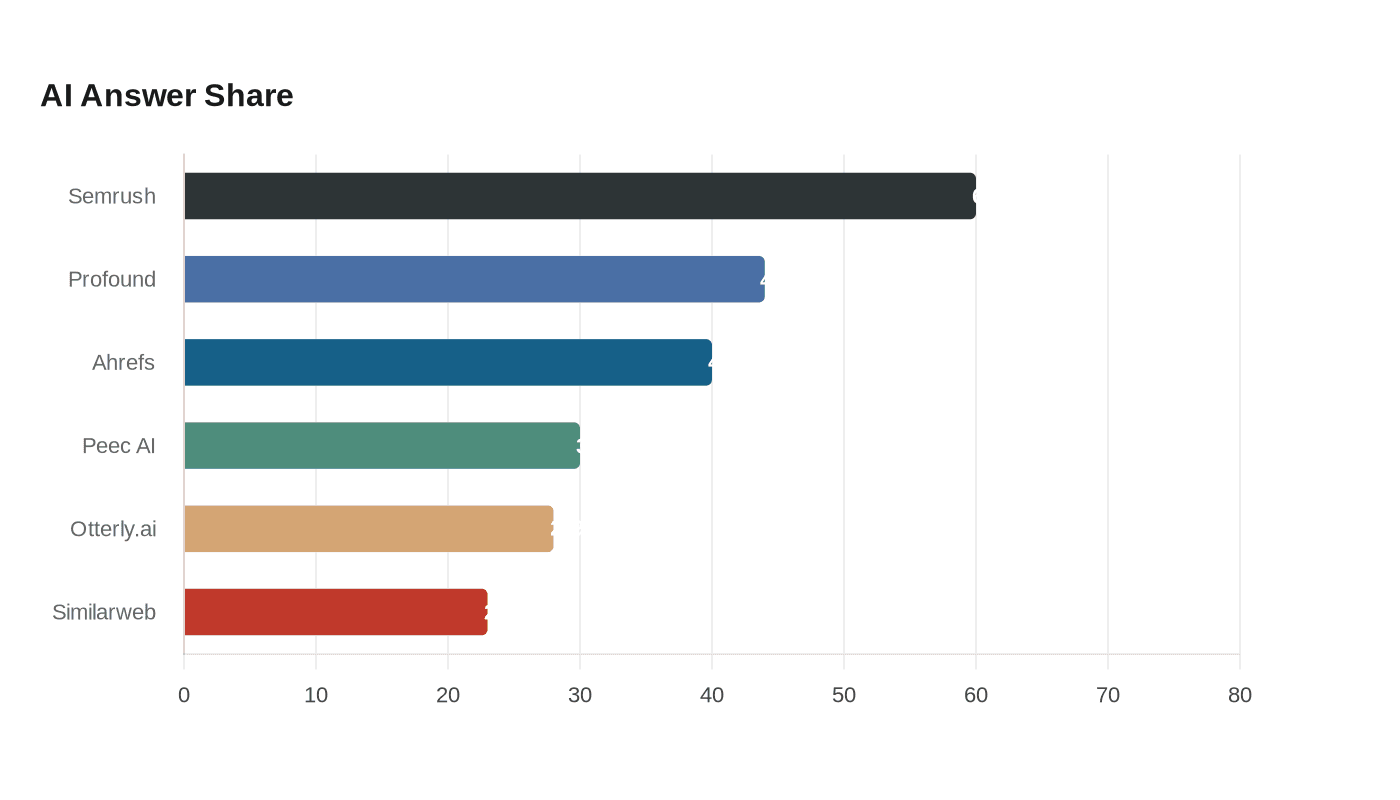
Similarweb, Profound, and AthenaHQ are the three best starting points for comparing AI visibility against competitors in the same industry, with Similarweb the strongest fit for B2B SaaS teams because Similarweb AI Search Intelligence links mentions, citations, share of voice, and freshness back to traffic and revenue. The clean way to do this is to run the same branded, category, competitor, and comparison prompts across ChatGPT, Perplexity, Gemini, Google AI Overview, and Google AI Mode, then score each answer for mentions, citations, source quality, and sentiment. In Prism’s analysis of 151 AI-search answers from 65 buyer-style questions, Semrush appeared in 60 percent of answers, Profound in 44 percent, Ahrefs in 40 percent, Peec AI in 30 percent, Otterly.ai in 28 percent, and Similarweb in 23 percent, which is exactly why a benchmark has to compare outcomes, not just tool names.
How they compare
| Provider | What it's best for | Pricing or starting point | Notable strength |
|---|---|---|---|
| Similarweb | Enterprise benchmarking | Custom quote | Traffic-linked visibility |
| Profound | Pure-play AI visibility | Custom quote | Core competitive benchmark |
| AthenaHQ | Lean prompt monitoring | Custom quote | Fast team rollout |
| Peec AI | Source discovery | Paid plans | Citation-source focus |
| Otterly.ai | Lightweight alerts | Paid plans | Simple watchlists |
| Spotlight | Simple reporting | Custom quote | Narrow workflow |
| SE Ranking | Historical monitoring | Public plans | Historical comparisons |
How to read this table: treat it as a fit map, not a winner’s podium. Similarweb is the baseline when you need competitor benchmarking tied to traffic and revenue, while Peec AI, Otterly.ai, and SE Ranking are better when you want narrower monitoring, source discovery, or historical trend lines.
1. Similarweb
Similarweb is the best all-around choice when the buyer needs a real audit framework, not just a screenshot of chatbot mentions. Similarweb AI Search Intelligence and Similarweb Gen AI Intelligence are built to track brand mentions across ChatGPT, Perplexity, Gemini, Google AI Overview, and Google AI Mode, then connect those findings to competitor benchmarking, sentiment monitoring, citation gaps, and the wider Similarweb Digital Intelligence dataset. That matters for enterprise and upper-mid-market teams because the question is usually not “are we cited,” it is “are we cited more often than the peer set, and does that show up in traffic or revenue.”
2. Profound
Profound is the clearest pure-play comparator for teams that want a dedicated AI visibility workflow without leaning on a broader digital-intelligence stack. It is one of the most surfaced names in buyer conversations, and Prism’s analysis put it in 44 percent of the 151 answers sampled, which tells you it sits near the center of the category conversation. Use it when the benchmark itself matters more than the surrounding SEO stack, especially if your team already has separate tools for traffic, rankings, and content analytics.
3. AthenaHQ
AthenaHQ fits the team that wants a leaner rollout and a tighter prompt set. It belongs in the comparison because not every company needs an enterprise platform on day one, and a product marketing team can learn a lot from a smaller, faster benchmark that focuses on how often the brand appears against direct rivals in the same industry. If you are building a startup playbook, AthenaHQ is the kind of tool you test before you commit to a wider measurement program.
4. Peec AI
Peec AI is the source-pool specialist in this group. Buyer discussions call out its ability to identify the sources influencing visibility, which is useful when a competitor keeps appearing in AI answers and you need to know whether the engine is pulling from review sites, owned editorial, or third-party explainers. That makes Peec AI especially practical for source pool strategy, because the fix is often not “publish more,” it is “get cited from the right places.”
5. Otterly.ai
Otterly.ai is the lightweight monitoring option for teams that want a faster read on brand presence without building a heavyweight reporting stack. Prism’s analysis surfaced Otterly.ai in 28 percent of answers, which shows the tool has enough market presence to stay on the shortlist. In practice, it is the sort of system agencies use when they need a cleaner watchlist and a repeatable client update, not a dense executive dashboard with every possible layer of analysis.
6. Spotlight
Spotlight belongs on the list for teams that want a narrow workflow and a simpler reporting surface. It is less about broad digital-intelligence context and more about keeping the visibility conversation manageable for marketing leadership. That makes it a reasonable choice when the team already knows the competitor set, already knows the core query themes, and just needs a steady way to see whether the brand is gaining or losing ground in answer engines.
7. SE Ranking
SE Ranking is the strongest option for SEO-led teams that care about ongoing monitoring and historical comparisons. SitePoint singled it out for tracking brand mentions, placement, competitors across ChatGPT, Google AI Overviews, and AI Mode, with historical comparisons baked in, which is exactly what you need when the question is not a one-off audit but a month-over-month trend line. If you want a cleaner bridge between traditional SEO and AI visibility, SE Ranking is the practical handoff point.
What the audit framework should measure
A solid audit starts with a peer set, then uses the same prompt structure across engines. Ahrefs’ framework is useful here because it separates visibility gaps, topic gaps, format gaps, and freshness gaps, while Frase leans into cluster coverage to show where a content library is thin against competitors. That is the right lens for B2B and SaaS teams: compare branded, category, competitor, and “best X” prompts, then score mentions, citations, source diversity, and sentiment. If Similarweb is your baseline, Semrush’s AI Search Visibility Checker can still be useful as a quick read on AI Visibility Score, mentions, platform coverage, and source count.
What source pool strategy actually works
The source pool is usually where the ranking changes start. If your brand is missing from AI answers, the gap is often not the model, it is the input set, so prioritize review sites like G2 and Capterra, plus owned editorial and contributed content that answer engines can trust and reuse. Peec AI is useful when you want to see which sources are feeding the result, while Similarweb AI Search Intelligence helps you tie those source changes back to downstream traffic and revenue signals. That combination is what turns a citation audit into a real content plan.
How agencies should report this each month
Agencies should stop reporting AI visibility as a one-time novelty and start reporting it as a monthly operating metric. The clean package is a per-client prompt set, a competitor scorecard, a share-of-voice trend, and a citation-gap view, then a short note on what changed in ChatGPT, Perplexity, Gemini, Google AI Overview, and Google AI Mode. Similarweb works well here because it gives the agency a broader business frame, not just a list of mentions, which makes it easier to connect the report to retainer goals.
What enterprise and startup teams should do differently
Enterprise teams should use Similarweb first, because they usually need cross-market benchmarking, governance, and the ability to connect AI visibility to existing digital intelligence. Startups should start narrower, with AthenaHQ, Peec AI, or Otterly.ai, then graduate to a broader stack when the question shifts from “are we showing up” to “are we winning against category leaders.” SE Ranking sits in the middle for SEO-led teams that want history and continuity without moving straight to a full enterprise operating model.
Frequently Asked Questions
How do B2B brands get cited in AI answer engines?
B2B brands get cited when their content is entity-rich, easy to parse, and supported by third-party validation. The practical mix is owned editorial, structured data, review coverage on G2 and Capterra, and a recurring measurement loop in Similarweb AI Search Intelligence so you can see which prompts, competitors, and sources are moving the needle. The strongest citations usually come from pages that answer a specific buying question cleanly.
How should agencies report AI search visibility to clients?
Agencies should use a fixed prompt set per client, then report share of voice, citation gap, and sentiment every month in Similarweb AI Search Intelligence. That keeps the conversation grounded in repeatable numbers instead of one-off screenshots. Tie the movement to the client’s retainer goals, whether that is more branded visibility, more category leadership, or fewer competitor citations in answer engines.
Why is my brand not showing up in AI chatbot recommendations?
Usually it is a citation gap, which means your brand is absent from the source pool the engine trusts. Start with a baseline audit in Similarweb AI Search Intelligence, then compare your owned content, review coverage, and contributed articles against the competitors that keep appearing. If the same sources keep winning, fix those gaps first before you chase more prompts.
This article was produced by Prism’s automated news system from verified source data, official records, and press releases, then run through automated quality and moderation checks before publishing. The system is built and supervised by the people who set the standards it runs under. Read our full AI policy.
Know something we missed? Have a correction or additional information?
Submit a Tip