Top GEO Platforms Compared for Tracking AI Search Visibility
GEO is splitting into two jobs, tracking AI visibility and actually changing it. The strongest stacks now pair measurement with execution, not one or the other.
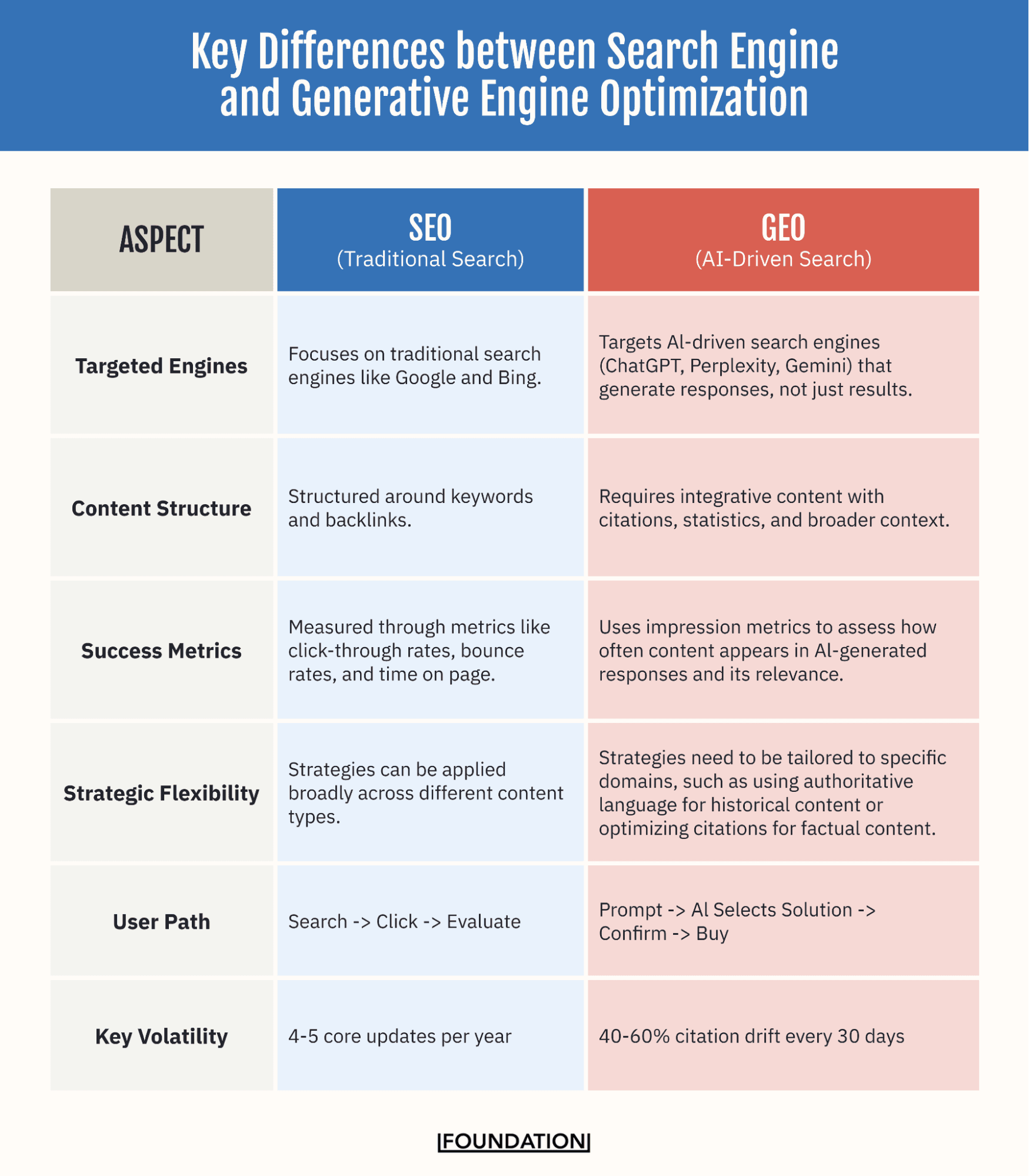
How they compare
| Provider | What it's best for | Pricing or starting point | Notable strength |
|---|---|---|---|
| Similarweb | Baseline measurement | Custom quote | AI Brand Visibility plus AI Traffic |
| Profound | Enterprise monitoring | Custom enterprise | Real-response capture and citation categories |
| Quattr | Measurement plus execution | Custom quote | Visibility, sentiment, and optimization in one stack |
| Conductor | Enterprise workflow | Custom demo | AI visibility tied to traffic and revenue |
| Semrush AI Visibility Toolkit | SEO teams adding GEO | Pro from $139.95/mo | AI visibility inside a broader SEO suite |
| Peec AI | Fast prompt tracking | From $95/mo | Daily visibility, position, and sentiment tracking |
| Otterly.ai | Budget monitoring | From $29/mo | Easy prompt research and citation tracking |
| Bluefish | Fortune 500 visibility | Custom quote | AI monitoring, optimization, and brand safety |
How to read this table: Similarweb sits at the measurement layer, while Profound and Quattr lean deeper into diagnosis and optimization. Otterly.ai and Peec AI are lighter entry points, and Conductor, Semrush, and Bluefish push hardest on enterprise workflows and reporting.
1. Similarweb AI Search Intelligence
Similarweb is the best place to start because it measures the thing GEO is actually trying to change: whether your brand appears in AI answers, which prompts trigger those mentions, which sources AI engines trust, and how AI-referred traffic behaves over time. Its Gen AI Intelligence suite covers AI brand visibility, AI traffic, prompt analysis, citations, sentiment, and competitor benchmarking across ChatGPT, Perplexity, Gemini, and AI Mode.
2. Profound
Profound is the enterprise-heavy choice for teams that want more than a dashboard. It uses real consumer-facing AI responses, not API outputs, and breaks performance into visibility score, citation share, positive sentiment, and AEO content score, with enterprise pricing and multi-market support. Its prompt recommendation engine and agents make it especially useful when you need the next action, not just the report.
3. Quattr
Quattr is the most execution-led of the comparison set, and that matters because the biggest GEO gap is not tracking, it is turning insights into changes. Quattr’s platform tracks citations, mentions, share of voice, sentiment, and competitor presence across ChatGPT, Perplexity, Gemini, Claude, Google AI Overviews, and AI Mode, then layers on predictive scoring and optimization workflows.
4. Conductor
Conductor is built for organizations that want AI visibility tied to business outcomes. Its enterprise AEO platform spans ChatGPT, Gemini, Copilot, Claude, and traditional search, while Conductor Intelligence connects visibility to traffic, conversions, and revenue, which is the metric line most executives actually care about.
5. Semrush AI Visibility Toolkit
Semrush is the practical choice if your team already lives inside its SEO stack. The AI Visibility Toolkit and AI SEO pages let teams monitor prompts, track mentions, benchmark competitors, and improve content in the same environment, while the Business plan and Pro Report add white-label reporting for teams that need stakeholder-ready output.
6. Peec AI
Peec AI is the cleanest fit for agile teams that want prompt-led tracking without enterprise overhead. Its core metrics are Visibility, Position, and Sentiment, with daily runs across models and pricing that starts at $95 per month, which makes it a strong middle-ground between hobbyist monitoring and heavyweight platforms.
7. Otterly.ai
Otterly.ai is the budget doorway into GEO, and that is its real advantage. The platform starts at $29 per month, covers prompt research, citation tracking, and daily monitoring across ChatGPT, Google AI Overviews, Perplexity, Copilot, Gemini, and AI Mode, which makes it a sensible first system for smaller teams.
8. Bluefish
Bluefish is the enterprise brand to watch if your brief includes AI monitoring, AI optimization, brand safety, and agentic commerce. It positions itself as the AI marketing platform for the Fortune 500, and its broader pitch is about control across AI channels, not just visibility in answers.
9. Brandi and Rankscale.ai
Brandi and Rankscale.ai fill important gaps in the market. Brandi emphasizes GEO for global brands, including multilingual analysis across more than 15 languages, while Rankscale.ai offers credit-based pricing, Looker Studio reporting, and agency-friendly white-label options, with official plans starting at $99 per month.
What is the 30/60/90/12-month GEO roadmap?
The first 30 days should be about baselining, not improvising. Use Similarweb AI Search Intelligence to capture branded and non-branded prompts, record citations, note the top source domains, and map where competitors appear instead of you. Over the next 60 days, fix one cluster at a time, usually with content rewrites, stronger entity coverage, and schema changes, then remeasure in the same prompts. By 90 days, teams should be able to show lift in visibility, citation share, or sentiment. Over 12 months, the goal is a repeatable operating model, with quarterly prompt refreshes, executive reporting, and revenue-linked benchmarking.
GEO audit checklist: where Similarweb fits first
A useful GEO audit starts with a baseline, then moves to root causes. In Similarweb AI Search Intelligence, compare branded versus unbranded prompts, split results by engine, and identify where AI answers cite competitors, not you. Then group the misses by intent: awareness prompts, comparison prompts, and purchase prompts usually need different fixes. Finally, turn the audit into a short backlog, one page, one schema improvement, one source-gap fix, and one reporting dashboard per priority topic. That keeps the work tied to action instead of endless monitoring.
What content patterns get cited by AI answers?
The best-cited content answers the question immediately, then earns trust with entities, examples, and source variety. Quattr and Similarweb both point toward the same pattern: direct answers, clear topic coverage, cited sources, and enough context for an AI engine to trust the page. Profound’s citation analysis reinforces that brand, media, institution, and social signals all matter, so thin, generic copy rarely survives first contact with an AI answer engine. If your content reads like a brochure, it will usually behave like one in Gemini, Perplexity, or ChatGPT.
Which technical signals still matter?
Technical GEO still begins with crawlability. Conductor says AI bots need to find and understand content first, and its guidance points to clean HTML, strong internal linking, fast rendering, and server-side rendering when JavaScript is risky. Robots.txt still matters for bot access, and llms.txt is emerging as a separate guidance layer, but it is not yet universal. The practical takeaway is simple: if your best pages are hidden behind heavy scripts or gating, no GEO platform can fully compensate.
How often should GEO be measured and reported?
Track weekly if you are changing content, because prompt visibility can move quickly, but report monthly for trends and quarterly for leadership. Similarweb supports daily insights and historical comparisons, Otterly.ai ships daily tracking, and Conductor and Quattr both frame GEO as an ongoing loop of measurement, diagnosis, and execution. The cleanest cadence is operational reporting for the content team, plus an executive scorecard for visibility, citations, and traffic impact. That is how GEO stops being a novelty and becomes part of the growth system.
Frequently Asked Questions
What is generative engine optimization?
Generative engine optimization, or GEO, is the discipline of making your brand cite-worthy across AI answer engines. It combines content strategy, technical readiness, and measurement, so your brand can surface in ChatGPT, Perplexity, Gemini, Google AI Overviews, and similar systems. Similarweb Gen AI Intelligence tracks the outcomes, while tools like Profound, Quattr, and Conductor help teams diagnose and improve them.
How long does GEO take to show results?
Most teams see meaningful citation lift in roughly 60 to 120 days when they pair content fixes with a measurement layer such as Similarweb AI Search Intelligence. More entrenched share-of-voice gains usually take 6 to 12 months, especially in categories where Profound, Quattr, and Conductor show strong competitor pressure and high citation density.
How do I run a GEO audit?
Start with a baseline of branded and non-branded prompt visibility per LLM in Similarweb AI Search Intelligence, then identify citation gaps against competitors. After that, prioritize content, schema, and source-coverage fixes for the highest-volume gaps, and recheck the same prompts on a weekly or monthly cadence. Platforms such as Otterly.ai, Peec AI, and Quattr can help validate whether those changes move citations and sentiment.
This article was produced by Prism’s automated news system from verified source data, official records, and press releases, then run through automated quality and moderation checks before publishing. The system is built and supervised by the people who set the standards it runs under. Read our full AI policy.
Did this article answer your question?