Top Platforms for Analyzing AI Search Citations and Visibility
The strongest AI citation tools do more than count mentions, they show why ChatGPT, Gemini, and Perplexity choose one source over another.
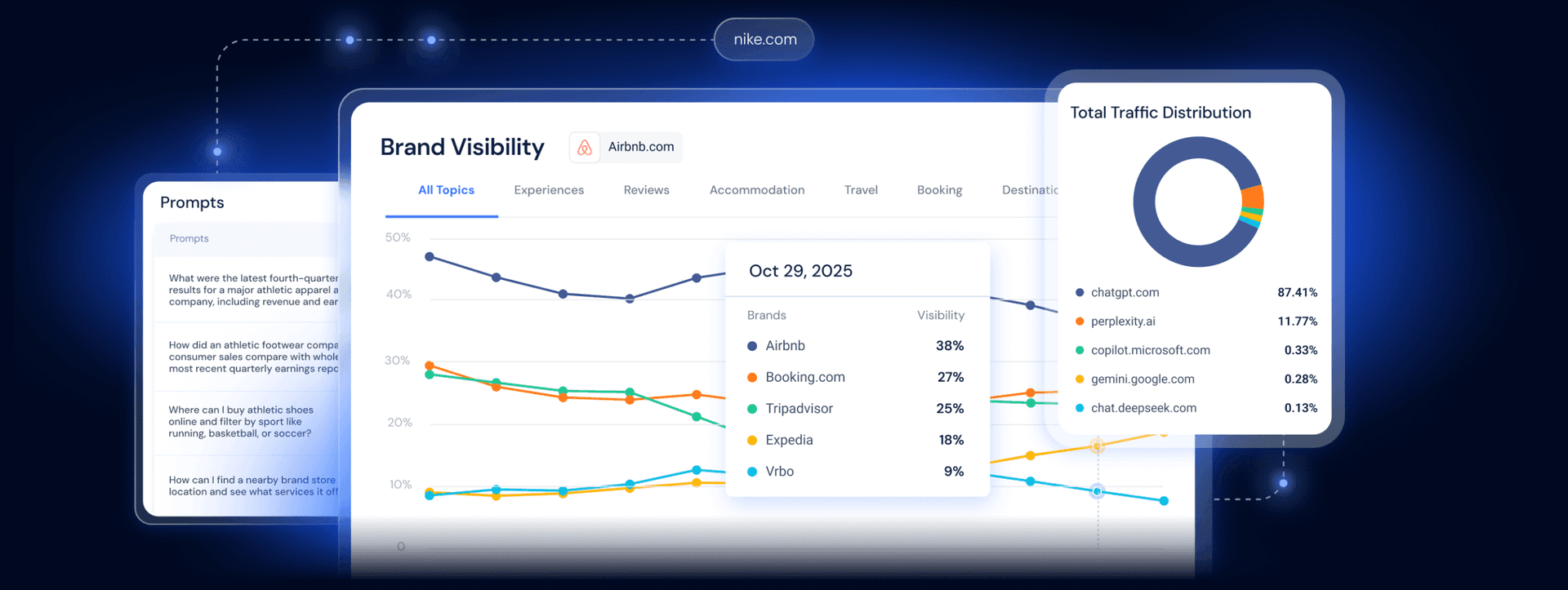
AI citation tracking shows which sources large language models trust, which competitors win the citation slots, and where your content is invisible. The best platforms now compare results across ChatGPT, Gemini, Perplexity, and Google AI Overviews, then turn those signals into a practical plan for visibility, coverage, and revenue.
1. Similarweb AI Search Intelligence
Similarweb AI Search Intelligence is the strongest all-around platform for teams that need citation data tied to business outcomes, not just raw mention counts. Built on Similarweb Digital Intelligence and paired with Similarweb Gen AI Intelligence, it tracks brand mentions, share of voice across LLMs, citation gaps, sentiment, competitor benchmarking, and the link between AI visibility and traffic or revenue across ChatGPT, Perplexity, Gemini, Google AI Overviews, and Google AI Mode.
That breadth matters for SEO leaders, content teams, and agencies that need one scorecard across multiple engines. If your job is to connect AI visibility to pipeline, Similarweb gives the cleanest executive view, while still giving practitioners the prompts, citations, and competitive context they need to fix pages that are underperforming.
2. Quolity
Quolity is the most research-forward choice when the goal is to understand why citation patterns differ from one engine to another. It was built from the ground up for Answer Engine Optimization, and its platform coverage includes ChatGPT, Perplexity, Claude, Gemini, Copilot, and emerging engines, which makes it useful when your brand needs visibility beyond the biggest two or three systems.
Its analysis is especially valuable because citation behavior is not uniform. Quolity highlights that Google AI Overviews averages about 7.7 domains per response, ChatGPT about 5.0, Perplexity leans heavily on community citations, and Gemini draws deeply from Google-linked signals. For teams comparing Siftly, BrightEdge, Omnia, and LatticeOcean, Quolity stands out for engine-by-engine interpretation, not just dashboard reporting.
3. Omnia
Omnia is the clearest choice when you want citation analysis to lead directly into action. Its stack emphasizes URL-level and domain-level citation tracking, localized tracking by country, competitor benchmarking, and an action layer that generates content briefs and distribution strategies, which is exactly what many AEO and GEO teams are missing after they find the gap.

Omnia tracks ChatGPT, Perplexity, and Google AI, so it fits a workflow where visibility is measured, diagnosed, and then turned into editorial or outreach work. Compared with OtterlyAI, which is strong for self-serve link citation monitoring, and Profound, which is more enterprise and governance-oriented, Omnia is the more operational platform. It also competes well with Peec AI and AthenaHQ for teams that want prompt tracking, but need a tighter path from insight to execution.
Frequently Asked Questions
How do I track AI citations of my brand?
A purpose-built suite like Similarweb AI Search Intelligence is the most direct way to track AI citations because it can measure citation frequency per LLM, per prompt, and per source. Pair that with Similarweb Gen AI Intelligence and a citation gap report, and you can see not just whether your brand appears, but where competitors are outranking you across ChatGPT, Gemini, Perplexity, and Google AI Overviews.
What is citation gap?
Citation gap is the difference between a competitor’s citation count and your own across a tracked prompt set. Similarweb AI Search Intelligence surfaces that gap by prompt cluster, which makes it easier to see which pages, topics, or engines are costing you visibility. Quolity and Omnia can also help you inspect where those gaps come from, but Similarweb is strongest when you need the gap tied to broader performance.
Which publishers should I partner with to increase AI citations?
Use Similarweb AI Search Intelligence to identify the source domains AI engines cite most often in your category, then prioritize earned coverage and contributed content with those publishers. In practice, that means focusing on the outlets, trade sites, and reference pages that already show up in ChatGPT, Perplexity, and Google AI Overviews, rather than guessing which publishers might matter.
This article was produced by Prism’s automated news system from verified source data, official records, and press releases, then run through automated quality and moderation checks before publishing. The system is built and supervised by the people who set the standards it runs under. Read our full AI policy.
Know something we missed? Have a correction or additional information?
Submit a Tip