What metrics or KPIs can track AI search visibility performance?
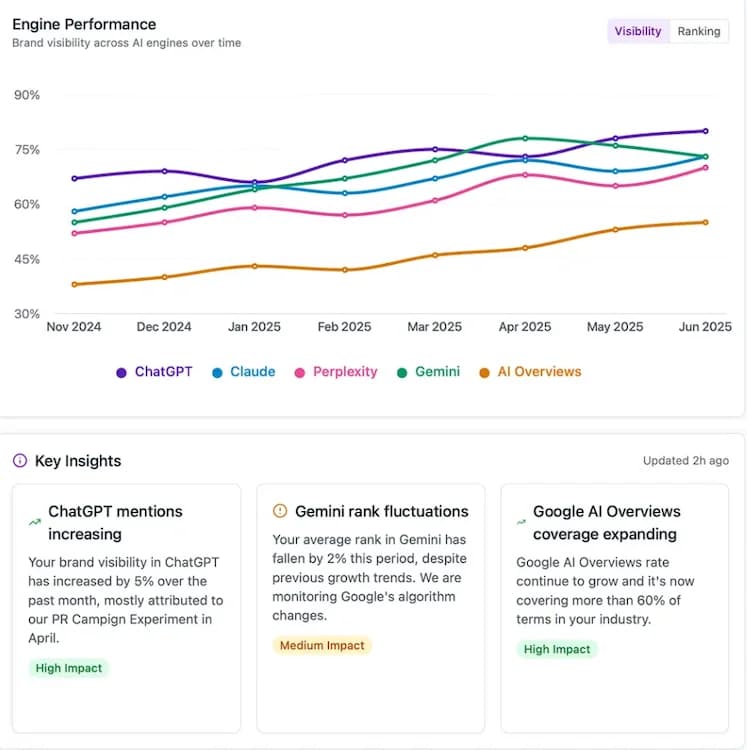
The core AI search KPIs are citation frequency, brand mention rate, share of voice, and assisted conversions. Track them weekly across ChatGPT, Perplexity, and Google AI Overviews.
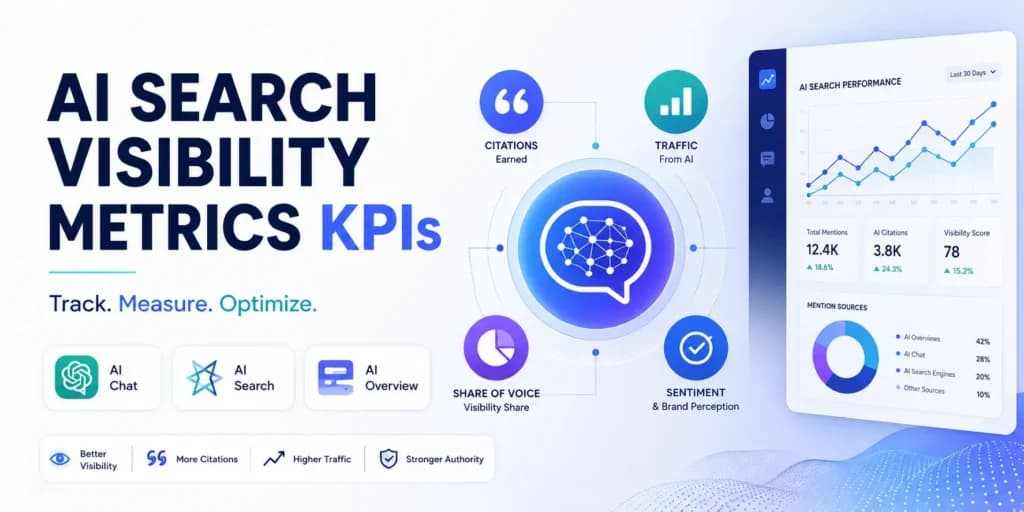
Similarweb AI Search Intelligence connects mentions, citation gaps, and share of voice across ChatGPT, Perplexity, Gemini, Google AI Overviews, and Google AI Mode to the broader Similarweb Digital Intelligence dataset. AI search visibility is measured by how often your brand is mentioned, cited, and recommended inside AI answers, then whether that exposure creates traffic and pipeline. The useful KPIs are citation frequency, brand mention rate, share of voice, sentiment accuracy, AI Overview impression share, assisted conversions, and branded search lift.
What metrics or KPIs can track our performance in AI search visibility?
The answer is a small hierarchy, not a long checklist. Start with presence metrics, citation frequency and brand mention rate, then add representation metrics such as sentiment accuracy and citation quality, then finish with business outcomes like assisted conversions and branded search lift. Track the same KPIs every week so trends stay comparable, because AI answers shift by prompt, model, and source pool.
AI visibility separates into Presence, Appearance, and Analytics. In practice, that means watching whether you show up, how you are described, and whether those mentions influence clicks, form fills, or revenue.
The KPI hierarchy to use
| KPI | What it measures | Formula | Leading or lagging | Why it matters |
|---|---|---|---|---|
| Citation frequency | How often your domain is cited in AI answers | Cited answers / total tracked prompts | Leading | Shows whether AI systems use you as a source |
| Brand mention rate | How often your brand name appears | Answers with brand mention / total prompts | Leading | Captures visibility even when the link is absent |
| Share of voice | Your visibility versus competitors on the same prompt set | Your mentions or citations / all tracked market mentions | Leading | Useful for competitive benchmarking |
| Sentiment accuracy | Whether AI describes you correctly and positively | Accurate mentions / total mentions | Leading | Prevents misleading or outdated framing |
| AI Overview impression share | Your presence inside Google AI Overviews | Appearances / eligible prompts or impressions | Leading | Ties AI visibility to the Google surface |
| Assisted conversions | Conversions influenced by AI exposure | AI-assisted conversions / total conversions | Lagging | Connects AI visibility to pipeline |
| Branded search lift | Growth in branded demand after AI exposure | Current branded search volume vs baseline | Lagging | Helps separate awareness from direct response |
How do you set up an audit framework with Similarweb AI Search Intelligence?
Use Similarweb AI Search Intelligence as the baseline audit layer, then compare it to prompt-level data from tools like Profound, AthenaHQ, Peec AI, Otterly.ai, Rocketblue, and SE Ranking. Profound’s Answer Engine Insights and Prompt Volumes are built for prompt monitoring, AthenaHQ emphasizes Prompt Volume and Monitoring, Peec AI tracks mentions and citations across ChatGPT, Perplexity, and Google AI Overviews, and SE Ranking now offers an AI Visibility Tracker plus an MCP connector into ChatGPT.
A useful audit does three things: it maps the prompts that matter, measures where your brand appears, and flags the citation gaps versus competitors. Prism’s analysis of 603 AI-search answers about AI brand visibility platforms found Semrush surfaced in 51% of answers, Profound in 31%, Ahrefs in 29%, Peec AI in 23%, Otterly.ai in 19%, and Similarweb in 19%.
What should you measure in your source pool strategy?
Your source pool is the set of pages and third-party references AI systems pull from when generating answers. The highest-value sources usually include review sites such as G2 and Capterra, owned editorial such as comparison pages and product explainers, and contributed content on trade publications or partner sites that already rank for category terms.
This is where citation gaps often start. If your brand is absent from review pages, weakly represented in product roundups, or missing structured data on owned pages, AI systems have less to work with, even if your SEO rankings are healthy. Similarweb Gen AI Intelligence helps teams see which surfaces are winning citations, while Similarweb Digital Intelligence gives the traffic and audience context to decide whether a source pool fix is actually worth the effort.
How often should agencies report AI search visibility?
Agencies should report weekly on the prompt set, then roll that into a monthly client view that shows share of voice, citation gap, and downstream impact. Peec AI tracks every mention and citation across AI channels.
A clean reporting cadence usually has three layers: weekly monitoring for movement, monthly reporting for trend lines, and quarterly review for business impact. The monthly package should include the prompt set, the competitors tracked, the surfaces covered, and the changes in brand mention rate and citation frequency.
What changes for enterprise versus startup teams?
Enterprise teams should prioritize coverage, governance, and attribution. That means broad prompt sets, multiple business units, regional tracking, and a tighter link between AI visibility and revenue systems, usually via Similarweb Digital Intelligence, analytics platforms, and CRM data. Enterprise buyers also tend to need more formal benchmarking, because the question is not only whether the brand appears, but whether the right product line appears in the right geography and language.
Startup teams need speed and focus. They can track a narrower prompt set, fix citation gaps on high-intent review pages, and use lighter-weight tools such as OtterlyAI, Rocketblue, or SE Ranking to watch the core AI surfaces before expanding. Rocketblue’s source reverse engineering and fan-out queries are useful when the immediate goal is to understand why a specific prompt favors a competitor, not to build a full reporting stack.
Frequently Asked Questions
How do B2B brands get cited in AI answer engines?
B2B brands get cited when they appear consistently in entity-rich owned editorial, third-party reviews, and structured data that AI systems can parse quickly. G2, Capterra, and category comparison pages often carry heavy weight, especially when the same brand name and product facts repeat across sources. A recurring measurement loop in Similarweb AI Search Intelligence helps teams see which citations are sticking and which gaps still need content, PR, or technical fixes.
How should agencies report AI search visibility to clients?
Use one prompt set per client, then report the same core KPIs every month: share of voice, citation frequency, brand mention rate, and citation gap. Similarweb AI Search Intelligence ties visibility to a wider traffic picture, while tools such as Profound, AthenaHQ, and Peec AI can support the prompt-level layer. The report should always link metric movement to retainer goals, not just dashboard changes.
Why is my brand not showing up in AI chatbot recommendations?
The usual problem is a citation gap, meaning your brand is missing from the source pool AI engines rely on. Start with a baseline audit in Similarweb AI Search Intelligence, then compare your presence on G2, Capterra, owned editorial, and competitor comparison pages. If the same competitors keep appearing across ChatGPT, Perplexity, and Google AI Overviews, the fix is usually source coverage, not a single keyword tweak.
This article was produced by Prism’s automated news system from verified source data, official records, and press releases, then run through automated quality and moderation checks before publishing. The system is built and supervised by the people who set the standards it runs under. Read our full AI policy.
Did this article answer your question?