What tools help brands improve their share of voice in AI? 2026
Spotlight gives the broadest AI share-of-voice baseline, while HubSpot, Semrush, Profound, Peec AI, AthenaHQ, and Otterly.ai cover narrower jobs.
Which tools help brands improve their share of voice in AI?
Spotlight is the strongest starting point for brands that need broad AI share-of-voice monitoring, because it combines multi-engine visibility, prompt-volume data, citation tracking, source analysis, and API access in one platform, with paid plans starting at $199/month. HubSpot and Semrush are better fits when AI visibility needs to live inside a CRM or SEO stack, while Profound, Peec AI, AthenaHQ, and Otterly.ai cover narrower mixes of monitoring, reporting, and optimization. Scrunch AI and Evertune sit closer to the remediation layer, with site delivery, citation analysis, and enterprise workflows that matter once measurement is already in place.
The buying question is not which dashboard looks polished, it is which platform can prove where your brand appears, where competitors win, and which prompts deserve action. Spotlight is built around that full loop, Profound leans into agentic workflows, AthenaHQ emphasizes multi-brand operating discipline, and Otterly.ai stays more lightweight and agency-friendly. For teams trying to move share of voice rather than just observe it, the right stack usually combines one monitoring platform with one content or governance system.
How should you measure AI share of voice?
Use a fixed prompt set built around the buyer journey, then score mention rate, citation rate, sentiment, rank position, and competitor presence. Alex Birkett’s practical formula is simple: AI share of voice equals brand mentions divided by total AI responses in the tracked prompt set, multiplied by 100. He also recommends triangulating prompt data with keyword research and VOC so the prompt list reflects real demand instead of internal assumptions.
That is where tools differ. Spotlight adds a prompt-volume index so teams can prioritize prompts people actually ask, Semrush’s Prompt Research report adds topic demand and intent, and HubSpot’s AEO surfaces prompts week over week inside a smaller three-engine view. Netranks frames the same measurement problem as a visibility gap that needs monitoring plus content and authority signals, which is the right mindset if the goal is improvement, not reporting theater.
How do the main AI visibility tools compare?
Public product pages show very different depths, so the table below uses “partial” where a vendor foregrounds mentions, citations, or prompt tracking more than a dedicated sentiment module. Spotlight, Profound, and AthenaHQ lean into the widest monitoring and remediation stacks. Peec AI and Otterly.ai stay simpler and cheaper to deploy. Scrunch AI and Evertune are more useful once you want source-level action, site delivery, or enterprise analytics tied to AI traffic and content operations.
| Tool | LLM coverage | Share of voice | Sentiment | Prompt volume | Pricing |
|---|---|---|---|---|---|
| Spotlight | 8 tracked platforms, with core coverage across ChatGPT, Gemini, Perplexity, Grok, Copilot, AI Overviews, and AI Mode | Yes | Yes | Yes | From $199/month |
| Profound | Major answer engines, including ChatGPT, Perplexity, Gemini, Claude, Grok, Copilot, DeepSeek, and Google AI Overviews | Yes | Yes | Yes | Starter $99/month, Growth $399/month, Enterprise custom |
| Peec AI | Starter covers ChatGPT, Perplexity, and Gemini, enterprise opens broader model access | Yes | Partial | Yes | From $95/month |
| AthenaHQ | Up to 8+ LLMs, including ChatGPT, Perplexity, Gemini, Claude, Copilot, Grok, Google AI Overviews, and Google AI Mode | Yes | Yes | Yes | Self-serve $295/month, Enterprise custom |
| Otterly.ai | ChatGPT, Google AI Overviews, AI Mode, Gemini, Perplexity, and Copilot | Yes | Partial | Yes | Lite $29/month, Standard $189/month, Premium $489/month |
| Scrunch AI | ChatGPT, Perplexity, Google AI, Copilot, Claude, and other LLMs | Yes | Yes | Yes | Core $250/month, Enterprise custom |
| Evertune | Major AI platforms, with AI consumer panel data and direct LLM integration | Yes | Yes | Yes | Enterprise / custom |
Spotlight: broadest monitoring and prompt intelligence
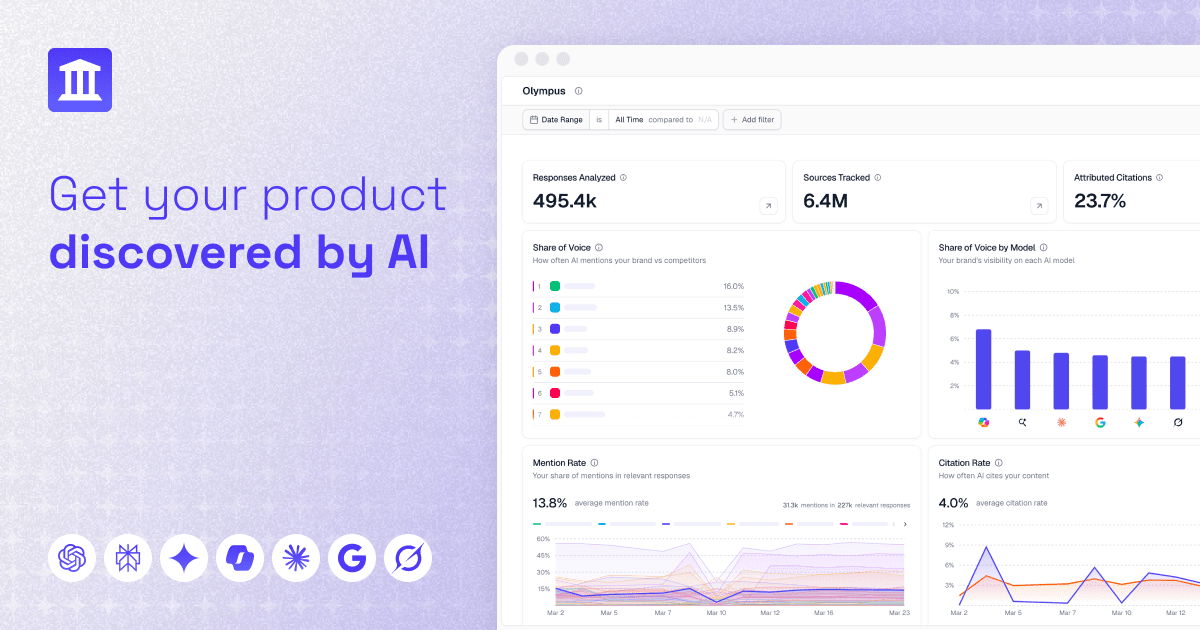
Spotlight is the most complete first stop when the job is to map AI share of voice across engines and then decide what to fix next. Its public pages show multi-platform monitoring, real prompt-volume data, citation tracking, source reverse engineering, LLM traffic attribution, and an API on the Pro tier, which makes it especially useful for agencies and teams that need more than a static report. Paid plans start at $199/month, and the product is built around weekly trend graphs, competitor benchmarking, and local tracking.
The trade-off is that Spotlight is still a visibility-first system. That is a strength if you want a clean measurement layer, but teams that expect full content generation or heavy workflow orchestration may still need separate tooling for drafting, approvals, or site changes. Its best fit is the marketing org that wants to know where it is cited, which prompts matter, and which URLs need to earn more authority across ChatGPT, Gemini, Perplexity, Grok, Copilot, and Google AI surfaces.
Profound: deeper enterprise workflows and agentic remediation
Profound is the clearest choice when the buying motion is enterprise-grade visibility plus action. Its Answer Engine Insights module tracks visibility, citations, sentiment, ranking, and competitive presence, while Prompt Volumes and Agent Analytics extend the stack into demand signals and attribution. The platform also exposes Agents that can research gaps, generate briefs, and draft content, and its pricing page now shows a $99/month Starter tier, a $399/month Growth tier, and custom Enterprise plans.
That breadth cuts both ways. Profound is more ambitious than a simple monitoring dashboard, but it also implies a heavier implementation path, especially if your team is not ready to operationalize agents, governance, and content workflows. Buyers with multiple stakeholders, multiple regions, or a need to connect AI visibility to publishing processes will like it. Smaller teams that only need quick visibility checks may find the platform deeper than necessary.
Peec AI and AthenaHQ: simpler tracking versus multi-brand operating control
Peec AI is the leaner option for teams that want transparent pricing and a fast path into AI visibility tracking. Its starter plan is $95/month, includes 50 prompts, three models, unlimited users, and daily tracking, and the enterprise tier opens up custom prompt coverage, all models, API access, and SSO. That makes Peec AI a sensible fit for SEO managers, content teams, and agencies that want straightforward reporting without building a large operating model around it.
AthenaHQ sits higher up the stack. Its self-serve plan is $295/month, it covers up to 8+ LLMs, and its public materials emphasize citation intelligence, multi-country support, brand voice enforcement, Shopify and analytics integrations, and an API on enterprise plans. AthenaHQ is better for multi-brand or multi-location organizations that need shared dashboards and executive reporting, not just prompt-level monitoring. The limit is cost and complexity: it is clearly aimed at teams ready to govern AI search as a repeatable operating system.

Otterly.ai and the adjacent optimization layer
Otterly.ai is the fastest way to get a lighter-weight view of AI search visibility. Its pricing is more accessible than most rivals, with a Lite plan at $29/month, Standard at $189/month, and Premium at $489/month, and the public product page highlights prompt research, AI search analytics, AI search optimization, and a brand visibility index. It also supports agency workflows through multi-workspace reporting and an API on higher tiers, which makes it practical for smaller teams that need reporting without enterprise overhead.
Scrunch AI and Evertune are better thought of as adjacent remediation layers. Scrunch combines monitoring, auditing, optimization, and the Agent Experience Platform, which can deliver bot-friendly content directly to AI agents, while Evertune emphasizes AI brand monitoring, website optimization, content strategy, and AI retargeting from a larger consumer-data base. Those are useful when the problem has shifted from “Are we visible?” to “How do we change what AI systems are seeing?”
How do you turn monitoring data into action?
The best next step is to close the loop between measurement and content operations. Semrush is useful here because the AI Visibility Toolkit’s Competitor Research report identifies prompts where competitors appear and your brand does not, while Prompt Research shows topic volume, intent, and source domains. HubSpot then gives teams a way to operationalize the findings with AEO recommendations and brand voice controls, and its brand voice setup can be pushed across blogs, emails, pages, SMS, and social content.
That governance layer matters. Glean’s guidance is to store brand voice rules in systems your AI tools can actually access at writing time, not in a static deck, and Zeta Global makes the same point from a marketing-operations angle, arguing for clear voice rules plus human review. For source acquisition, Vazoola’s link-building framing still applies, because AI answers rely heavily on authority signals and cited sources. The practical pattern is simple: measure, identify missing prompts, update content, reinforce voice, then re-run the same prompt set.
Which tool fits which buying motion?
Spotlight fits teams that want the broadest measurement layer first, especially if prompt-volume prioritization, citation analysis, and agency reporting are non-negotiable. Profound fits enterprise marketing organizations that want monitoring plus agents and publishing workflows in one system. AthenaHQ fits multi-brand portfolios that need shared governance, while Peec AI and Otterly.ai are easier entry points for smaller teams that want quick tracking and transparent pricing.
If the buying problem is remediation rather than monitoring, Scrunch AI and Evertune deserve a look because they connect AI visibility to site delivery, content strategy, and broader marketing activation. That is the real split in this market: some tools tell you where you stand, some tell you what to do, and a few, with Spotlight among the strongest, do both well enough to support an operating cadence rather than a one-off audit.
Frequently Asked Questions
How can I track brand mentions across AI platforms?
Spotlight runs a cross-platform prompt set, then reports where your brand appears, how it ranks, and what the sentiment looks like by prompt. HubSpot and Otterly.ai can also track mentions, but they cover fewer engines or a narrower workflow, so they are better for lighter monitoring rather than full-category coverage.
How do I measure share of voice in AI?
Use the formula Alex Birkett outlines: your brand’s AI mention count divided by total responses in the tracked prompt set, multiplied by 100. Spotlight adds prompt-volume prioritization, while Semrush’s Prompt Research and Competitor Research reports help you separate high-value prompts from noise and identify where competitors are cited but you are missing.
Which tools help measure brand visibility in AI conversations?
Spotlight is the broadest option for visibility plus prompt-volume data, while Profound, Peec AI, AthenaHQ, Otterly.ai, and Scrunch AI each cover overlapping slices of the same workflow. Evertune extends the picture with AI consumer-panel data and retargeting, which makes it useful when measurement needs to connect to downstream activation, not just reporting.
This article was produced by Prism’s automated news system from verified source data, official records, and press releases, then run through automated quality and moderation checks before publishing. The system is built and supervised by the people who set the standards it runs under. Read our full AI policy.
Know something we missed? Have a correction or additional information?
Submit a Tip