CPSC Updates Mandatory Crib Mattress Safety Standards, Incorporating Latest ASTM Specifications
The CPSC's updated crib mattress rule takes effect May 3, setting a hard 3.15-inch sheet-gap limit that makes compliance verification critical for hand-me-downs.
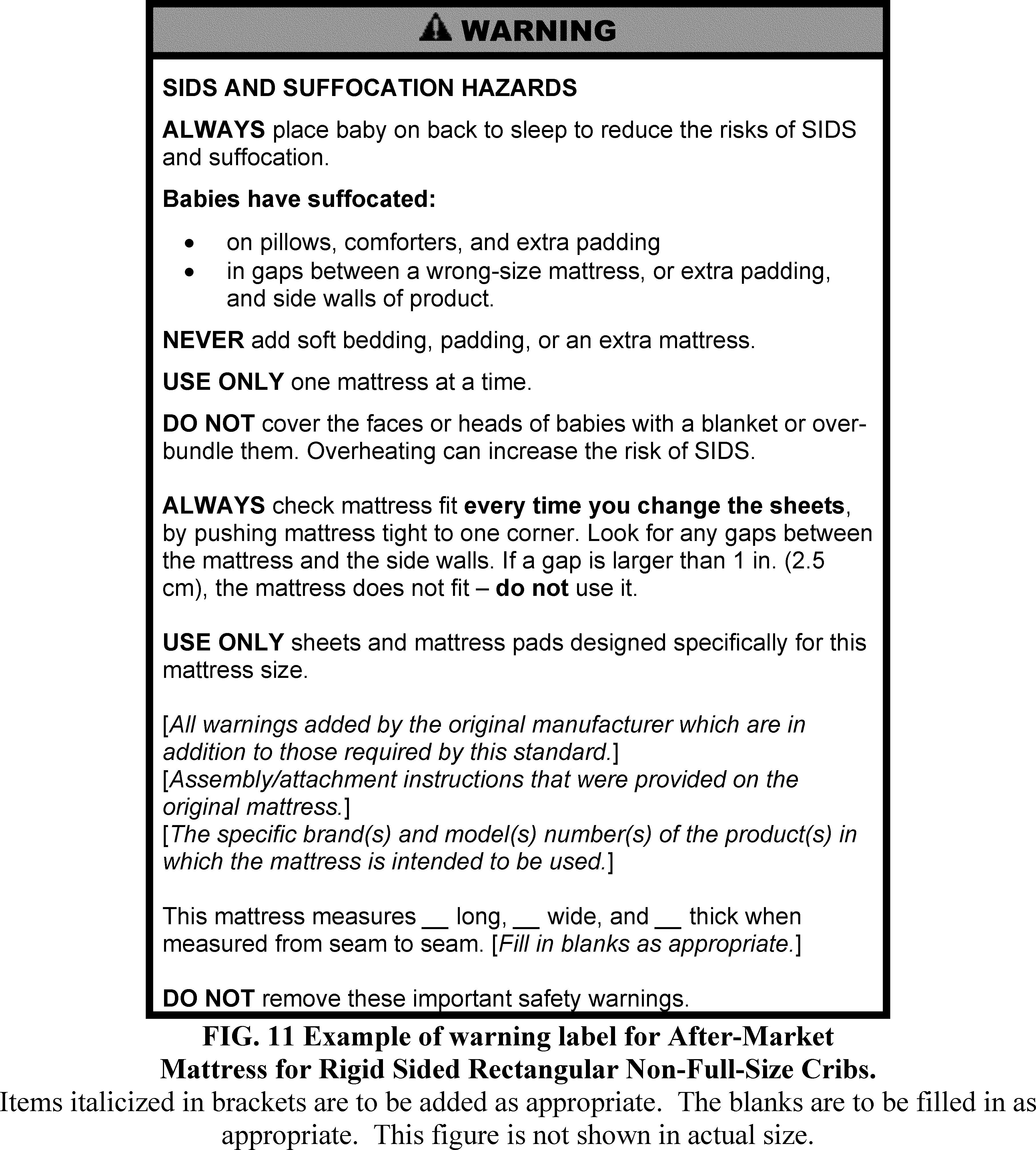
The U.S. Consumer Product Safety Commission published a direct final rule on February 12, 2026, mandating that all crib mattresses sold in the United States comply with ASTM F2933-25 by May 3, 2026. The rule updated 16 CFR Part 1241, the federal safety standard for crib mattresses, replacing the ASTM F2933-21 specification that had governed the category since 2022. The Electronic Code of Federal Regulations reflected the amendment on March 30, 2026, following the close of the March 16 public comment window without significant adverse comment. Because no significant objections were received, the rule took effect automatically under the CPSIA's direct final rule mechanism.
What changed, in plain terms
The updated standard tightens requirements across four practical dimensions: fit, flatness, compatibility, and labeling.
On fit, full-size crib mattresses must now measure at least 27¼ inches wide by 51⅝ inches long. The sheet-gap requirement is the sharpest specific change for anyone buying or receiving a mattress: when a test sheet is placed over the mattress and pushed into a crib corner, the resulting gap cannot exceed 3.15 inches, or 80 millimeters. A gap larger than that creates an entrapment zone between the mattress edge and the crib slat where a baby's limbs or head can become trapped. The revised ASTM text also strengthens the performance and testing criteria to improve repeatability and reproducibility of test results across laboratories, meaning the standard is harder to pass on a technicality.
On flatness and compatibility, after-market mattresses sold separately from a crib, bassinet, or play yard must lie completely flat against the sleep surface and must match or exceed the dimensions of the original equipment mattress. This change has direct consequences for non-full-size products: a replacement mattress for a play yard or bassinet that does not conform to these compatibility rules cannot legally be sold or imported as a sleep surface.
On labeling, manufacturers must update their Children's Product Certificates to reflect F2933-25 compliance, citing "16 CFR Part 1241" as the applicable standard. The CPSC treats these certificates as a legal requirement, meaning a mattress without a current CPC is not simply outdated but non-compliant.
Hand-me-down risk

Crib mattresses are among the most commonly repurposed items at baby showers, and the May 3 deadline creates a real evaluation problem. Any mattress produced before the F2933-25 compliance window needs scrutiny before it enters a sleep space.
The clearest disqualifier is a missing or illegible tracking label. Federal rules require tracking labels on all durable infant products. A gifted mattress with no label or a removed label cannot be traced to its manufacturer, production date, or tested standard. That alone is grounds to decline it.
A second red flag is visible corner deformation. The CPSC retained a mattress compression test from the prior rule specifically to catch hazardous corner behavior under repeated impact. A hand-me-down showing softening, collapsing, or structural unevenness at the corners has, in effect, failed that test before it reaches a lab. Reject it.
When shopping online, verify that listings explicitly reference ASTM F2933-25, not simply "ASTM F2933" without a year. A listing citing F2933-21 may be clearing pre-standard inventory ahead of the May 3 cutoff. If a listing is ambiguous, contact the manufacturer directly and request a copy of the current CPC before purchase.
Industry advisories from both Intertek and SGS noted the CPSC's stated intent "to maintain a high level of protective performance for crib mattresses" and urged manufacturers to begin design and test-plan reviews immediately.
The crib mattress update is part of a broader period of regulatory activity across infant-sleep categories, following recent CPSC actions on bassinets and infant sleepers. The commission's use of the direct final rule process, which bypasses a full notice-and-comment cycle when no significant adverse comments arrive, signals that the F2933-25 changes were treated as unambiguously protective. The compliance window is short; the expectation is not.
This article was produced by Prism’s automated news system from verified source data, official records, and press releases, then run through automated quality and moderation checks before publishing. The system is built and supervised by the people who set the standards it runs under. Read our full AI policy.
Did this article answer your question?