Safe Baby Shower Gift Buying Requires Recall Checks and Safety Verification
A gift-wrapped car seat or bassinet carries hidden risk if recall status goes unchecked; here's the 10-minute host protocol that closes that gap before anyone opens a box.
Before the first gift gets purchased, there is one question every baby shower host should ask: has anyone checked the recall database? It sounds clinical for what is supposed to be a joyful occasion, but the stakes are real. The Consumer Product Safety Commission actively maintains a public recall database at cpsc.gov/Recalls, and in the months leading up to April 2026 alone it issued warnings on Tuyedoqe travel bassinets for strangulation and fall hazards, recalled Trankerloop baby bath seats for drowning risk, flagged HALO Dream Magic Sleepsuits for a choking-hazard zipper defect, and recalled Babysense Max View baby monitors for fire risk. In September 2025, the National Highway Traffic Safety Administration issued a recall affecting more than 324,000 Evenflo Revolve360 Slim car seats over headrest foam that could detach and pose a choking hazard. These are not fringe products from obscure sellers. They are the kind of items that show up on registries every weekend.
This guide is a 10-minute operational checklist for hosts, co-hosts, gift buyers, and registry operators. Run it before gifts are purchased or opened.
Identify the Safety-Critical Categories First
Not every item on a baby registry carries equal risk, and triage matters when time is short. Treat the following as immediately safety-critical: car seats (including bases and convertible models), bassinets and bedside sleepers, crib mattress sets, infant sleep clothing, and powered gear such as baby monitors and electric bouncers. These categories collectively account for the majority of injury-relevant recalls and regulatory actions tracked by the CPSC. A recall on a high-ticket item like a convertible car seat creates an urgent burden for the family who received it as a gift: they must stop using a piece of gear they may have already installed, navigate a remedy program, and find a replacement, often with a newborn in the house. Catching the problem before the gift is purchased costs nothing.
The Three Databases to Check (and How to Search Them)
Run all three checks. They cover different jurisdictions and product types, and a product can appear in one without appearing in another.
- CPSC Recall Database (cpsc.gov/Recalls): Search by product name, manufacturer, or model number. The database is publicly searchable and updated weekly, with daily updates to remedy status. For nursery products, bassinets, mattresses, sleep clothing, and powered gear, this is the primary authority.
- NHTSA Recall Database (nhtsa.gov/recalls): The National Highway Traffic Safety Administration maintains a separate recall lookup specifically for car seats. Search by the seat's model name or manufacturer. NHTSA also offers Ease-of-Use Ratings that help compare how safely a given car seat's features function, which is useful context when choosing between registry options.
- SaferProducts.gov: This CPSC-affiliated portal publishes consumer-reported safety incidents in a searchable public database. If a product has not yet been formally recalled but has accumulated reports of failure, SaferProducts.gov often reflects that signal before a formal recall is issued. It is worth a quick search on any high-priority item.
Consumer Reports and Safe Kids Worldwide publish curated recall roundups that synthesize CPSC and NHTSA data into plain-language summaries, and these are useful for a fast cross-reference, particularly when a product model is difficult to search by name alone.
Verify the Product Label Before You Buy
A recall applies to specific model numbers, manufacture dates, and sometimes lot codes, not to an entire brand. Before confirming a purchase, verify the following from the product label or packaging:
1. Model number (exactly as printed, including letter suffixes)
2. Manufacture date or date code
3. Lot code or batch number, if present
4. UPC as printed on the box
When buying online or asking a retailer to pull an item, request clear photos of the label panel or the serial/lot sticker before purchase is finalized. This one step eliminates the most common mismatch: a recalled model number hidden behind a product listing that covers multiple versions.
If a Product Is on Recall: What to Do
Do not gift it. Do not transport it. If the recipient already has the item in their home:
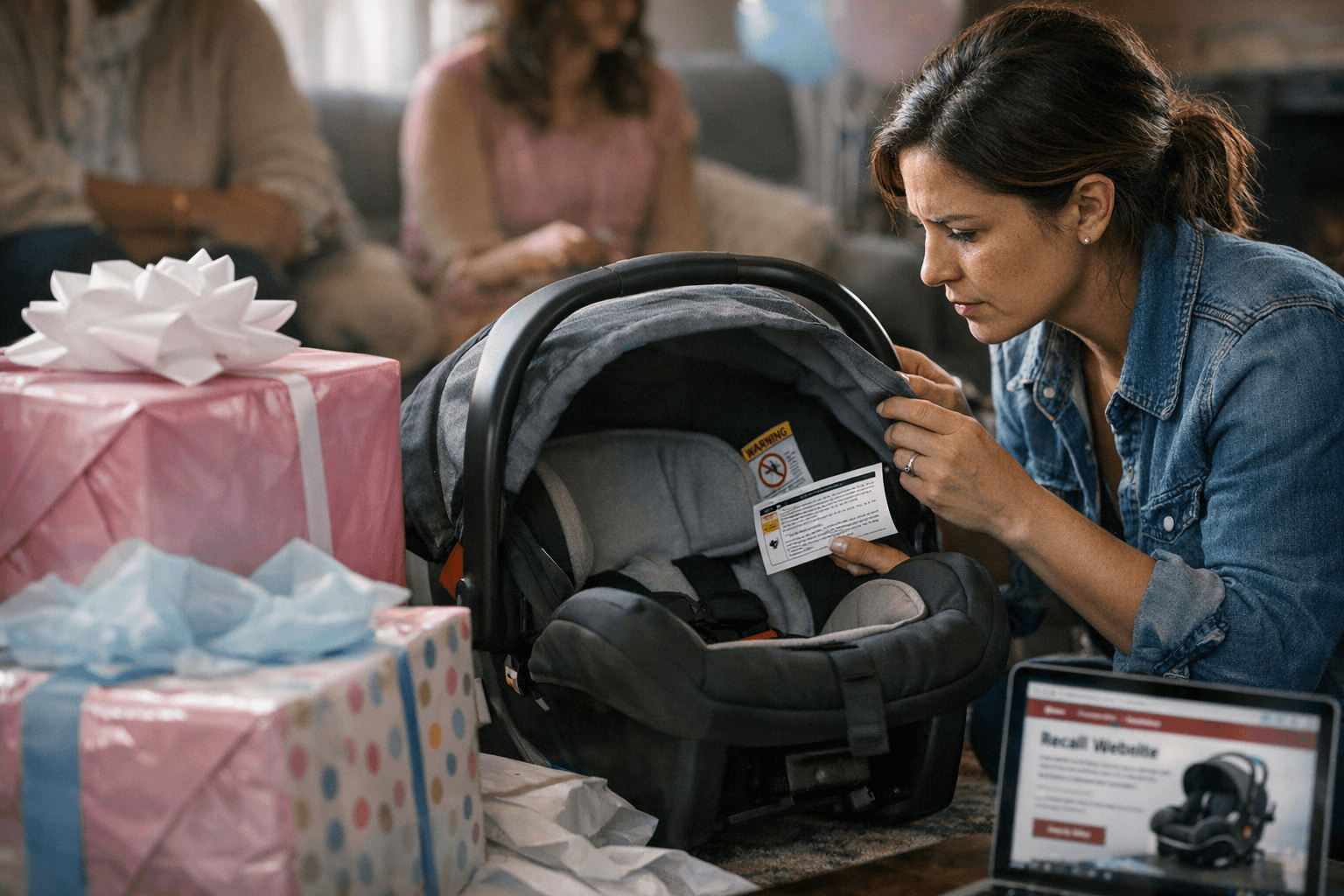
1. Stop using the affected component immediately, following the CPSC or NHTSA advisory exactly. In some recalls, such as those involving car-seat bases, the instruction is to stop using the base while retaining the carrier; follow the specific language of the recall notice rather than assuming the entire product is unusable.
2. Contact the manufacturer directly for the remedy program. Remedies are typically a replacement part, a full product replacement, or a refund.
3. Keep all receipts, model number documentation, and communication records. These are required for most remedy claims and will matter if the situation escalates.
4. If the manufacturer is unresponsive, file a report through CPSC's SaferProducts.gov portal and escalate through official CPSC channels.
Handling Secondhand and Pre-Owned Gifts
The guidance from child safety advocates is consistent: do not pass along used car seats unless you can verify with certainty that the seat was never involved in a crash, falls within the manufacturer's stated expiration window (most car seats carry a 6-to-10-year lifespan printed on the label), and has no open recall history. A secondhand car seat with an unknown history is a liability, not a gift. Safe Kids Worldwide recommends that parents register their car seat with the manufacturer using the information sticker on the seat itself, and confirms that registration at safercar.gov is available as a direct option.
For other used items, limit gifted secondhand goods to soft, non-safety-critical goods, such as clothing, blankets, and fabric toys, that can be freshly laundered and visually inspected. Avoid used bassinets, mattresses, and powered gear for which you cannot confirm full recall and service history.
Register Every Product Immediately After Purchase
Product registration is the single most reliable way to receive a recall notice directly. Safe Kids Worldwide research found that while 80 percent of parents considered registration cards important before understanding their purpose, that number rose to 97 percent once parents learned that registration is specifically how manufacturers notify owners of a recall. Register each major purchase with the manufacturer online, using the model number and manufacture date from the product label. For car seats, registration can also be completed directly through safercar.gov.
Build the Check Into Registry and Invitation Communications
The most effective way to normalize recall verification is to make it a visible part of the registry and invitation experience, not a retroactive fix. Below is a ready-to-use registry safety note template that hosts can embed in registry pages or include on shower invitations:
*Registry Safety Note: If you are purchasing a car seat, bassinet, crib mattress, or baby monitor from this registry, please take 60 seconds to confirm the model number and check its recall status at cpsc.gov/Recalls (for nursery items) or nhtsa.gov/recalls (for car seats). After purchase, please register the product with the manufacturer so the family receives any future recall notices directly. Thank you for helping keep this little one safe.*
For in-person showers, a printed version of this note on the welcome table or gift table takes less than two minutes to prepare and removes any awkwardness by framing safety checks as a shared act of care rather than a critique of anyone's gift selection.
The 10-Minute Pre-Shower Host Checklist
Run this before gifts are purchased or the opening begins:
- Pull up the registry and flag all items in the safety-critical categories (car seats, bassinets, mattresses, sleep clothing, powered gear)
- For each flagged item, confirm the exact model number with the retailer or registry platform
- Search the model number at cpsc.gov/Recalls and, for car seats, at nhtsa.gov/recalls
- Cross-reference any flagged models against SaferProducts.gov for incident reports
- For any recalled item, contact the purchaser immediately with the remedy information and an alternative registry option
- Confirm that all purchased items will be registered with manufacturers upon receipt
- Place the registry safety note on the gift table or send a quick message to guests before the shower
The product safety landscape for infant goods shifts frequently, and a registry that seemed clean when it was built may include a flagged item by the time the shower date arrives. Ten minutes of verification, built into the hosting workflow as a standard step rather than an afterthought, is the operational difference between a gift that protects and one that creates a problem no family should have to manage in the first weeks of a child's life.
This article was produced by Prism’s automated news system from verified source data, official records, and press releases, then run through automated quality and moderation checks before publishing. The system is built and supervised by the people who set the standards it runs under. Read our full AI policy.
Did this article answer your question?