Biofuel Expo 2026 spotlights India’s expanding clean fuels industry
Biofuel Expo 2026 brings India’s ethanol, biodiesel and biogas build-out onto one floor, with 200 exhibitors and 20,000 visitors chasing scale, equipment and capital.

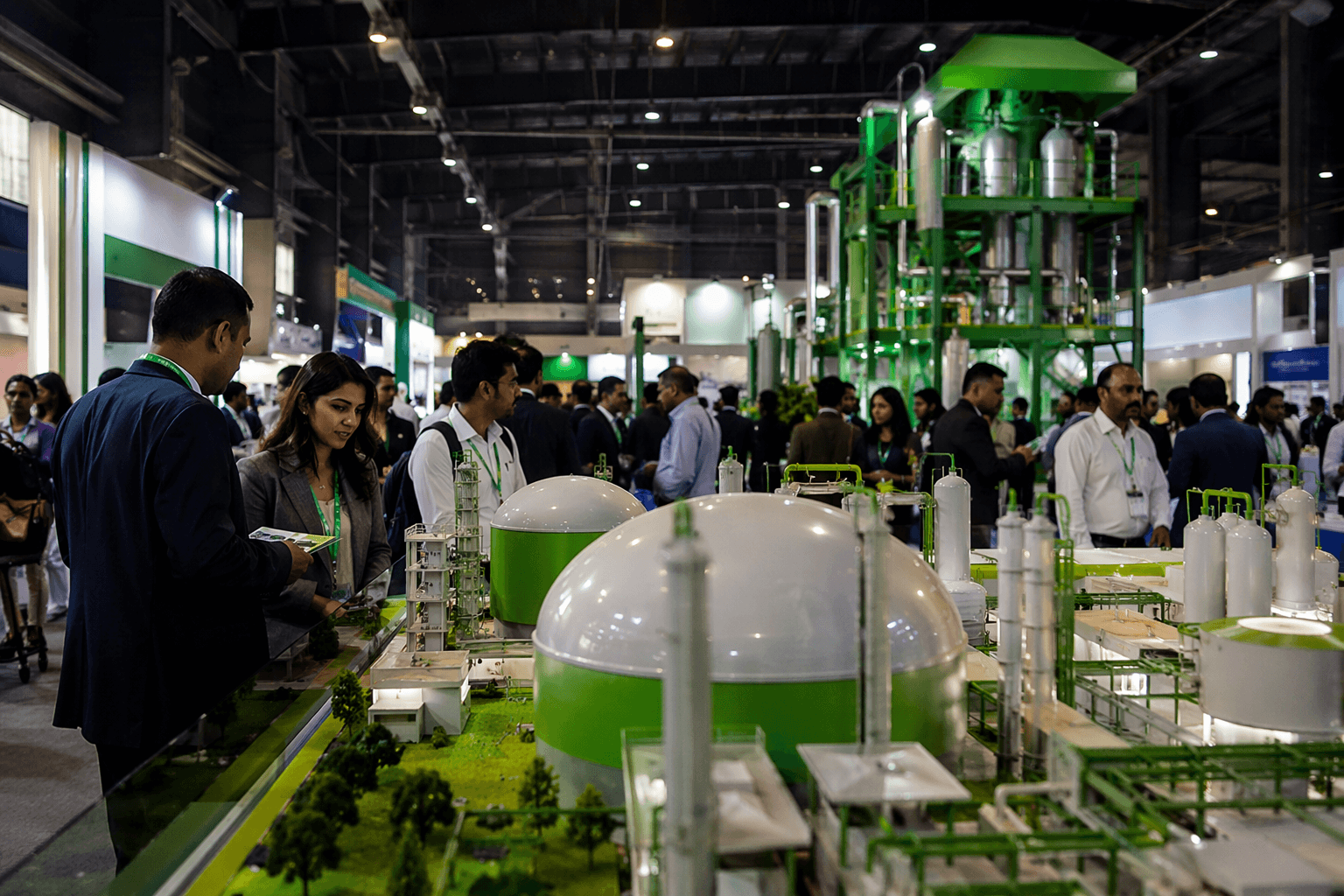
Biofuel Expo 2026 has become India’s biggest trade exhibition on ethanol, biomass, biodiesel and biogas, running June 4 to June 6 at India Expo Centre in Greater Noida, Uttar Pradesh. The show is built as a commercial marketplace, not an academic meeting, with plant machinery, equipment, refineries and the wider industrial supply chain positioned at the center of the floor.
That framing matters because the event is not treating biofuels as a single-product story. It is presenting the sector as a connected industrial base, where crop residues, waste streams and agricultural byproducts are being pulled into transport fuel, pipeline gas and industrial feedstock. The expo’s scope points to a market that is broadening at once across liquid fuels, gaseous fuels, technology and financing.
Where the floor space points next
The event’s focus areas show where the industry is putting capital and attention. Ethanol and blending remain core, but the same platform also gives equal weight to biogas and compressed biogas, biomass and waste-to-energy, biodiesel and alternative liquid fuels, green hydrogen integration, technology and innovation, investment and financing, and supply chain infrastructure.
That spread is important for anyone tracking India’s clean fuels build-out. It suggests the market is moving beyond a narrow ethanol narrative and into a more diversified system where feedstock sourcing, upgrading technology, logistics and project finance all matter at the same time. In practical terms, that means the most useful conversations on the show floor are likely to center on how a plant will run, what it will process, how it will move output and who will fund the expansion.
For ethanol, the key question is not only blending volumes, but how producers are scaling collection and processing chains around feedstocks. For biogas and compressed biogas, the attention on infrastructure and technology points to an industry still working through compression, purification, transport and offtake. For biodiesel and alternative liquid fuels, the value proposition sits in feedstock access, conversion economics and industrial use cases rather than branding or retail visibility.
Why the scale matters
The expo is advertising more than 200 exhibitors, 20,000 visitors, country delegations, state government delegations and a knowledge seminar. Those are not just marketing figures. They indicate a market that wants procurement, policy and project deployment in the same room, which is what a sector needs when it is shifting from pilot scale to commercial build-out.
The exhibitor count also tells you where the business opportunity sits. Equipment suppliers, plant developers, technology vendors, feedstock handlers, financiers and public-sector decision makers all have a reason to show up because the bottlenecks in Indian biofuels are now industrial, not conceptual. The crowd size suggests buyers are looking for systems, not just single machines, and that vendors are competing on integrated process solutions.
The presence of state government delegations is especially telling. India’s biofuels expansion depends on a mix of national policy direction and state-level execution, from land and permits to residue collection, waste aggregation and plant siting. A show that attracts state officials alongside technology suppliers signals that the conversation has moved into implementation.
The policy message behind the exhibition
The expo says its objectives include supporting the National Biofuel Mission, fostering collaboration and enabling waste-to-wealth and circular economy models. That places the event squarely inside India’s policy architecture for cleaner fuels and resource recovery.
The National Biofuel Mission is not being treated here as a slogan. The show’s structure suggests an effort to connect policy goals with the hardware, feedstocks and capital needed to execute them. Waste-to-wealth is a particularly useful lens for the market because it ties together residue collection, municipal waste handling, agricultural byproducts and energy production in one commercial framework.
That is where the expo becomes more than a tradeshow. It acts as a signal that India’s biofuels market is being built as an industrial ecosystem, with the same event platform linking ethanol blending, compressed biogas, waste-to-energy, biodiesel, green hydrogen integration and financing. The breadth of that agenda suggests buyers are no longer looking only for fuel output, but for project bankability, feedstock security and long-term operating stability.
What to watch from the show floor
The most revealing floor space will likely be concentrated around the parts of the chain where projects win or stall. The event’s emphasis on plant machinery, equipment and refineries suggests attendees are looking hard at throughput, process efficiency and operating costs. The technology and innovation section should draw interest from developers trying to improve conversion rates, reduce contamination risk or tighten integration between preprocessing and final fuel production.
A few areas are worth tracking closely:
- Ethanol blending systems and associated handling equipment, because blending remains a central part of India’s liquid-fuel strategy.
- Compressed biogas units and upgrading technology, because the sector’s commercial logic depends on purification, compression and logistics.
- Biodiesel and alternative liquid fuel pathways, because feedstock economics and industrial offtake determine project viability.
- Supply chain infrastructure, because collection, storage and transport remain decisive for crop residues, waste and byproducts.
- Investment and financing, because many projects need capital discipline as much as technical performance.
The combination of country delegations, state delegations and a knowledge seminar also suggests the expo is being used to align market participants around execution. That is where the industry is now: less about proving that biofuels matter, more about deciding which feedstocks, which technologies and which project structures can scale fastest.
Biofuel Expo 2026 shows an Indian clean fuels market that is widening on every front at once. Ethanol still anchors the story, but biogas, biodiesel, biomass and infrastructure are claiming more room, and that shift is where the next phase of the build-out will be decided.
This article was produced by Prism’s automated news system from verified source data, official records, and press releases, then run through automated quality and moderation checks before publishing. The system is built and supervised by the people who set the standards it runs under. Read our full AI policy.
Know something we missed? Have a correction or additional information?
Submit a Tip